

Review of Regional Weather for February 2026
1. Overview
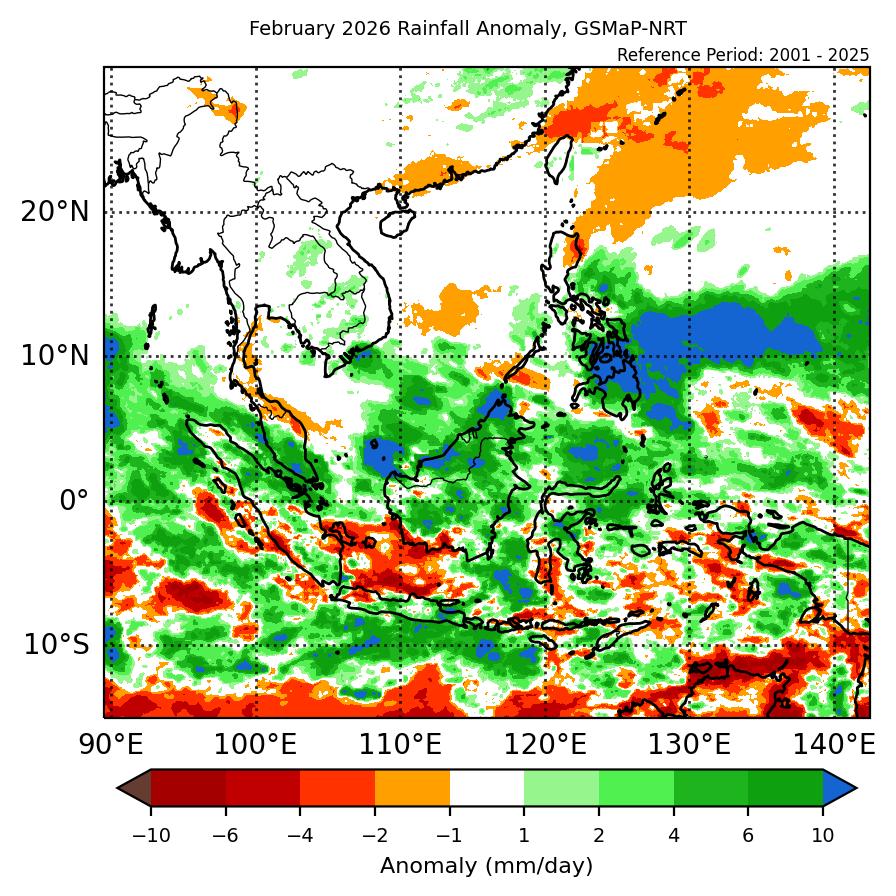
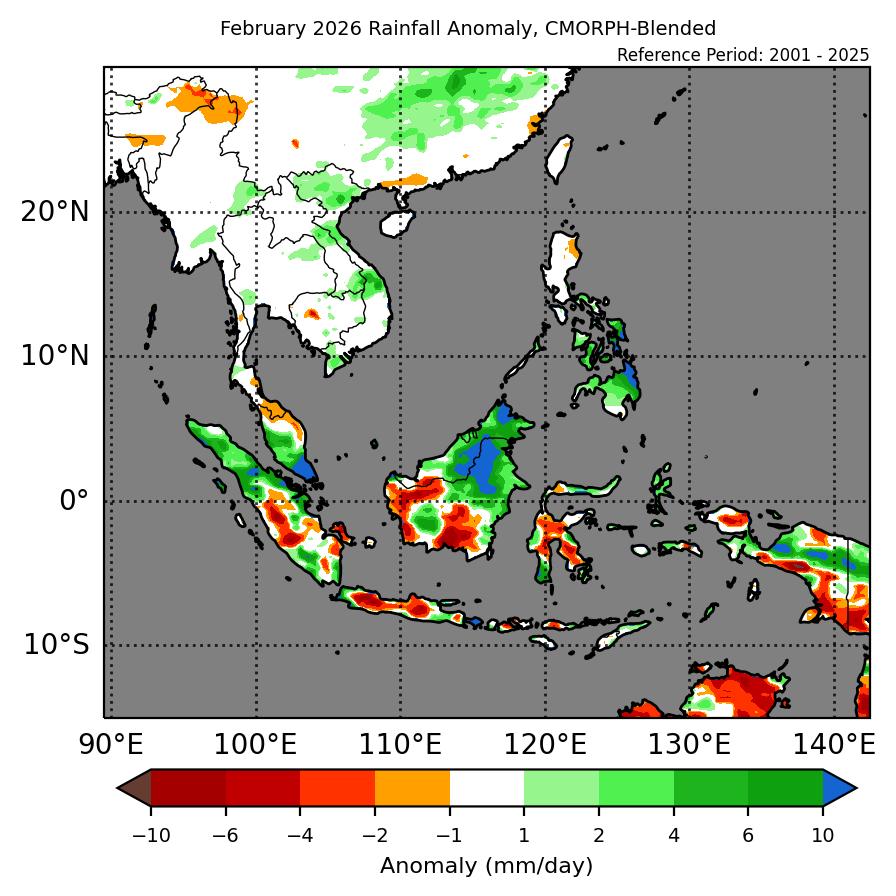
1.1 During February 2026, above-average rainfall was recorded over much of the northern half of the Maritime Continent with near-average rainfall over most of Mainland Southeast Asia (Figure 1). While above-average (wetter) anomalies are observed distributed over much of northern half of the area for both datasets (GSMaP-NRT and CMORPH-BLD), there is disagreement elsewhere over the Maritime Continent. GSMaP-NRT recorded above-average anomalies but CMORPH-BLD recorded mainly below-average (drier) anomalies for much of the southern half of the Maritime Continent. There were no notable anomalies over most of Mainland Southeast Asia, in line with the current dry season, with some regions of above-average rainfall over parts of Viet Nam. The largest positive (wetter) anomalies were recorded over southern Philippines for both datasets, with the largest negative (drier) anomalies over southern Borneo for CMORPH-BLD.
1.2 The observed rainfall anomaly pattern of above-average rainfall over the northeastern Maritime Continent, where the highest anomalies are recorded, is consistent with the predictions from the subseasonal weather outlooks for February 2025 (2 – 15 February 2026, and 16 Febraury – 1 March 2025). The subseasonal weather outlooks predicted a drier central Maritime Continent, which is more consistent with the recorded rainfall from CMORPH-BLD. The observations match the most likely tercile from the seasonal outlook for February 2026 for northeastern Maritime Continent where the rainfall observed the largest positive anomalies.
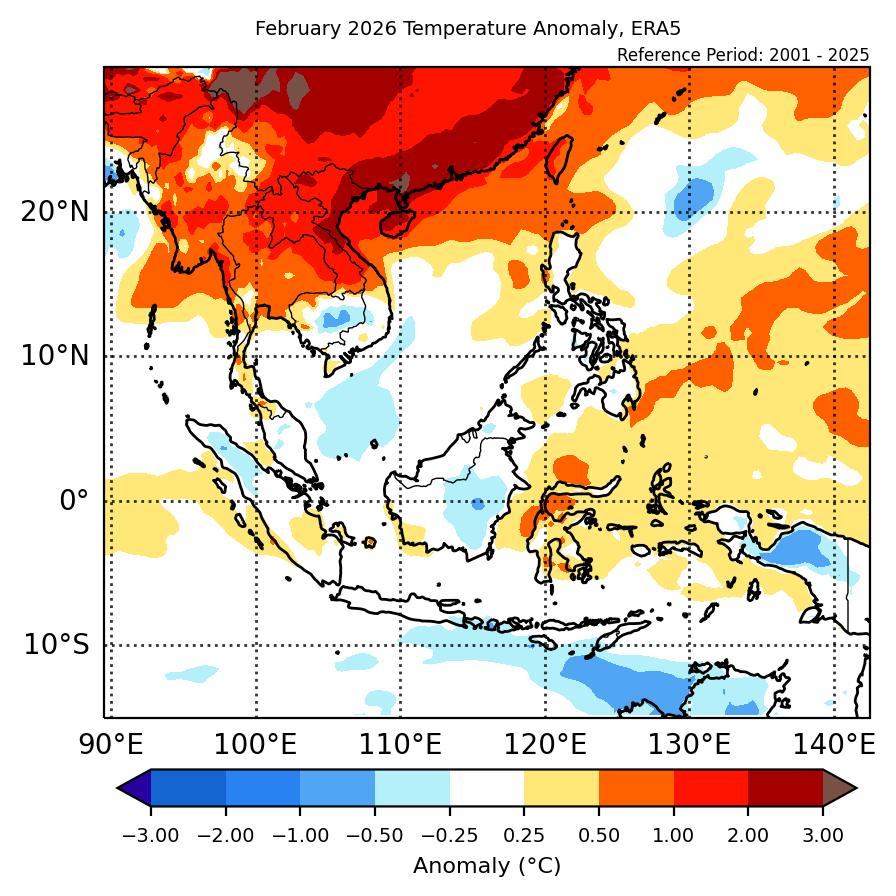
1.3 Above-average temperature was recorded over most of Mainland Southeast Asia, with below- to near-average temperature for southeastern Mainland Southeast Asia (Figure 2). For the Maritime Continent, near-average temperature was generally recorded. The warmest anomalies (2°C – 3°C above average) were recorded over northern Viet Nam, while the coolest anomalies (0.5°C – 1°C below average) were recorded over Papua and central Cambodia.
2. Climate Drivers
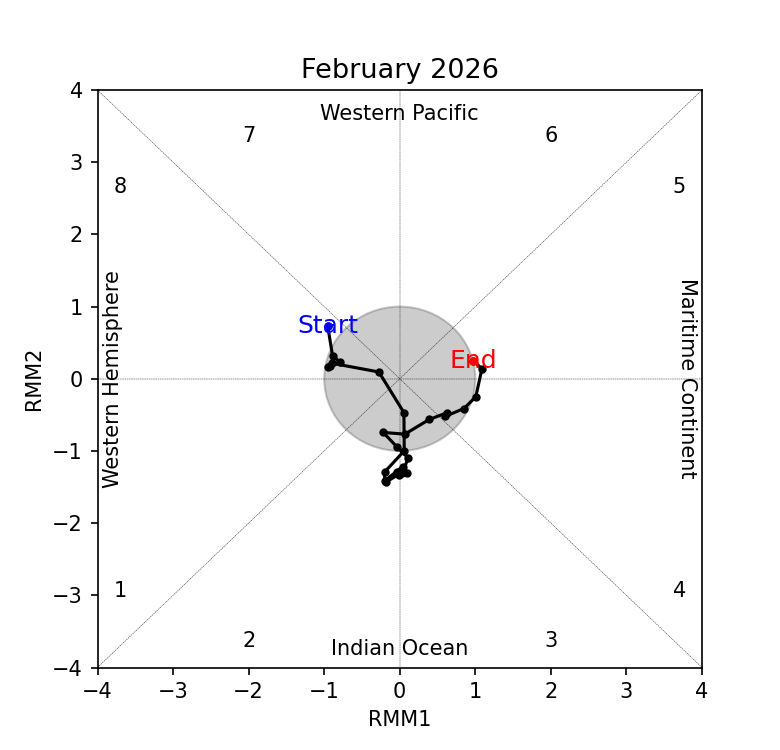
2.1 At the start of January, the Madden-Julian Oscillation (MJO) was inactive based on the RMM diagram (Figure 3). The signal emerged over the Western Pacific (Phase 6) in Week 2, strengthening with little eastward propagation in Phase 6 until middle of Week 3 when it weakened slightly and started again propagating eastwards. By Week 4, the MJO signal was in Phase 7 of the Western Pacific where it stalled and weakened at the end of the month. At this time of the year, Phases 6 and 7 tend to bring drier conditions to the western and southern Maritime Continent, in line with the observed rainfall in January also showing drier conditions for much of the Maritime Continent.
2.2 La Niña conditions persisted and continued weakening in February 2026. La Niña events tend to bring wetter-than-average conditions to much of the Maritime Continent during this time of the year. The Indian Ocean Dipole (IOD) is currently in the neutral state.