Review of Regional Haze Situation for February 2026
1.1 During February 2026, Northeast monsoon conditions were predominantly observed over the ASEAN region. While the prevailing winds blew mostly from the northeast or northwest over the region, the Mekong sub-region occasionally experienced days with prevailing light and variable winds. (Figure 1)
1.2 Extensive dry conditions were generally observed over the Mekong sub-region as well as the northern parts of the Philippines during the month of February 2026, though there were some showers observed over the southeastern and central parts of the Mekong sub-region on a few days during the last week of February. Parts of Peninsular Malaysia and Sumatra also experienced days with relatively lower rainfall during the month (Figure 1). Heavier showers were observed over the Philippines, which can be attributed to Tropical Storm Penha. To reflect the ongoing and expected dry weather conditions over the Mekong sub-region, ASMC issued Alert Level 2 for the Mekong sub-region on 2 February 2026.
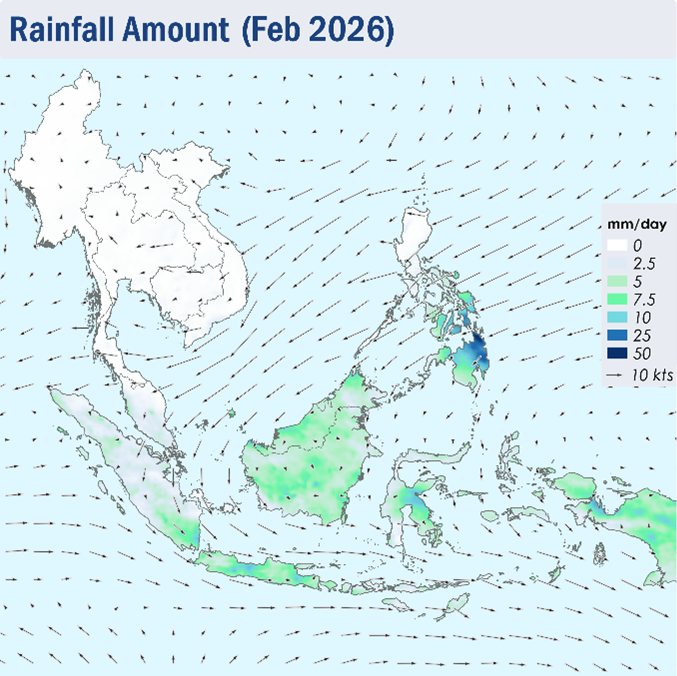
Figure 1: Average Daily Rainfall and Mean Winds for February 2026. (Source: JAXA GsMaP and GFS, respectively)
1.3 Despite the drier conditions, hotspot counts over the ASEAN region for February 2026 were observed to be much lower or comparable compared to the hotspot counts from the preceding years (2022-2025), except for Sumatra where hotspot counts were higher.
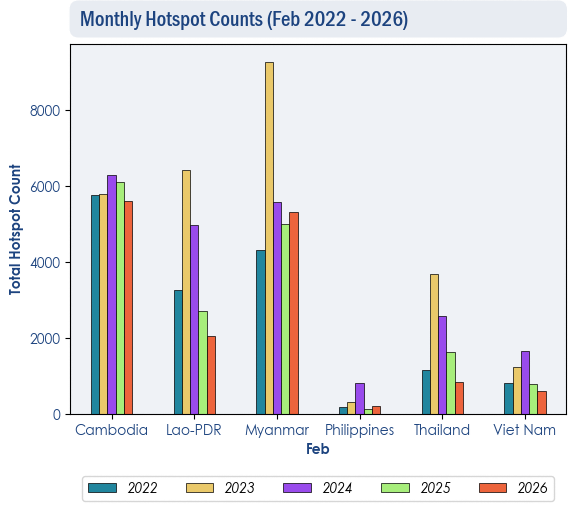
Figure 2: Hotspot counts for the northern ASEAN region for February (2022-2026) based on NOAA-20 satellite surveillance.
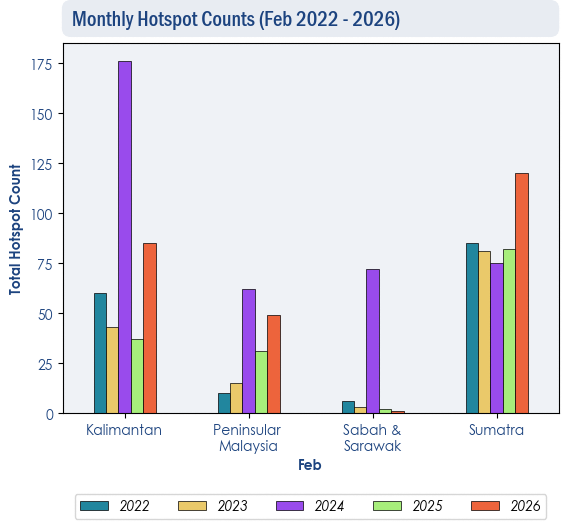
Figure 3: Hotspot counts for the southern ASEAN region for February (2022-2026) based on NOAA-20 satellite surveillance.
1.4 Scattered to widespread hotspots were often observed over the northern and western parts of Cambodia as well as the southern parts of Lao PDR (Figure 4), leading to moderate to dense smoke plumes observed over these areas for many days during February 2026 (Figure 6). Transboundary smoke haze would occasionally occur from the southern parts of Lao PDR to the northern parts of Cambodia, as well as from the western parts of Cambodia to the central parts of Thailand (Figure 8 & 9) . Moderate to dense smoke haze was observed to persist over the central and northern parts of Myanmar under the prevailing light winds situation (Figure 6 and 9 ). In the southern ASEAN region, Smoke plumes were also observed in the southern parts of Peninsular Malaysia, the central parts of Sumatra and in West Kalimantan for a few days in the month. (Figure 6 and 7 )
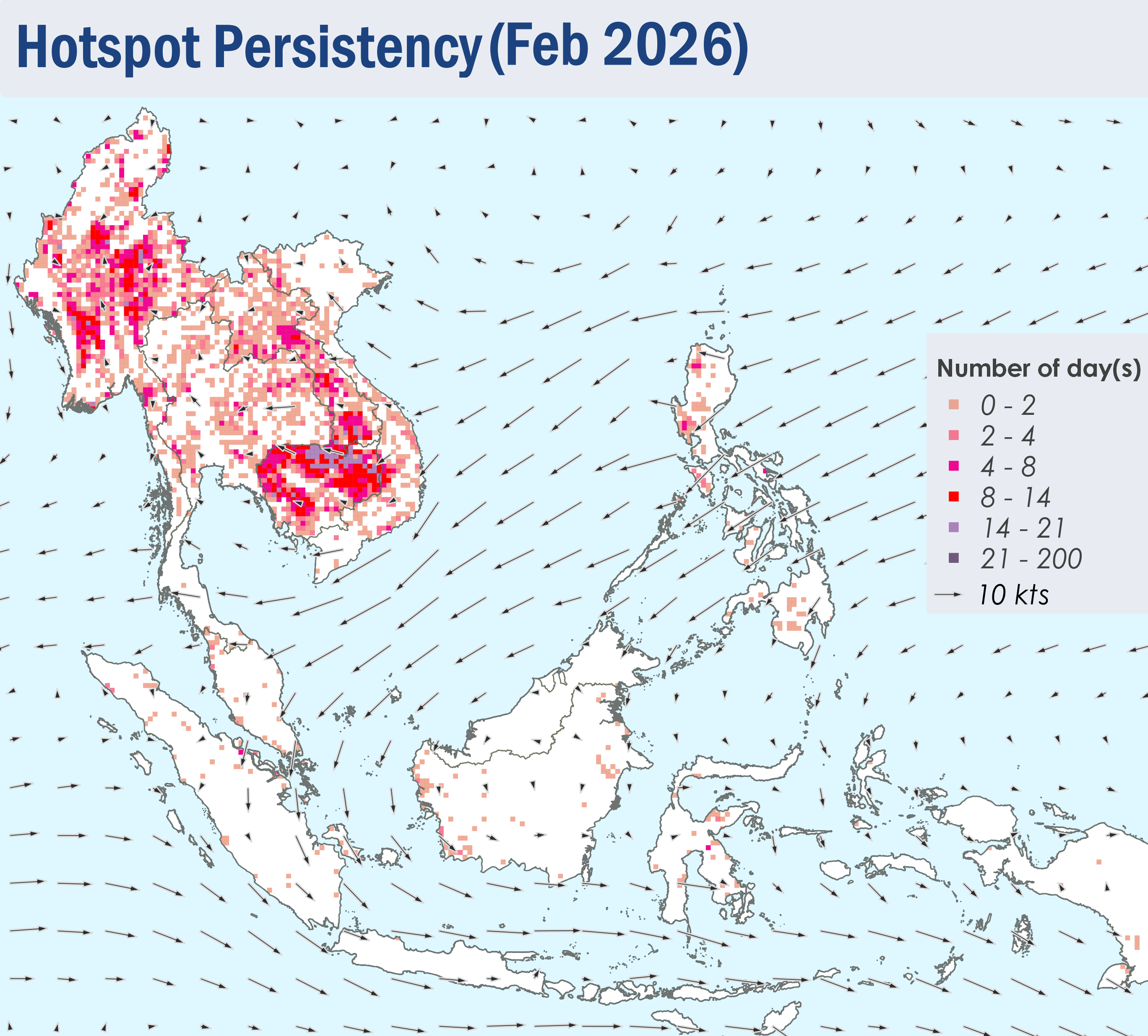
Figure 4: Distribution of hotspots detected in February 2026 based on NOAA-20 satellite surveillance.
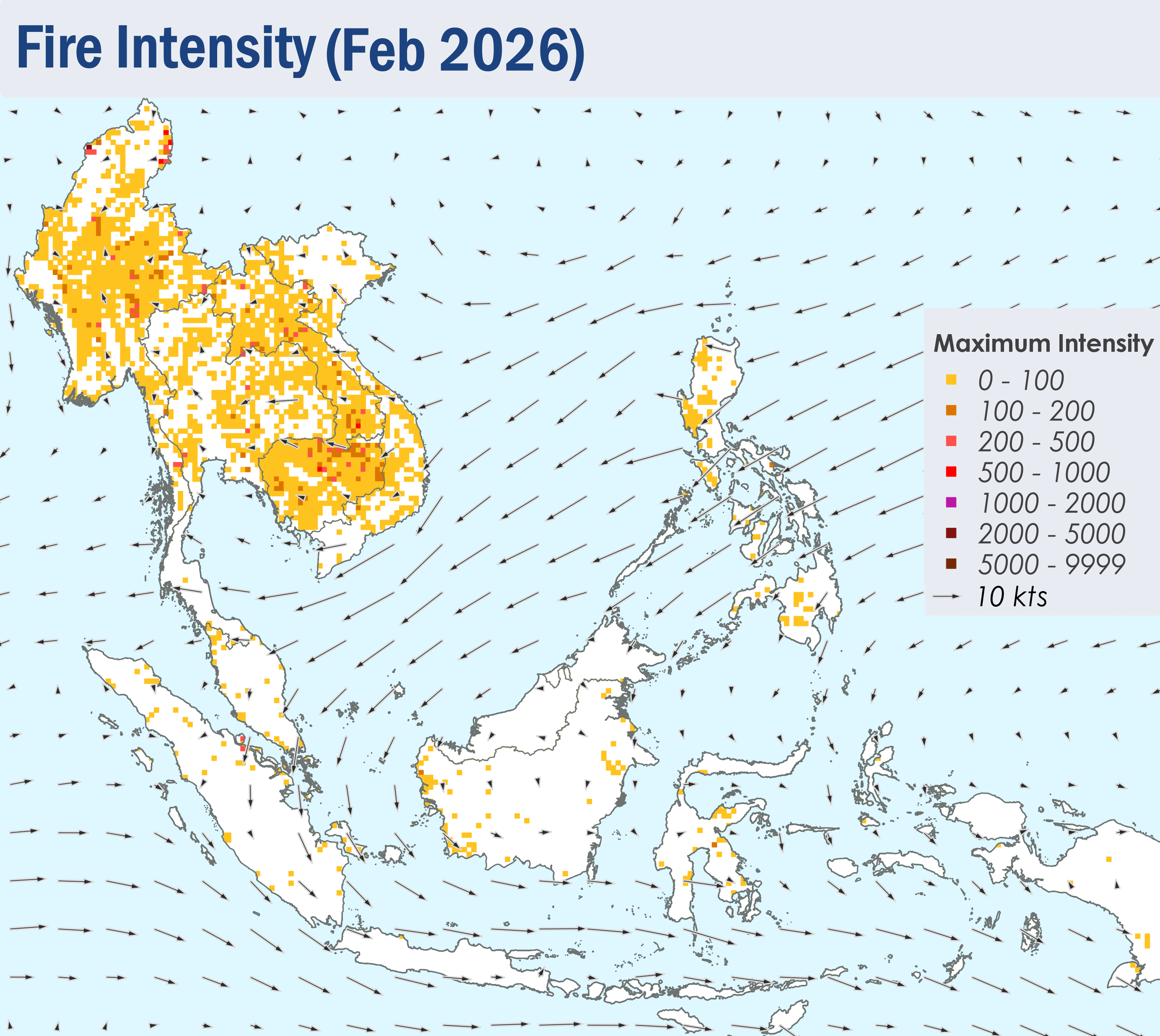
Figure 5: Maximum fire intensity in February 2026 based on NOAA-20 satellite surveillance.
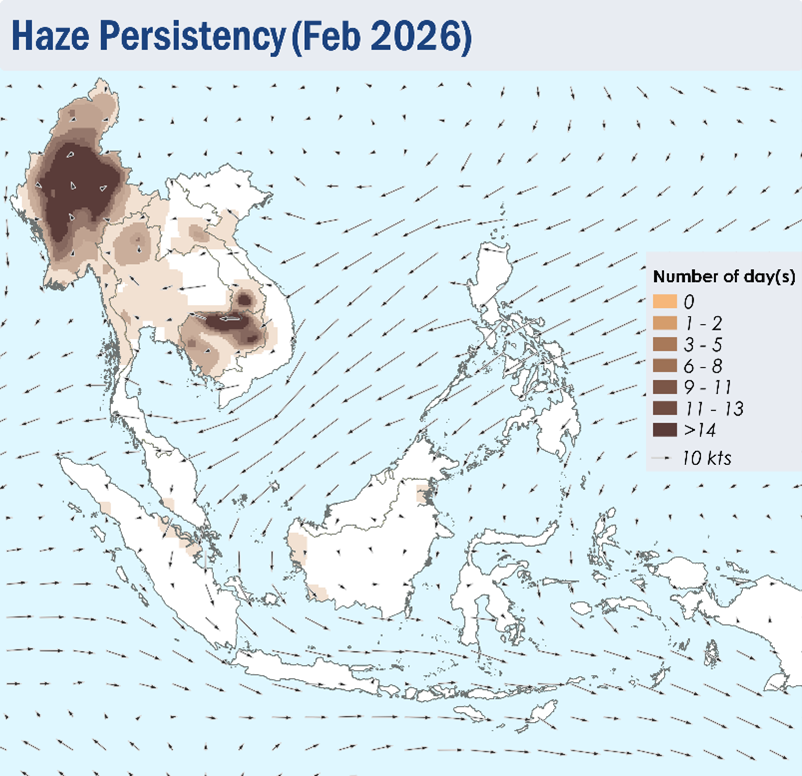
Figure 6: Number of days with moderate to dense smoke haze observed in February 2026 based on satellite imagery, ground observations, and air quality reports.
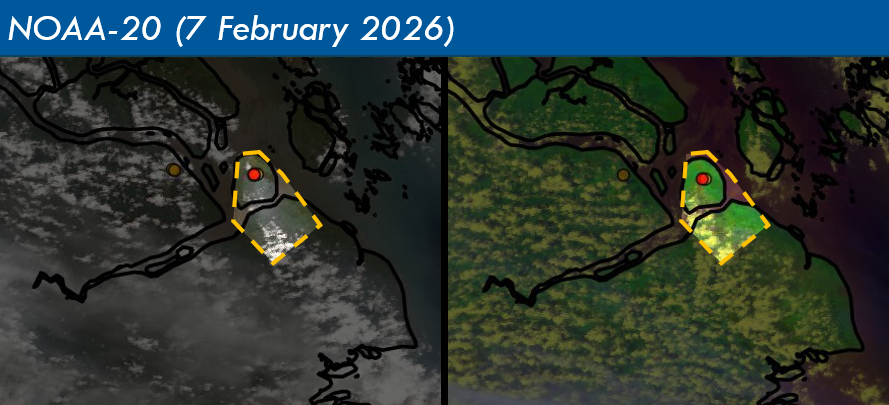
Figure 7: Moderate smoke plume observed over the central parts of Sumatra on 7 February 2026. (Source: NOAA-20 satellite surveillance)
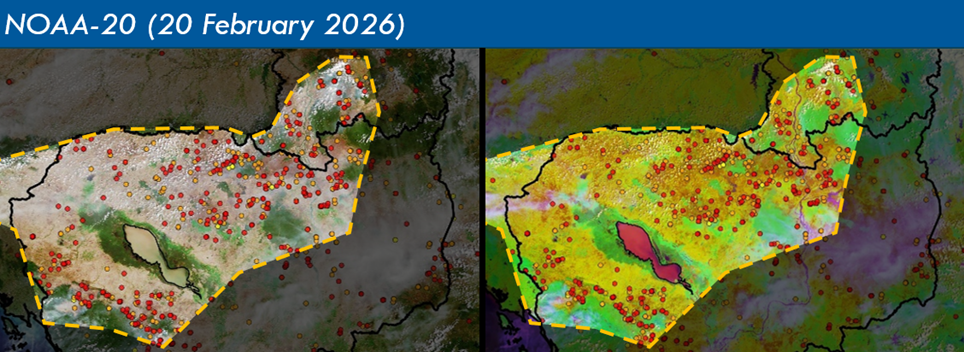
Figure 8: Moderate to dense smoke plumes observed over Cambodia and Lao PDR on 20 February 2026, with transboundary haze drifting from Lao PDR to Cambodia. (Source: NOAA-20 satellite surveillance)
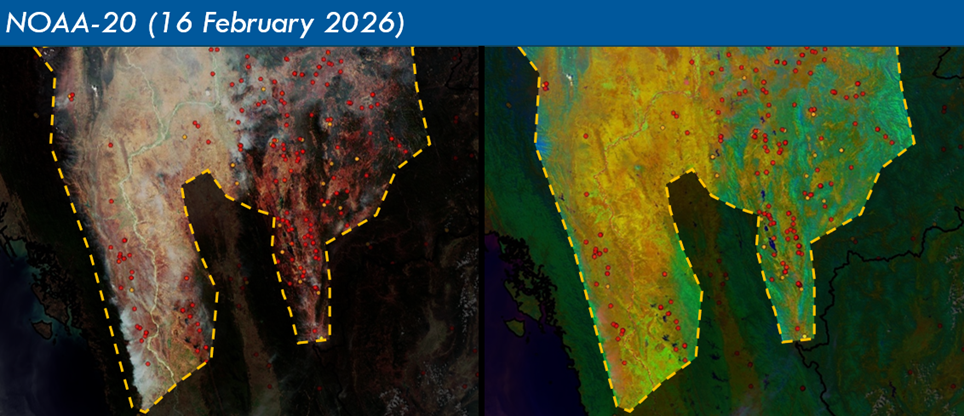
Figure 9: Moderate to dense smoke plumes over the central parts of Myanmar on 16 February 2026. (Source: NOAA-20 satellite surveillance)
Review of Regional Weather for February 2026
1. Overview
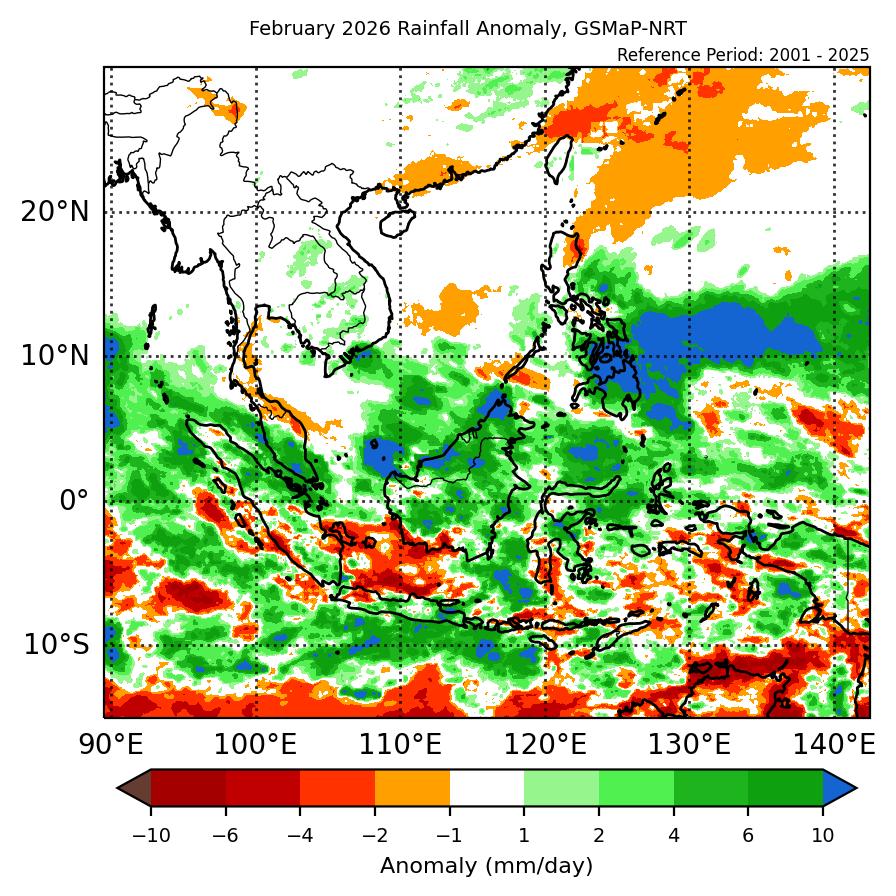
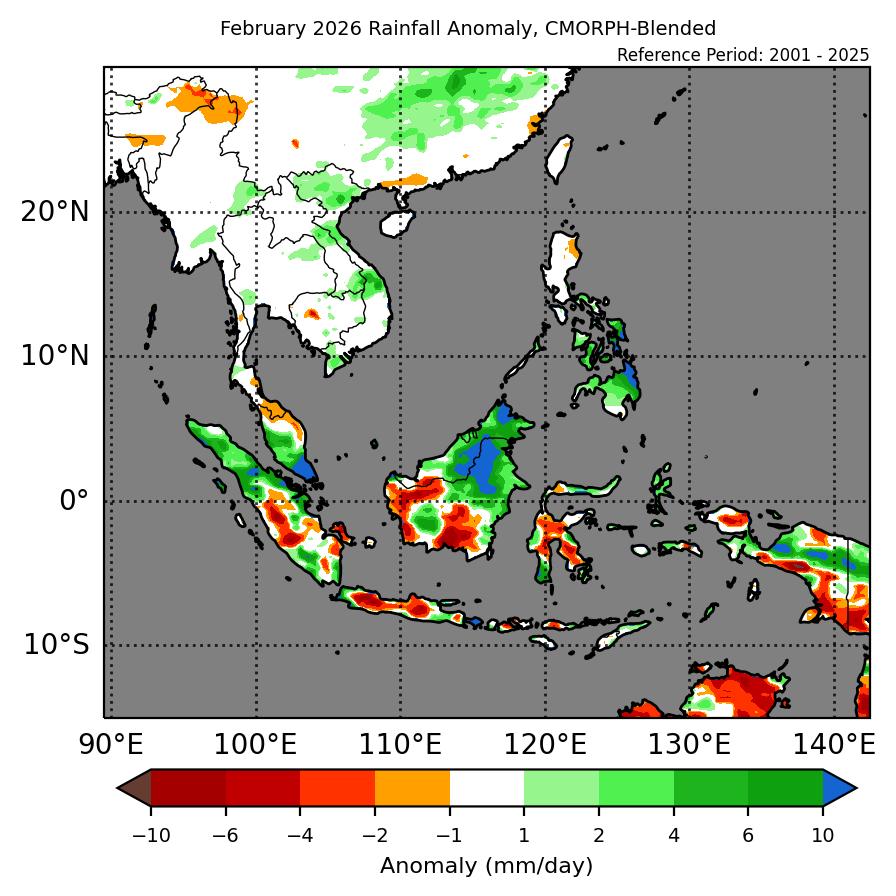
1.1 During February 2026, above-average rainfall was recorded over much of the northern half of the Maritime Continent with near-average rainfall over most of Mainland Southeast Asia (Figure 1). While above-average (wetter) anomalies are observed distributed over much of northern half of the area for both datasets (GSMaP-NRT and CMORPH-BLD), there is disagreement elsewhere over the Maritime Continent. GSMaP-NRT recorded above-average anomalies but CMORPH-BLD recorded mainly below-average (drier) anomalies for much of the southern half of the Maritime Continent. There were no notable anomalies over most of Mainland Southeast Asia, in line with the current dry season, with some regions of above-average rainfall over parts of Viet Nam. The largest positive (wetter) anomalies were recorded over southern Philippines for both datasets, with the largest negative (drier) anomalies over southern Borneo for CMORPH-BLD.
1.2 The observed rainfall anomaly pattern of above-average rainfall over the northeastern Maritime Continent, where the highest anomalies are recorded, is consistent with the predictions from the subseasonal weather outlooks for February 2025 (2 – 15 February 2026, and 16 Febraury – 1 March 2025). The subseasonal weather outlooks predicted a drier central Maritime Continent, which is more consistent with the recorded rainfall from CMORPH-BLD. The observations match the most likely tercile from the seasonal outlook for February 2026 for northeastern Maritime Continent where the rainfall observed the largest positive anomalies.
Figure 1: Rainfall anomalies for February 2026 based on GSMaP-NRT data (left) and CPC CMORPH-CRT data (right). The climatological reference period is 2001-2024. Green colour denotes above-average rainfall (wetter), while orange denotes below-average rainfall (drier).
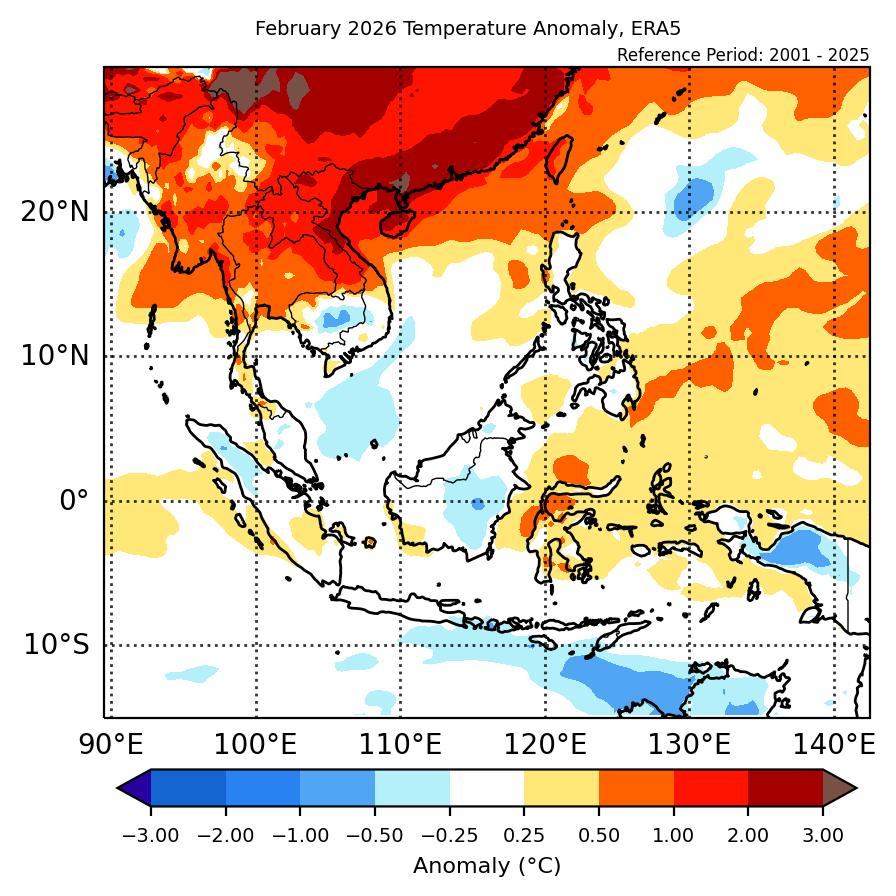
1.3 Above-average temperature was recorded over most of Mainland Southeast Asia, with below- to near-average temperature for southeastern Mainland Southeast Asia (Figure 2). For the Maritime Continent, near-average temperature was generally recorded. The warmest anomalies (2°C – 3°C above average) were recorded over northern Viet Nam, while the coolest anomalies (0.5°C – 1°C below average) were recorded over Papua and central Cambodia.
Figure 2: Temperature anomalies for February 2026 based on ERA-5 reanalysis. The climatological reference period is 2001-2024. Red colour denotes above-average temperature (warmer), while blue denotes below-average temperature (colder).
2. Climate Drivers
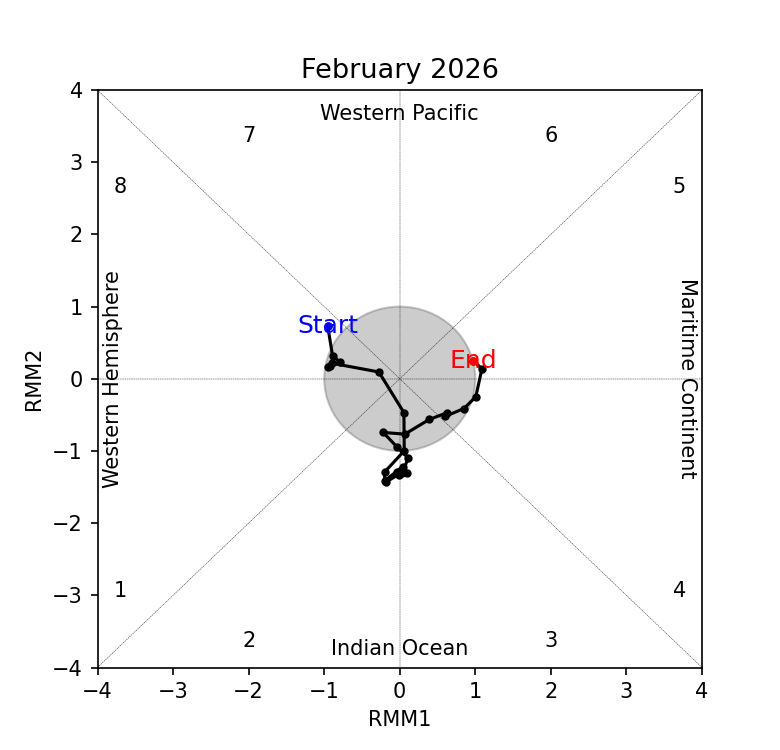
2.1 At the start of January, the Madden-Julian Oscillation (MJO) was inactive based on the RMM diagram (Figure 3). The signal emerged over the Western Pacific (Phase 6) in Week 2, strengthening with little eastward propagation in Phase 6 until middle of Week 3 when it weakened slightly and started again propagating eastwards. By Week 4, the MJO signal was in Phase 7 of the Western Pacific where it stalled and weakened at the end of the month. At this time of the year, Phases 6 and 7 tend to bring drier conditions to the western and southern Maritime Continent, in line with the observed rainfall in January also showing drier conditions for much of the Maritime Continent.
Figure 3: The Madden-Julian Oscillation (MJO) was inactive for much of February based on the RMM diagram (Figure 3). The signal decayed over the Western Hemisphere (Phase 8) at the beginning of the month , before emerging shortly in the middle of February over the Indian Ocean (Phases 2 and 3) and decaying again after a week. The MJO signal remained indiscernible for much of Week 4, before emerging over the Maritime Continent (Phases 4 and 5) at the end of the month. At this time of the year, Phases 2 and 3 as well as Phases 4 and 5 tend to bring wetter conditions to the Maritime Continent, with the observed rainfall in February also showing wetter conditions (data from the Bureau of Meteorology, Australia).
2.2 La Niña conditions persisted and continued weakening in February 2026. La Niña events tend to bring wetter-than-average conditions to much of the Maritime Continent during this time of the year. The Indian Ocean Dipole (IOD) is currently in the neutral state.
Subseasonal Weather Outlook (16 – 29 March 2026)
Issued: 11 March 2026
First forecast week: 16 – 22 March 2026
Second forecast week: 23 – 29 March 2026
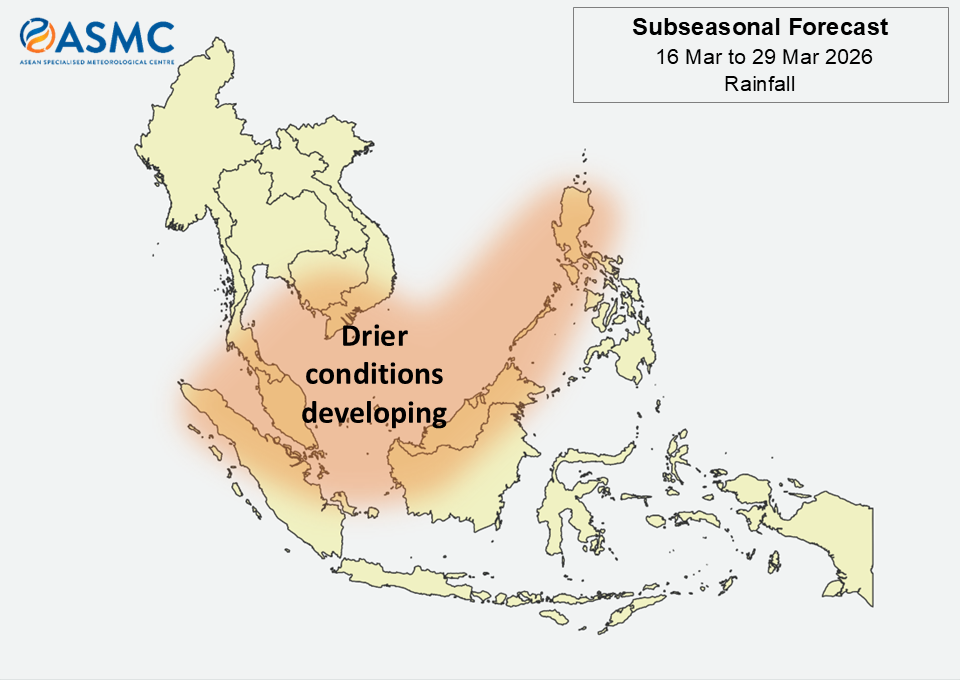
Figure 1: Rainfall Outlook
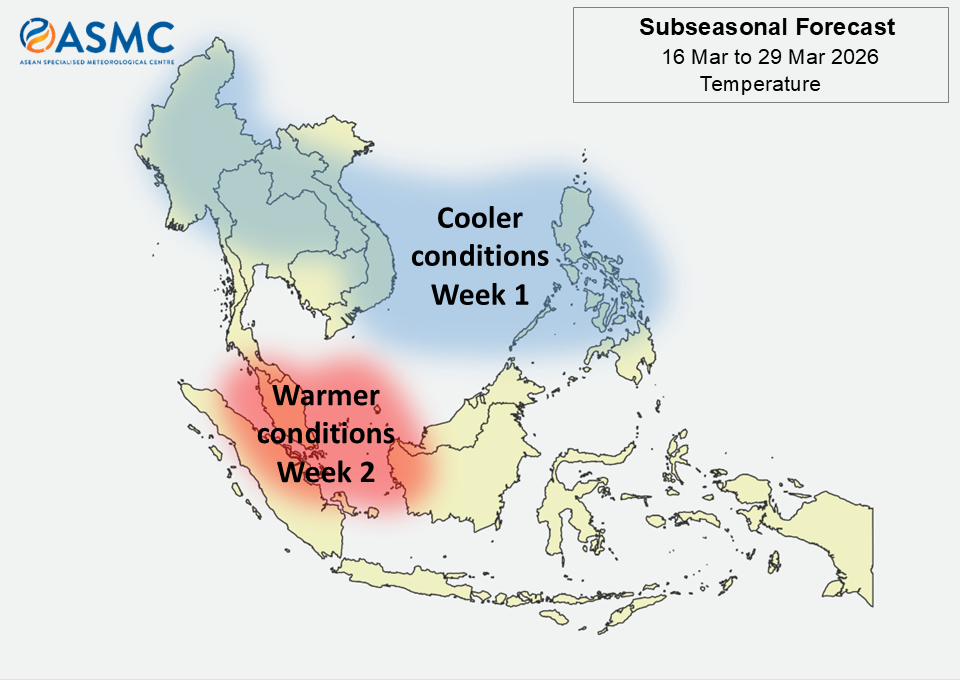
Figure 2: Temperature Outlook
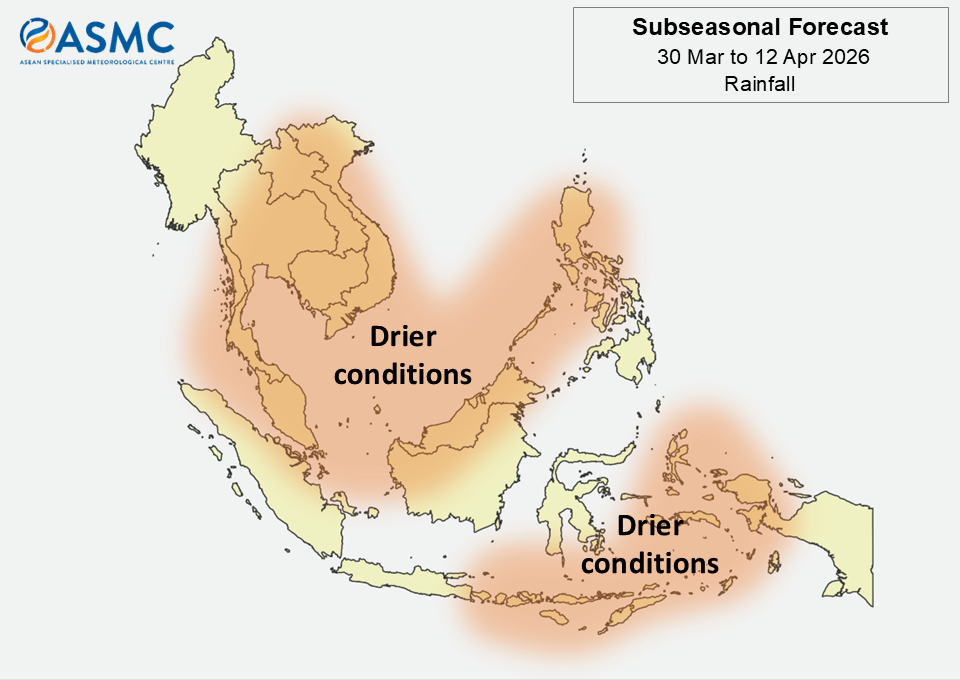
Drier than usual conditions are predicted over southeastern Mainland Southeast Asia and the northeastern Maritime Continent during the next fortnight (16 – 29 March). Drier conditions are also predicted to develop over parts of the western and central equatorial region in Week 1 (16 – 22 March) and persist in Week 2 (23 – 29 March).
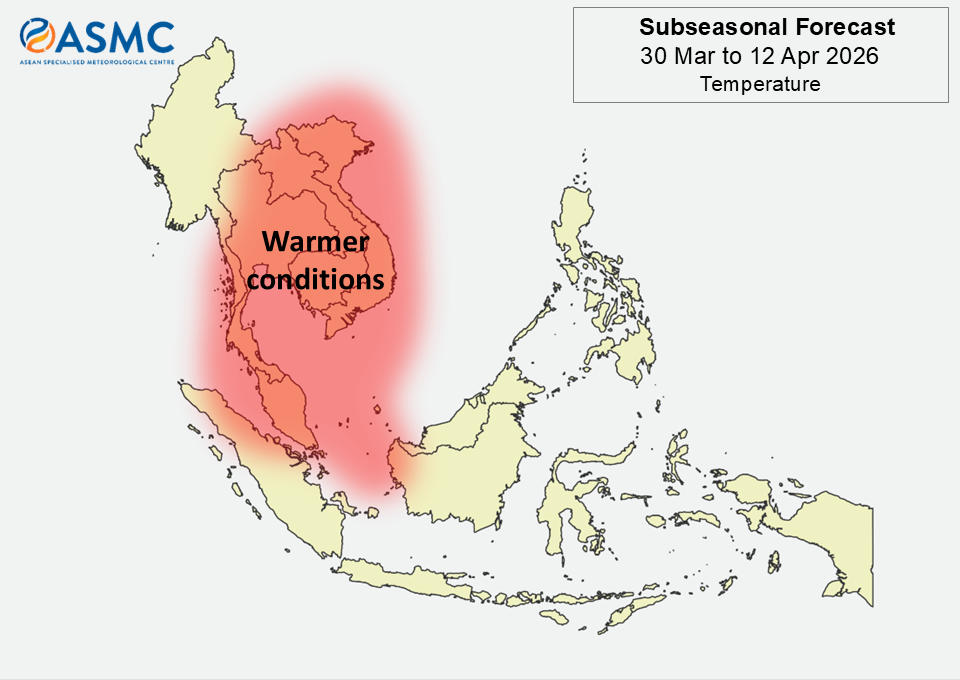
Cooler than usual temperatures are predicted over most of Mainland Southeast Asia and the northeastern Maritime Continent in Week 1 (16 – 22 March). Warmer than usual temperatures are predicted over parts of the western Maritime Continent in Week 2 (23 – 29 March).
No discernible Madden-Julian Oscillation (MJO) signal was present at the start of the second week of March, based on the RMM index. Some models predict an MJO signal to develop over the Western Pacific (Phase 7) by the start of the forecast period, reaching the Western Hemisphere and Africa (Phase 8) during Week 1 (16 – 22 March). There is little agreement on the predicted MJO activity among the rest of the models in Week 1 (16 – 22 March). In Week 2 (23 – 29 March), most models predict no discernible MJO activity.
The outlook is assessed for the region in general, where conditions are relative to the average conditions for the corresponding time of year. For specific updates on the national scale, the relevant ASEAN National Meteorological and Hydrological Services should be consulted.