Category Archives: Fortnightly Weather Outlook

CR58

June 8, 2026

Review of Regional Haze Situation for May 2026

Review of Regional Haze Situation for May 2026

1.1 Light and variable winds were observed over many parts of the ASEAN region during the review period of May 2026 (Figure 1). Over the Mekong sub-region, the prevailing winds were mostly light and southerly, while southeasterly winds continued to dominate over Java, Sulawesi and the Lesser Sunda Islands.

1.2 Overall, the ASEAN region experienced wet weather during the review period as the monsoon rainband shifted northwards and was situated over the area near the Equator. The Alert Level for the Mekong sub-region was downgraded to Level 0 on 14 May 2026 following the increase in showers and the expected persistent rainfall over the sub-region. The southern ASEAN region continued to experience wet weather, except for drier conditions over Java and the Lesser Sunda Islands.

Figure 1: Average Daily Rainfall and Mean Winds for May 2026. (Source: JAXA GsMaP and GFS, respectively)

1.3 Hotspot counts in the ASEAN region were generally comparable to the previous years.

Figure 2: Hotspot counts for the northern ASEAN region for May (2022-2026) based on NOAA-20 satellite surveillance.

Figure 3: Hotspot counts for the southern ASEAN region for May (2022-2026) based on NOAA-20 satellite surveillance.

1.4 Isolated hotspots were detected in the northern ASEAN region, particularly in the northern parts of Lao PDR and the central parts of Viet Nam where hotspots are more intense and persistent. During the first half of May 2026, slight to moderate smoke haze was observed over the southern parts of Myanmar and the western parts of Thailand. Localised smoke plumes were also occasionally observed over the northern parts of Lao PDR and Viet Nam in the latter half of the review period.

1.5 For the southern ASEAN region, a few to isolated hotspots were mostly detected in parts of Sumatra, Borneo and Peninsular Malaysia. Slight and localised smoke plumes were observed emanating from these hotspots on a few days.

Figure 4: Distribution of hotspots detected in May 2026 based on NOAA-20 satellite surveillance.

Figure 5: Maximum fire intensity in May 2026 based on NOAA-20 satellite surveillance.

Figure 6: Number of days with moderate to dense smoke haze observed in May 2026 based on satellite imagery, ground observations, and air quality reports.

Figure 7: Slight to moderate localised smoke plumes observed over northern Lao PDR on 19 May 2026. (Source: Himawari-9 satellite surveillance)

Figure 8: Slight and localised smoke plumes observed over the southern parts of Sumatra on 31 May 2026. (Source: Himawari-9 satellite surveillance)

June 4, 2026

Subseasonal Weather Outlook (8 – 21 June 2026)

Subseasonal Weather Outlook (8 – 21 June 2026)

Issued: 3 June 2026
First forecast week: 8 – 14 June 2026
Second forecast week: 15 – 21 June 2026

figure1

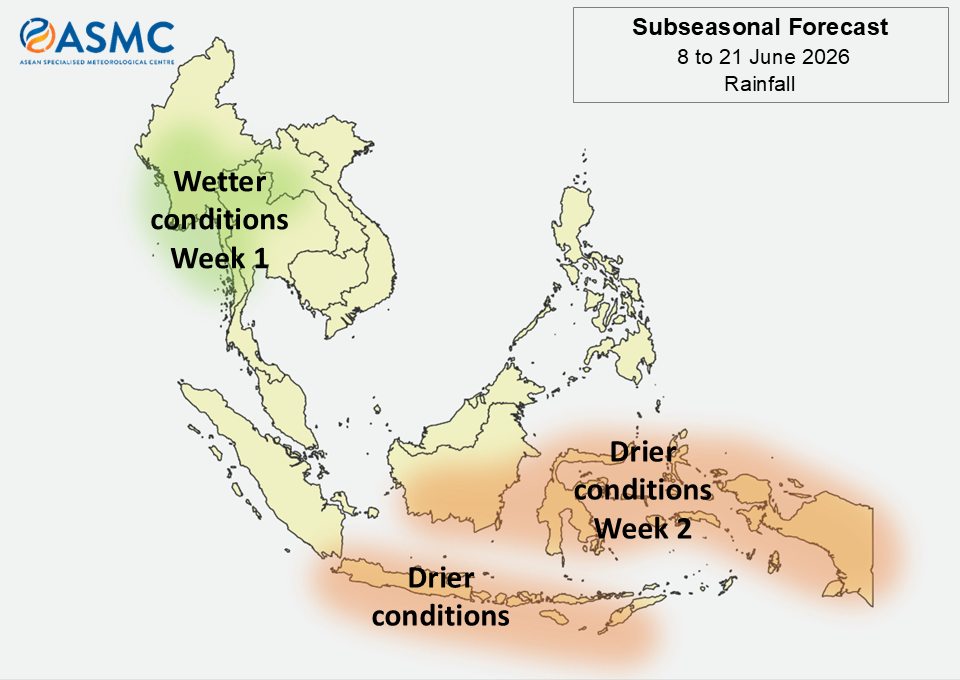
Figure 1: Rainfall Outlook

figure2

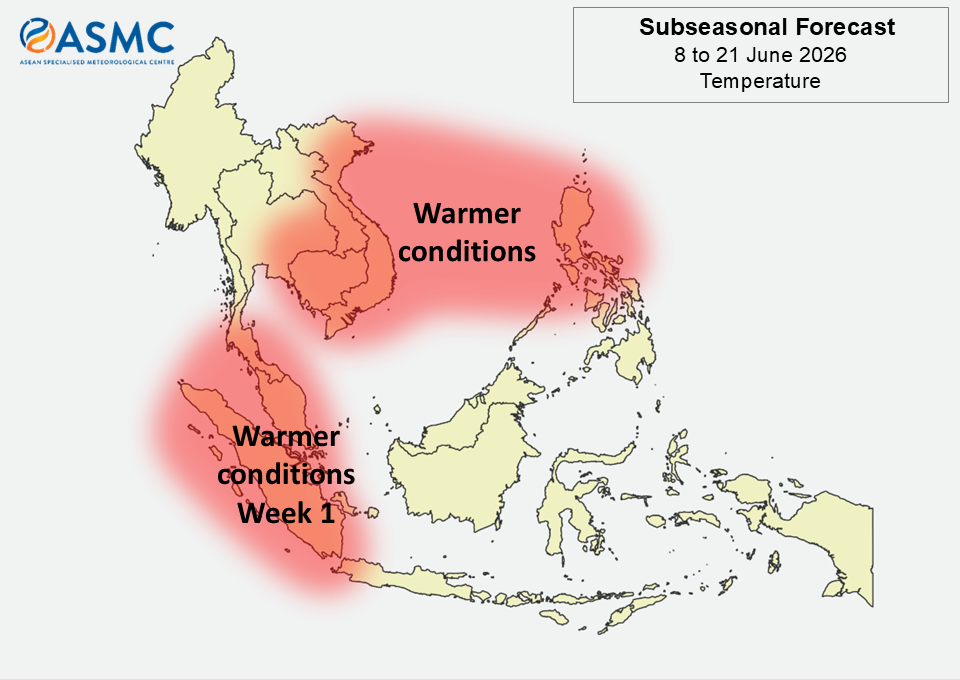
Figure 2: Temperature Outlook

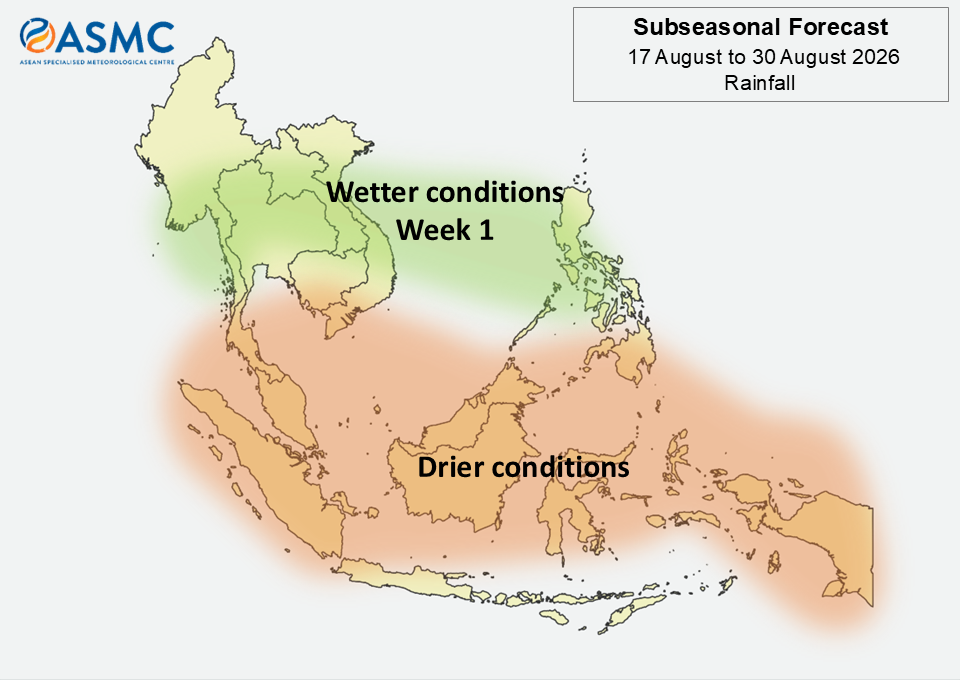
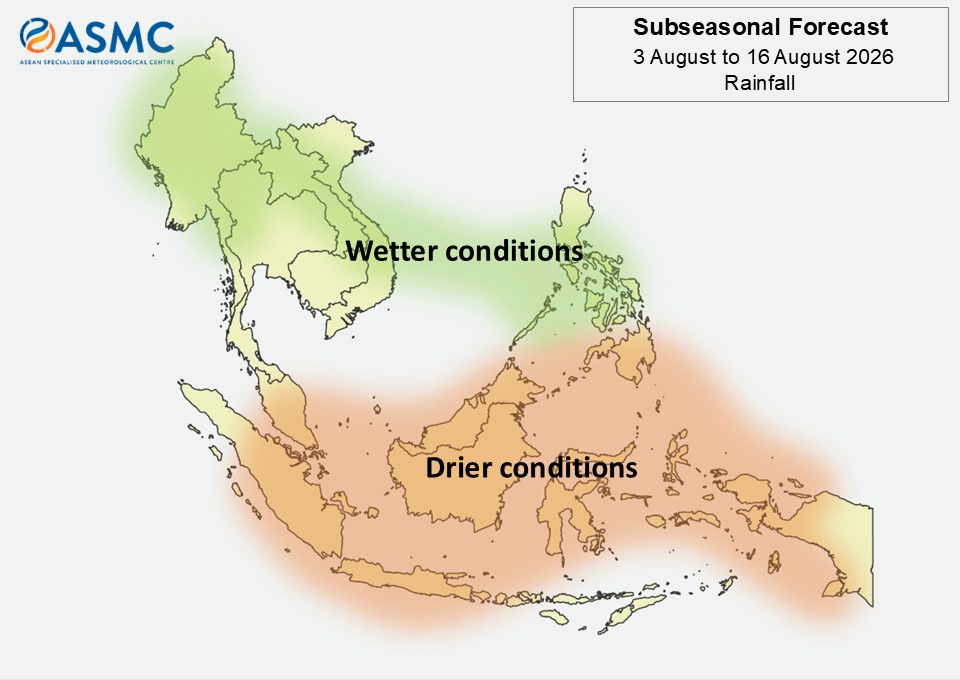
Wetter conditions are predicted over much of western and northern Mainland Southeast Asia in Week 1 (8 – 14 June).

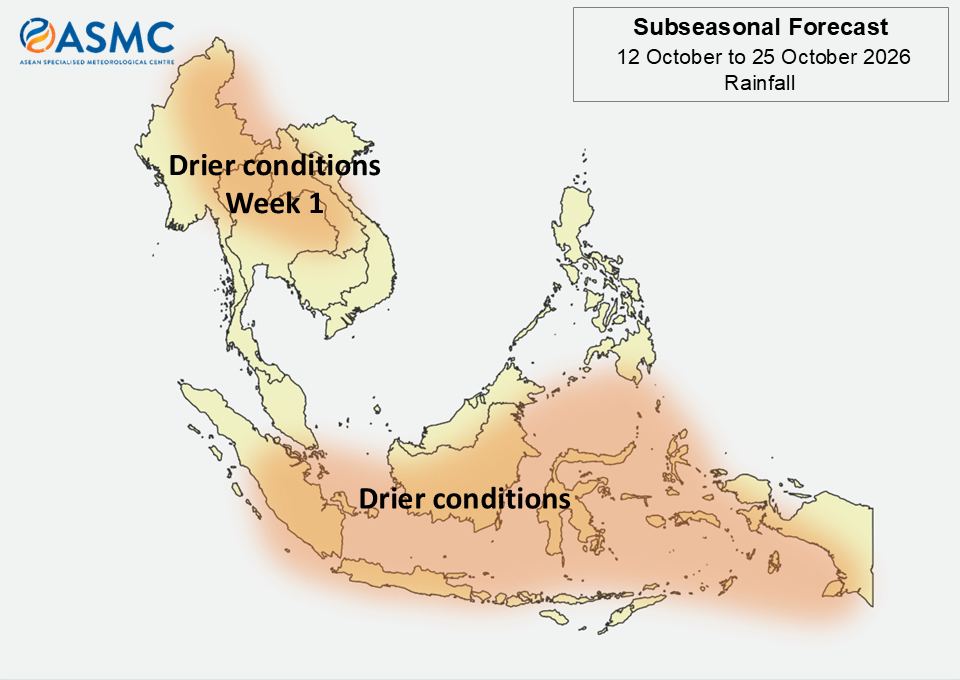
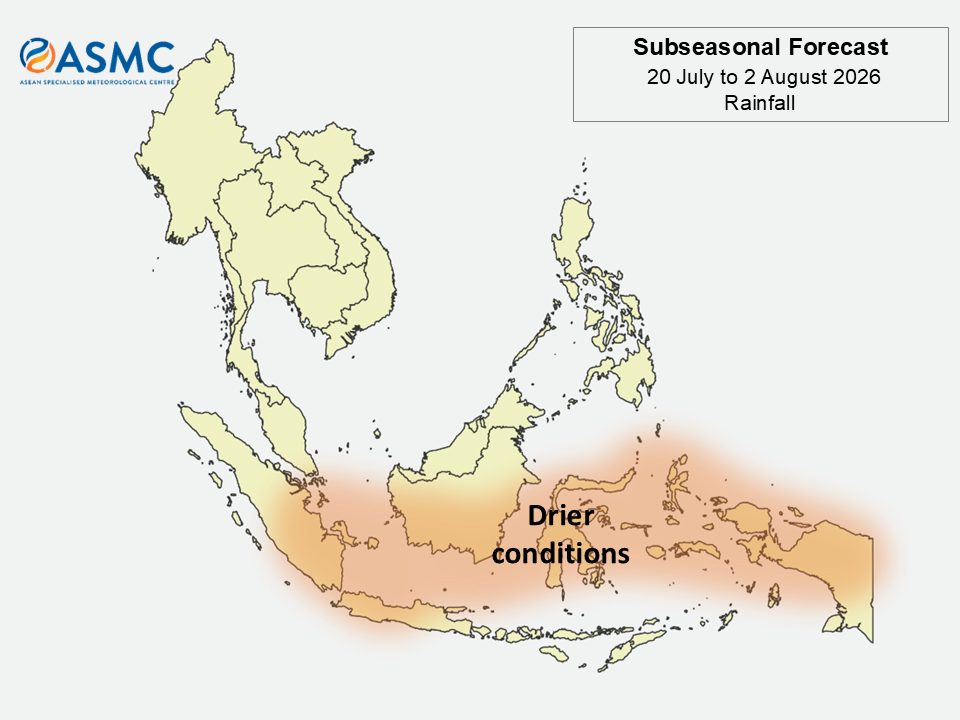
Drier conditions are predicted over the southern Maritime Continent during the next fortnight (8 – 21 June). Drier conditions are also predicted over much of the central and eastern equatorial region in Week 2 (15 – 21 June).

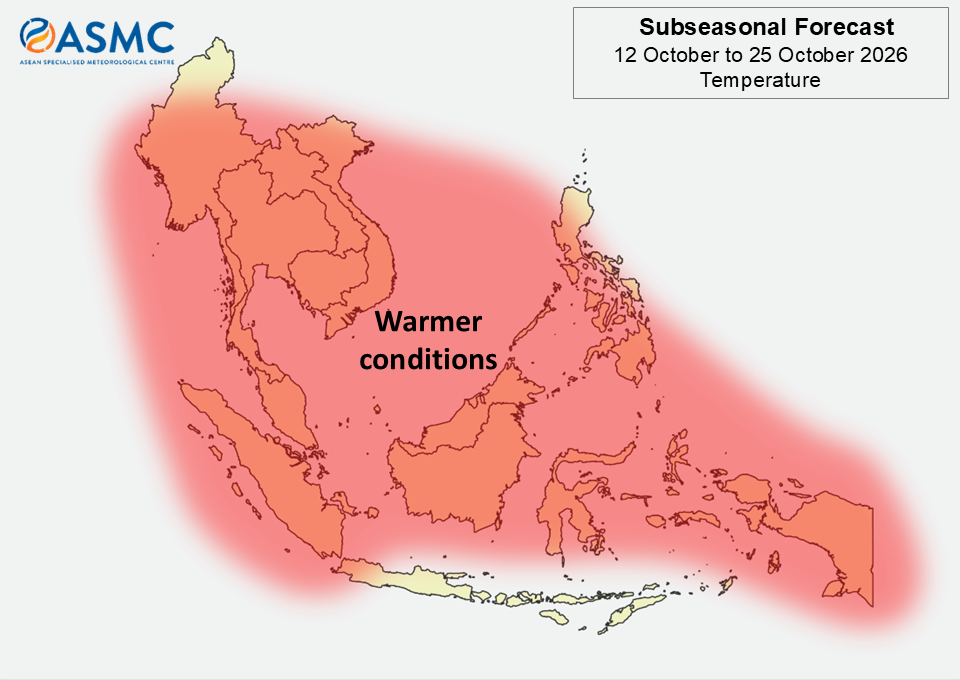
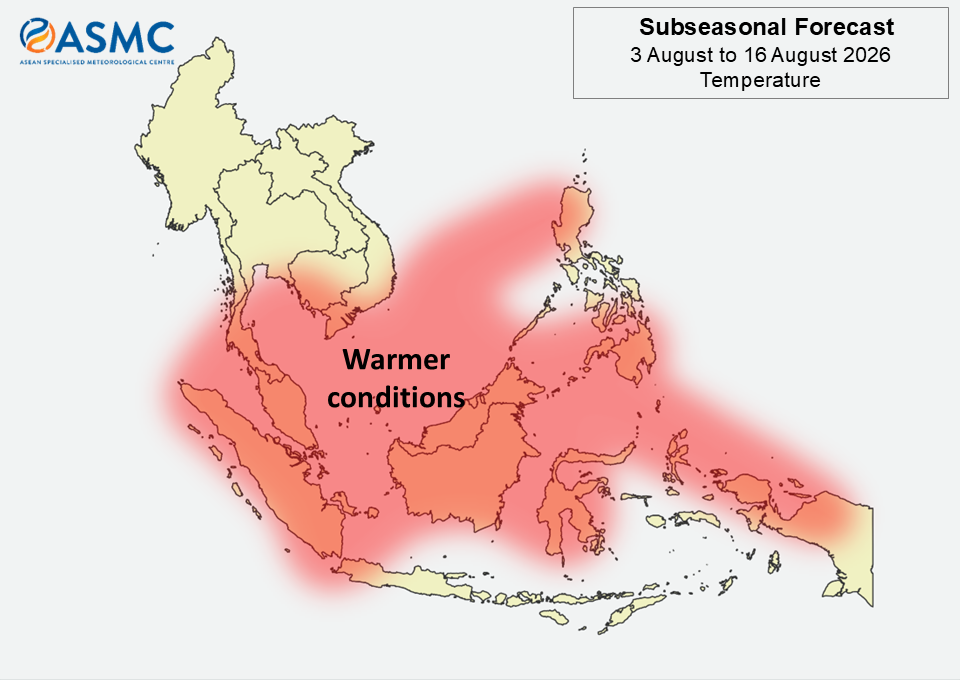
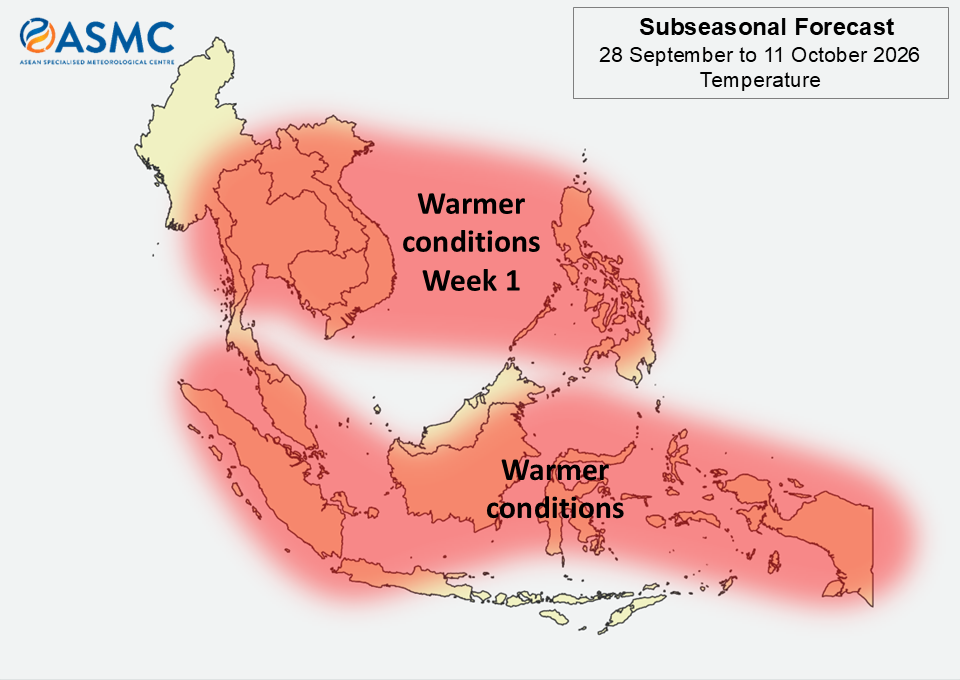
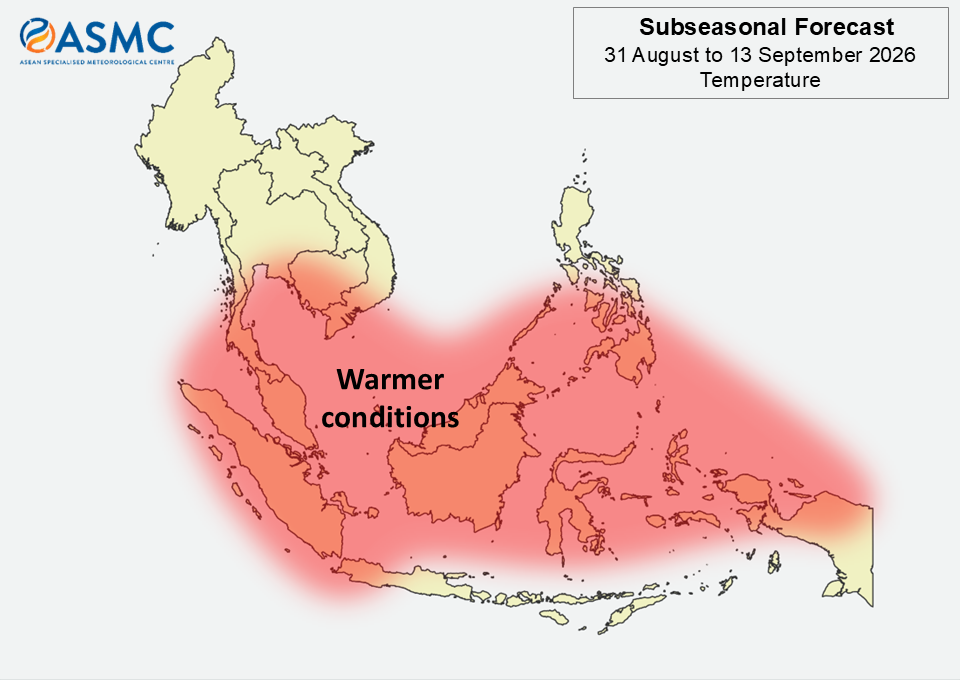
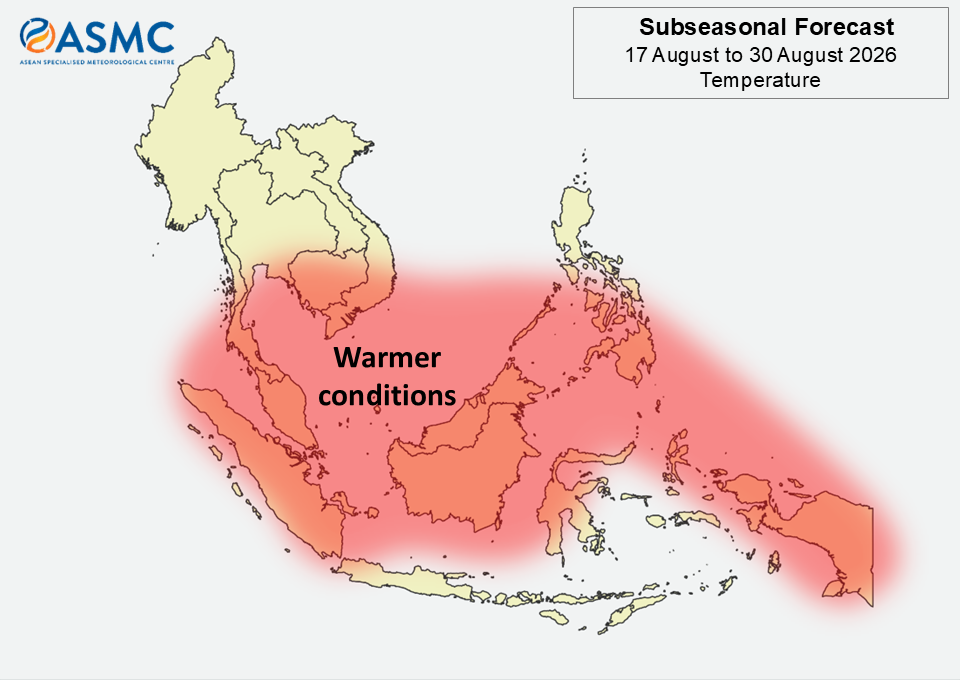
Warmer than usual temperatures are predicted over the western Maritime Continent in Week 1 (8 – 14 June). Warmer than usual temperatures are also predicted over eastern Mainland Southeast Asia and parts of the northeastern Maritime Continent during the next fortnight (8 – 21 June).

A Madden-Julian Oscillation (MJO) signal was present over the Western Pacific (Phase 7) at the start of June 2026, based on the RMM Index. Most models predict the MJO signal to propagate to the Western Hemisphere and Africa (Phase 8) and weaken, becoming indiscernible either by the start of the forecast period or in Week 1 (8 – 14 June). No significant MJO activity is predicted for Week 2 (15 – 21 June).

The outlook is assessed for the region in general, where conditions are relative to the average conditions for the corresponding time of year. For specific updates on the national scale, the relevant ASEAN National Meteorological and Hydrological Services should be consulted.
May 20, 2026

Subseasonal Weather Outlook (25 May – 7 June 2026)

Subseasonal Weather Outlook (25 May – 7 June 2026)

Issued: 20 May 2026
First forecast week: 25 – 31 May 2026
Second forecast week: 1 – 7 June 2026

figure1

Figure 1: Rainfall Outlook

figure2

Figure 2: Temperature Outlook

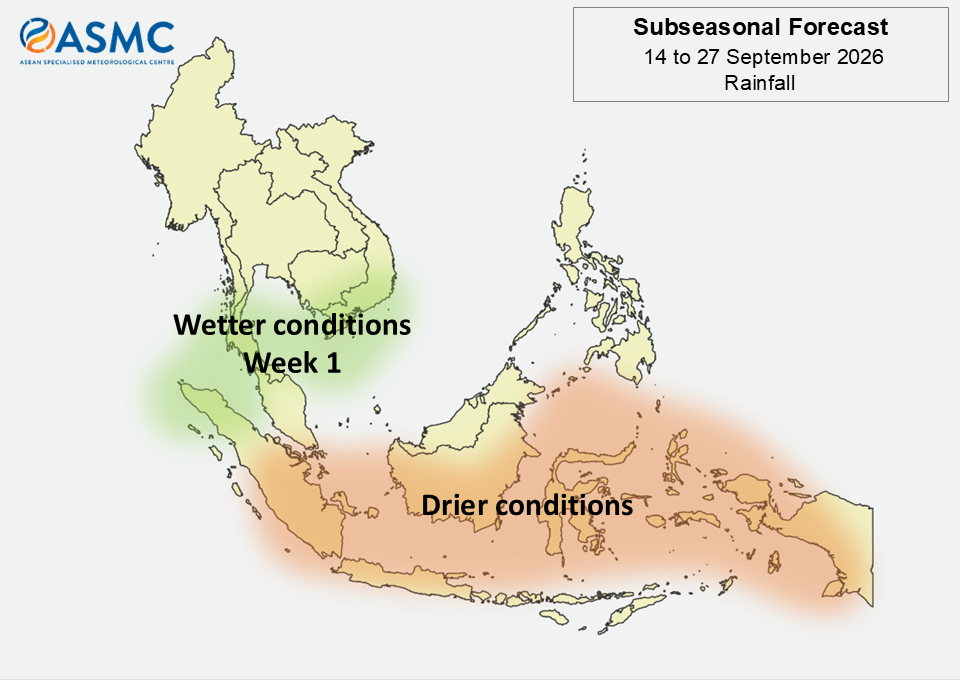
Over much of the eastern Maritime Continent, wetter conditions are predicted in Week 1 (25 – 31 May) and drier conditions in Week 2 (1 – 7 June).

Over the western half of the equatorial region, drier conditions are predicted over the next fortnight (25 May – 7 June).

Over parts of the northeastern Maritime Continent and much of Mainland Southeast Asia, wetter conditions are predicted in Week 2 (1 – 7 June).

Warmer than usual temperatures are predicted over most of the equatorial region in Week 2 (1 – 7 June), broadly in line with the predicted drier conditions for that week.

A Madden-Julian Oscillation (MJO) was present over the Indian Ocean (Phases 2 and 3) in the middle of May. The signal is expected to dissipate by the start of the forecast period.
Most models predict an MJO signal over the Western Pacific (Phases 6 and 7) in Week 1 (25 – 31 May). There is uncertainty across models whether the MJO signal will continue to propagate through the Western Hemisphere (Phases 8 and 1) in Week 2 (1 – 7 June).

The outlook is assessed for the region in general, where conditions are relative to the average conditions for the corresponding time of year. For specific updates on the national scale, the relevant ASEAN National Meteorological and Hydrological Services should be consulted.
May 7, 2026

Subseasonal Weather Outlook (11 – 24 May 2026)

Subseasonal Weather Outlook (11 – 24 May 2026)

Issued: 6 May 2026
First forecast week: 11 – 17 May 2026
Second forecast week: 18 – 24 May 2026

figure1

Figure 1: Rainfall Outlook

figure2

Figure 2: Temperature Outlook

Wetter conditions are predicted over most of the equatorial region in Week 1 (11 – 17 May) and over most of southwestern Mainland Southeast Asia in Week 2 (18 – 24 May).

Drier than usual conditions are predicted over parts of the eastern half of Mainland Southeast Asia in Week 1 (11 – 17 May).

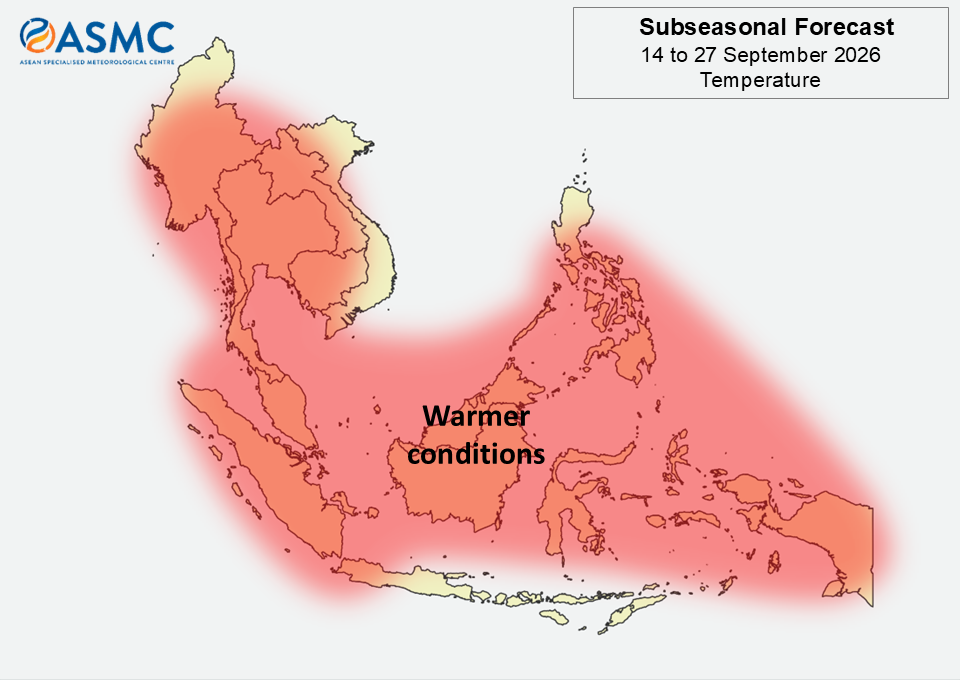
Warmer than usual temperatures are predicted over most of southeastern Mainland Southeast Asia and the northeastern Maritime Continent in Week 1 (11 – 17 May). Warmer than usual temperatures are also predicted over the western and southern Maritime Continent in the next fortnight (11 – 24 May).

A Madden-Julian Oscillation (MJO) signal was present over the Indian Ocean (Phase 2) in the beginning of May 2026. Most models predict the MJO signal to weaken and become inactive by the start of the forecast period and to remain inactive during Week 1 (11 – 17 May). Most models predict an MJO signal to emerge over the Western Pacific (Phase 7) either in Week 2 (18 – 24 May) or after the forecast period.

The outlook is assessed for the region in general, where conditions are relative to the average conditions for the corresponding time of year. For specific updates on the national scale, the relevant ASEAN National Meteorological and Hydrological Services should be consulted.
April 23, 2026

Subseasonal Weather Outlook (27 April – 10 May 2026)

Subseasonal Weather Outlook (27 April – 10 May 2026)

Issued: 22 April 2026
First forecast week: 27 April – 3 May 2026
Second forecast week: 4 – 10 May 2026

figure1

Figure 1: Rainfall Outlook

figure2

Figure 2: Temperature Outlook

Wetter conditions are predicted over much of the southern Maritime Continent in Week 1 (27 April – 3 May).

Drier than usual conditions are predicted over much of central and southern Mainland Southeast Asia and parts of the western Maritime Continent in the next fortnight (27 April – 10 May).

Warmer than usual temperatures are predicted over much of central and southern Mainland Southeast Asia and most of the northern half of the Maritime Continent in the next fortnight (27 April – 10 May).

A Madden-Julian Oscillation (MJO) signal was present over the Western Hemisphere and Africa (Phases 8 and 1) during mid-April. Most models predict the MJO signal to continue propagating eastwards, reaching the Indian Ocean (Phases 2 and 3) by the start of the forecast period, and then weakening over the Indian Ocean during Week 1 (27 April – 3 May).

The outlook is assessed for the region in general, where conditions are relative to the average conditions for the corresponding time of year. For specific updates on the national scale, the relevant ASEAN National Meteorological and Hydrological Services should be consulted.
April 8, 2026

Subseasonal Weather Outlook (13 – 26 April 2026)

Subseasonal Weather Outlook (13 – 26 April 2026)

Issued: 8 April 2026
First forecast week: 13 – 19 April 2026
Second forecast week: 20 – 26 April 2026

figure1

Figure 1: Rainfall Outlook

figure2

Figure 2: Temperature Outlook

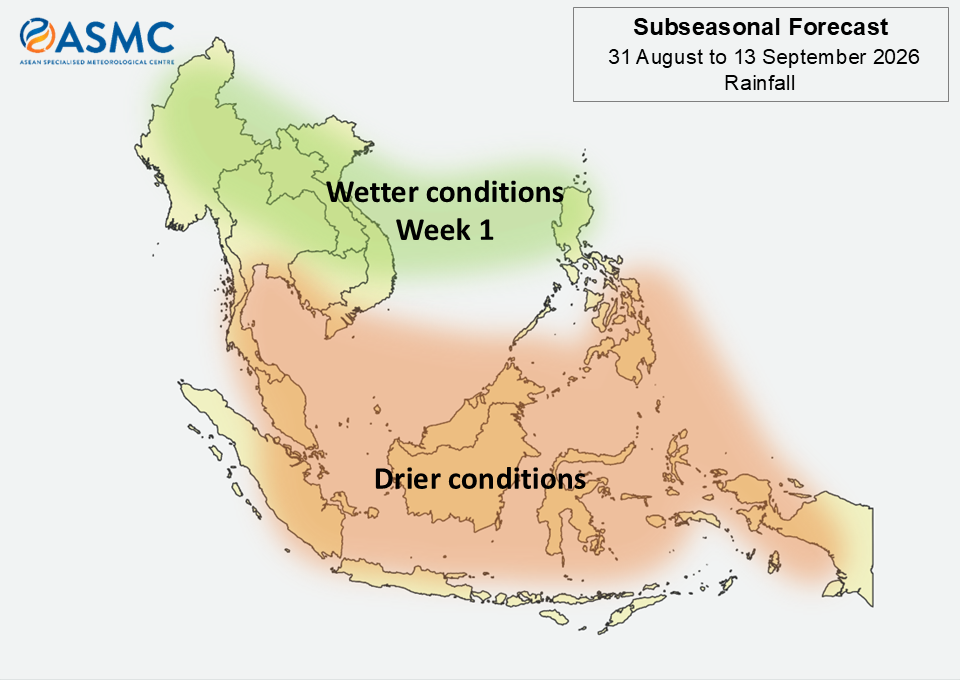
Drier than usual conditions are predicted over the southeastern Maritime Continent in Week 1 (13 – 19 April).

Drier than usual conditions are also predicted over much of Mainland Southeast Asia and most of the northern Maritime Continent in Week 1 (13 – 19 April). These drier conditions are predicted to ease over much of the region in Week 2 (20 – 26 April), except over southeastern Mainland Southeast Asia, the northwestern Maritime Continent, and northern Borneo where the drier conditions are likely to persist.

Warmer than usual temperatures are predicted over much of Mainland Southeast Asia and parts of the northwestern Maritime Continent in Week 1 (13 – 19 April), easing in Week 2 (20 – 26 April).

No Madden-Julian Oscillation (MJO) signal was present at the end of the first week of April 2026. Most models predict an MJO signal to develop over the Western Pacific (Phases 6 and 7) by the start of the forecast period. The MJO signal is predicted to propagate eastwards, reaching the Western Hemisphere and Africa, in Phase 8 during Week 1 (13 – 19 April) and Phase 1 during Week 2 (20 – 26 April).

The outlook is assessed for the region in general, where conditions are relative to the average conditions for the corresponding time of year. For specific updates on the national scale, the relevant ASEAN National Meteorological and Hydrological Services should be consulted.
March 25, 2026

Subseasonal Weather Outlook (30 March – 12 April 2026)

Subseasonal Weather Outlook (30 March – 12 April 2026)

Issued: 25 March 2026
First forecast week: 30 March – 5 April 2026
Second forecast week: 6 – 12 April 2026

figure1

Figure 1: Rainfall Outlook

figure2

Figure 2: Temperature Outlook

Drier than usual conditions are predicted over much of Mainland Southeast Asia and most of the northern and southeastern Maritime Continent during the next fortnight (30 March – 12 April).

Warmer than usual temperatures are predicted over much of Mainland Southeast Asia and parts of the northwestern Maritime Continent during the next fortnight (30 March – 12 April).

A Madden-Julian Oscillation (MJO) signal was present over the Western Hemisphere (Phase 8) in the third week of March, based on the RMM index. Most models predict the signal to weaken by the start of the forecast period. During Week 1 (30 March – 5 April), models indicate the signal will either be present over the Western Hemisphere (Phases 8 and 1) or be inactive. There is little agreement on the predicted MJO activity among the models in Week 2 (6 – 12 April).

The outlook is assessed for the region in general, where conditions are relative to the average conditions for the corresponding time of year. For specific updates on the national scale, the relevant ASEAN National Meteorological and Hydrological Services should be consulted.
March 11, 2026

Subseasonal Weather Outlook (16 – 29 March 2026)

Subseasonal Weather Outlook (16 – 29 March 2026)

Issued: 11 March 2026
First forecast week: 16 – 22 March 2026
Second forecast week: 23 – 29 March 2026

figure1

Figure 1: Rainfall Outlook

figure2

Figure 2: Temperature Outlook

Drier than usual conditions are predicted over southeastern Mainland Southeast Asia and the northeastern Maritime Continent during the next fortnight (16 – 29 March). Drier conditions are also predicted to develop over parts of the western and central equatorial region in Week 1 (16 – 22 March) and persist in Week 2 (23 – 29 March).

Cooler than usual temperatures are predicted over most of Mainland Southeast Asia and the northeastern Maritime Continent in Week 1 (16 – 22 March). Warmer than usual temperatures are predicted over parts of the western Maritime Continent in Week 2 (23 – 29 March).

No discernible Madden-Julian Oscillation (MJO) signal was present at the start of the second week of March, based on the RMM index. Some models predict an MJO signal to develop over the Western Pacific (Phase 7) by the start of the forecast period, reaching the Western Hemisphere and Africa (Phase 8) during Week 1 (16 – 22 March). There is little agreement on the predicted MJO activity among the rest of the models in Week 1 (16 – 22 March). In Week 2 (23 – 29 March), most models predict no discernible MJO activity.

The outlook is assessed for the region in general, where conditions are relative to the average conditions for the corresponding time of year. For specific updates on the national scale, the relevant ASEAN National Meteorological and Hydrological Services should be consulted.
February 26, 2026

Subseasonal Weather Outlook (2 – 15 March 2026)

Subseasonal Weather Outlook (2 – 15 March 2026)

Issued: 26 February 2026
First forecast week: 2 – 8 March 2026
Second forecast week: 9 – 15 March 2026

figure1

Figure 1: Rainfall Outlook

figure2

Figure 2: Temperature Outlook

Over most of the central and eastern equatorial region in Week 1 (2 – 8 March), drier than usual conditions for this time of the year are predicted, along with warmer than usual temperatures.

Over much of the northeastern Maritime Continent in Week 2 (9 – 15 March), wetter than usual conditions are predicted.

Over much of Mainland Southeast Asia in Week 1 (2 – 8 March), cooler than usual temperatures are predicted to develop. These cooler conditions are likely to persist in Week 2 (9 – 15 March).

There was no discernible Madden-Julian Oscillation (MJO) signal towards the end of February, based on the RMM index. Most models predict no significant MJO activity during the forecast period (2 – 15 March), although a few models predict the development of an MJO signal in the Maritime Continent (Phase 5) during Week 1 (2 – 8 March).

The outlook is assessed for the region in general, where conditions are relative to the average conditions for the corresponding time of year. For specific updates on the national scale, the relevant ASEAN National Meteorological and Hydrological Services should be consulted.
February 11, 2026

Subseasonal Weather Outlook (16 February – 1 March 2026)

Subseasonal Weather Outlook (16 February – 1 March 2026)

Issued: 11 February 2026
First forecast week: 16 – 22 February 2026
Second forecast week: 23 February – 1 March 2026

figure1

Figure 1: Rainfall Outlook

figure2

Figure 2: Temperature Outlook

Wetter conditions are predicted over parts of western and central Mainland Southeast Asia as well as parts of the northwestern Maritime Continent in Week 1 (16 – 22 February). Wetter conditions are predicted over parts of the northeastern Maritime Continent in the next fortnight (16 February – 1 March).

Drier than usual conditions for this time of the year are predicted over much of the western and central equatorial region in Week 2 (23 February – 1 March).

No significant regional temperature anomalies are predicted in the next fortnight (16 February – 1 March).

A Madden-Julian Oscillation (MJO) signal was present over the Indian Ocean (Phases 2 and 3) towards the middle of February 2026, based on the RMM index. Most models predict the signal to propagate eastwards towards the Maritime Continent (Phase 4) in Week 1 (16 – 22 February), with no significant MJO activity in Week 2 (23 February – 1 March).

The outlook is assessed for the region in general, where conditions are relative to the average conditions for the corresponding time of year. For specific updates on the national scale, the relevant ASEAN National Meteorological and Hydrological Services should be consulted.