Category Archives: Regional Weather Outlook for Year 2026

March 25, 2026

Subseasonal Weather Outlook (30 March – 12 April 2026)

Subseasonal Weather Outlook (30 March – 12 April 2026)

Issued: 25 March 2026
First forecast week: 30 March – 5 April 2026
Second forecast week: 6 – 12 April 2026

figure1

Figure 1: Rainfall Outlook

figure2

Figure 2: Temperature Outlook

Drier than usual conditions are predicted over much of Mainland Southeast Asia and most of the northern and southeastern Maritime Continent during the next fortnight (30 March – 12 April).

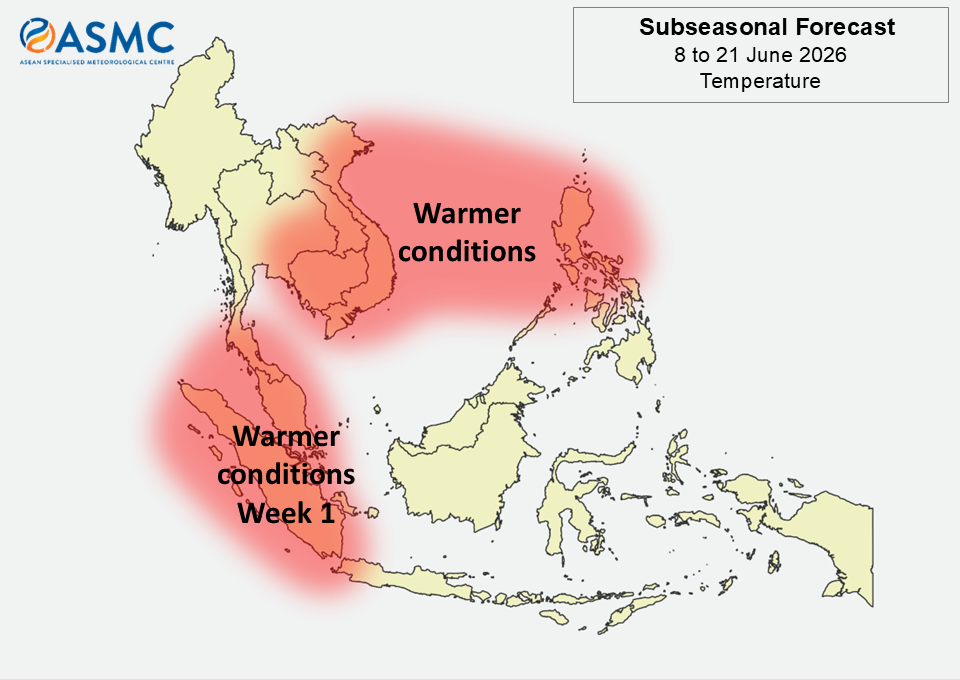
Warmer than usual temperatures are predicted over much of Mainland Southeast Asia and parts of the northwestern Maritime Continent during the next fortnight (30 March – 12 April).

A Madden-Julian Oscillation (MJO) signal was present over the Western Hemisphere (Phase 8) in the third week of March, based on the RMM index. Most models predict the signal to weaken by the start of the forecast period. During Week 1 (30 March – 5 April), models indicate the signal will either be present over the Western Hemisphere (Phases 8 and 1) or be inactive. There is little agreement on the predicted MJO activity among the models in Week 2 (6 – 12 April).

The outlook is assessed for the region in general, where conditions are relative to the average conditions for the corresponding time of year. For specific updates on the national scale, the relevant ASEAN National Meteorological and Hydrological Services should be consulted.
March 11, 2026

Subseasonal Weather Outlook (16 – 29 March 2026)

Subseasonal Weather Outlook (16 – 29 March 2026)

Issued: 11 March 2026
First forecast week: 16 – 22 March 2026
Second forecast week: 23 – 29 March 2026

figure1

Figure 1: Rainfall Outlook

figure2

Figure 2: Temperature Outlook

Drier than usual conditions are predicted over southeastern Mainland Southeast Asia and the northeastern Maritime Continent during the next fortnight (16 – 29 March). Drier conditions are also predicted to develop over parts of the western and central equatorial region in Week 1 (16 – 22 March) and persist in Week 2 (23 – 29 March).

Cooler than usual temperatures are predicted over most of Mainland Southeast Asia and the northeastern Maritime Continent in Week 1 (16 – 22 March). Warmer than usual temperatures are predicted over parts of the western Maritime Continent in Week 2 (23 – 29 March).

No discernible Madden-Julian Oscillation (MJO) signal was present at the start of the second week of March, based on the RMM index. Some models predict an MJO signal to develop over the Western Pacific (Phase 7) by the start of the forecast period, reaching the Western Hemisphere and Africa (Phase 8) during Week 1 (16 – 22 March). There is little agreement on the predicted MJO activity among the rest of the models in Week 1 (16 – 22 March). In Week 2 (23 – 29 March), most models predict no discernible MJO activity.

The outlook is assessed for the region in general, where conditions are relative to the average conditions for the corresponding time of year. For specific updates on the national scale, the relevant ASEAN National Meteorological and Hydrological Services should be consulted.
February 26, 2026

Subseasonal Weather Outlook (2 – 15 March 2026)

Subseasonal Weather Outlook (2 – 15 March 2026)

Issued: 26 February 2026
First forecast week: 2 – 8 March 2026
Second forecast week: 9 – 15 March 2026

figure1

Figure 1: Rainfall Outlook

figure2

Figure 2: Temperature Outlook

Over most of the central and eastern equatorial region in Week 1 (2 – 8 March), drier than usual conditions for this time of the year are predicted, along with warmer than usual temperatures.

Over much of the northeastern Maritime Continent in Week 2 (9 – 15 March), wetter than usual conditions are predicted.

Over much of Mainland Southeast Asia in Week 1 (2 – 8 March), cooler than usual temperatures are predicted to develop. These cooler conditions are likely to persist in Week 2 (9 – 15 March).

There was no discernible Madden-Julian Oscillation (MJO) signal towards the end of February, based on the RMM index. Most models predict no significant MJO activity during the forecast period (2 – 15 March), although a few models predict the development of an MJO signal in the Maritime Continent (Phase 5) during Week 1 (2 – 8 March).

The outlook is assessed for the region in general, where conditions are relative to the average conditions for the corresponding time of year. For specific updates on the national scale, the relevant ASEAN National Meteorological and Hydrological Services should be consulted.
February 11, 2026

Subseasonal Weather Outlook (16 February – 1 March 2026)

Subseasonal Weather Outlook (16 February – 1 March 2026)

Issued: 11 February 2026
First forecast week: 16 – 22 February 2026
Second forecast week: 23 February – 1 March 2026

figure1

Figure 1: Rainfall Outlook

figure2

Figure 2: Temperature Outlook

Wetter conditions are predicted over parts of western and central Mainland Southeast Asia as well as parts of the northwestern Maritime Continent in Week 1 (16 – 22 February). Wetter conditions are predicted over parts of the northeastern Maritime Continent in the next fortnight (16 February – 1 March).

Drier than usual conditions for this time of the year are predicted over much of the western and central equatorial region in Week 2 (23 February – 1 March).

No significant regional temperature anomalies are predicted in the next fortnight (16 February – 1 March).

A Madden-Julian Oscillation (MJO) signal was present over the Indian Ocean (Phases 2 and 3) towards the middle of February 2026, based on the RMM index. Most models predict the signal to propagate eastwards towards the Maritime Continent (Phase 4) in Week 1 (16 – 22 February), with no significant MJO activity in Week 2 (23 February – 1 March).

The outlook is assessed for the region in general, where conditions are relative to the average conditions for the corresponding time of year. For specific updates on the national scale, the relevant ASEAN National Meteorological and Hydrological Services should be consulted.
January 28, 2026

Subseasonal Weather Outlook (2 – 15 February 2026)

Subseasonal Weather Outlook (2 – 15 February 2026)

Issued: 28 January 2026
First forecast week: 2 – 8 February 2026
Second forecast week: 9 – 15 February 2026

figure1

Figure 1: Rainfall Outlook

figure2

Figure 2: Temperature Outlook

Wetter conditions are predicted over most of the northeastern Maritime Continent in the next fortnight (2 – 15 February).

Drier than usual conditions for this time of the year are predicted over most of the central Maritime Continent in Week 2 (9 – 15 February).

No significant regional temperature anomalies are predicted in the next fortnight (2 – 15 February).

A Madden-Julian Oscillation (MJO) signal was present over the Western Pacific (Phase 7) towards the end of January, based on the RMM index. Most models predict the signal to weaken by the start of the forecast period and remain inactive during the forecast period, although a few models predict a short-lived MJO signal over the Western Hemisphere (Phase 1) and Indian Ocean (Phase 2) in Week 1 (2 – 8 February).

The outlook is assessed for the region in general, where conditions are relative to the average conditions for the corresponding time of year. For specific updates on the national scale, the relevant ASEAN National Meteorological and Hydrological Services should be consulted.
January 14, 2026

Subseasonal Weather Outlook (19 January – 1 February 2026)

Subseasonal Weather Outlook (19 January – 1 February 2026)

Issued: 14 January 2026
First forecast week: 19 – 25 January 2026
Second forecast week: 26 January – 1 February 2026

figure1

Figure 1: Rainfall Outlook

figure2

Figure 2: Temperature Outlook

Drier conditions are predicted over the equatorial region in Week 1 (19 – 25 January).

Warmer than usual temperature for this time of the year is predicted over parts of the central and eastern Maritime Continent in Week 1 (19 – 25 January).

Cooler than usual temperature is predicted over parts of southeastern Mainland Southeast Asia and parts of the northeastern Maritime Continent in Week 1 (19 – 25 January).

A Madden-Julian Oscillation (MJO) signal emerged over the Western Pacific (Phase 6) in the second week of January based on the RMM index. Most models predict this signal to continue propagating eastwards, reaching the Western Hemisphere (Phases 8 and 1) by Week 2 (26 January – 1 February).

The outlook is assessed for the region in general, where conditions are relative to the average conditions for the corresponding time of year. For specific updates on the national scale, the relevant ASEAN National Meteorological and Hydrological Services should be consulted.
December 31, 2025

Subseasonal Weather Outlook (5 – 18 January 2026)

Subseasonal Weather Outlook (5 – 18 January 2026)

Issued: 31 December 2025
First forecast week: 5 – 11 January 2026
Second forecast week: 12 – 18 January 2026

figure1

Figure 1: Rainfall Outlook

figure2

Figure 2: Temperature Outlook

Wetter conditions are predicted over parts of the northeastern Maritime Continent in Week 1 (5 – 11 January).

Drier conditions are predicted over the western and parts of the central Maritime Continent in the next fortnight (5 – 18 January).

Cooler than usual temperatures are predicted for most of Mainland Southeast Asia in Week 1 (5 – 11 January). These cooler conditions are predicted to ease in Week 2 (12 – 18 January).

No significant Madden-Julian Oscillation (MJO) signal was present in the last week of December 2025. Most models predict the MJO signal to remain inactive during the forecast period (5 – 18 January).

The outlook is assessed for the region in general, where conditions are relative to the average conditions for the corresponding time of year. For specific updates on the national scale, the relevant ASEAN National Meteorological and Hydrological Services should be consulted.