Category Archives: Fortnightly Weather Review

CR58

April 10, 2017

Review of Regional Weather and Smoke Haze for Mar 2017

Review of Regional Weather and Smoke Haze for Mar 2017

Print Version

1.   Review of Regional Weather Conditions in March 2017

1.1    The Northeast Monsoon conditions in the region gave way to inter-monsoon conditions in the second half of March 2017. During the month, there was a gradual increase of shower activities over parts of the Mekong sub-region, particularly over Thailand, Cambodia and central Vietnam was observed while over most parts of the southern ASEAN region, wet weather conditions continued to prevail. The rainfall distribution for March 2017 is shown in Figure 1.

figure1

Figure 1: Daily average rainfall for the ASEAN region in March 2017. (Source: JAXA Global Satellite Mapping of Precipitation).

figure2

Figure 2: Percentage of Normal Rainfall for March 2017. The rainfall data may be less representative for areas with low density of rainfall network

1.2    In March 2017, rainfall was near to above-normal over most parts of the northern ASEAN region, except in parts of Myanmar, Cambodia and southern Vietnam where below-normal rainfall was received. Likewise in most parts of the Philippines, near- to above-normal rainfall prevailed with most of the rainfall affecting the Mindanao area. In the southern ASEAN region, rainfall received was mostly near to above-normal, and in the second half of March 2017, parts of West Java and Peninsular Malaysia were affected by floods due to the occurrence of heavy thunderstorm activities on some days. Figure 2 shows the percentage normal of rainfall for March 2017.

1.3    The prevailing winds during the month were predominantly from the north-east or east over the northern ASEAN region, and from the west or northwest over the southern ASEAN region. In the second half of March 2017, there was a gradual weakening of winds over the ASEAN region around and north of the Equator. Westerly wind anomalies prevailed over the equatorial region between the Indian Ocean and the eastern parts of Indonesian Archipelago. The anomalous convergence observed over the northern parts of Borneo and southern Philippines could have contributed to above-normal rainfall over those areas. Figure 3 shows the average and anomalous winds at 5000 feet.

figure3a

figure3b

Figure 3: 5000 ft average winds streamlines (left) and anomaly (right) for March 2017.

1.4    The cool anomalies of the equatorial Pacific Ocean’s sea-surface temperature (SST) over the Niño3.4 region further weakened towards neutral (neither El Niño nor La Niña) values, and most of the atmospheric indicators over the equatorial Pacific were in the near average conditions.

1.5    In early March 2017, the Madden Julian Oscillation (MJO) progressed through Phase 3 to Phase 4 in early March 2017, and this was a contributing factor to the increased rainfall received over the Indonesian Archipelago. The strength of the MJO gradually weakened towards mid-March 2017, and did not have a significant influence on the rainfall in the second half of the month.

figure4

Figure 4: The MJO phase diagram for March 2017. The MJO phase diagram illustrates the movement of the MJO through different phases, which correspond to different locations along the equator. The distance of the index from the centre of the diagram is correlated with the strength of MJO. When the index falls within the circle, the MJO is considered weak or no signal exhibited. (Source: Bureau of Meteorology)<

2.   Review of Land/Forest Fires and Smoke Haze Situation

2.1    In March 2017, the hotspot activities in the northern ASEAN region remained active under the prevailing dry weather conditions. Large clusters of hotspots were detected in Myanmar and northern Thailand compared to February 2017. Most of the hotspots and areas of smoke haze were detected close to the border of Myanmar and Thailand, in the provinces of Mae Hong Son, Chiang Rai and Kamphaeng Phet. In the second half of March 2017, there was a further deterioration in the air quality in northern Thailand, and the PM10 readings exceeded 150ug/m3 (Unhealthy range) on several days in Mae Hong Son and Chiang Rai provinces. In Lao PDR, a high density of hotspots was detected in Xiangkhoang and Xaignabouri pronvinces. On the other hand, there was an increase in shower activities in Cambodia during the month which helped to ease the hotspot situation there.

2.2    In contrast, hotspot activities in the southern ASEAN region remained low and were mostly subdued due frequent shower activities in the region.

2.3    Satellite images depicting some of the hotspot activities over parts of the ASEAN region during March 2017 are shown in Figure 5 – Figure 9.

figure5

Fig. 5: NOAA-19 satellite image on 3 March 2017 shows widespread hotspots with smoke haze in parts of Myanmar.

figure6

Fig. 6:NOAA-19 satellite image on 14 March 2017 shows slight to moderate smoke haze over parts of northern Thailand.


figure7

Figure 7: NOAA-19 satellite image on 14 March 2017 shows occurrence of shower activities which has helped to subdue the hotspot activities over the southern ASEAN region.

figure8

Figure 8: NOAA-19 satellite image on 28 March 2017 shows scattered hotspots with smoke haze in Myanmar.

figure9

Figure 9: NOAA-19 satellite image on 31 March 2017 shows more occurrence of shower activities over the Mekong sub-region.

2.4    The hotspot distribution charts and daily hotspot charts for March 2017 are shown in Figure 10, Figure 11 and Figure 12 respectively.

figure10

Figure 10: Figure 10: NOAA-19 hotspots distribution in March 2017.

figure11

Figure 11: Hotspot Counts in Cambodia, Lao PDR, Thailand, Vietnam and Myanmar in March 2017.

figure12

Figure 12: Hotspot Counts in Sumatra, Borneo and Peninsular Malaysia in March 2017.


3.   Status of El Niño/La Niña and Indian Ocean Dipole

3.1    Most models from major climate centres indicate the tropical Pacific Ocean will continue to gradually warm over the next 6 months, and there is an increasing chance that weak El Niño conditions could develop in the second half of 2017.

3.2    As the seasonal prediction model outlooks of El Niño at this time of the year is known to have the least skill, a more confidence assessment of El Niño risk would be available around mid-2017 onwards.

3.3    Typically, El Niño brings drier-than-normal rainfall conditions to most parts of Southeast Asia, except over the near-equatorial region where the impact is less pronounced during the Northeast Monsoon season. During La Niña events, the opposite, i.e wetter-than-normal condition, normally occurs. Locally specific impact differs from place to place and for different seasons.

3.4    In March 2017, the Indian Ocean Dipole (IOD) index was at neutral levels (Figure 13). In the next few months, based on international climate models, the IOD is forecast to remain neutral and it would unlikely have a significant influence on the weather over the ASEAN region. The formation of IOD typically starts around May or June, and peaks between August and October before decaying rapidly between December and April.

figure13

Figure 13: Indian Ocean Dipole (IOD) index time series. The IOD index is at the neutral level for March 2017. (Source: Bureau of Meteorology).

March 10, 2017

Review of Regional Weather and Smoke Haze for Feb 2017

Review of Regional Weather and Smoke Haze for Feb 2017

Print Version

1.   Review of Regional Weather Conditions in February 2017

1.1    The Northeast Monsoon conditions prevailed over the ASEAN region in February 2017. Dry weather conditions persisted over most areas of the Mekong sub-region, except over parts of Thailand and Cambodia where brief periods of showers were observed. During the month, the monsoon rain band was between the Equator and 15 S, and rainy weather conditions were experienced over most parts of the southern ASEAN region. The rainfall distribution for February 2017 is shown in Figure 1.

figure1

Figure 1: Daily average rainfall for the ASEAN region in March 2017. (Source: JAXA Global Satellite Mapping of Precipitation).

figure2

Figure 2: Percentage of Normal Rainfall for March 2017. The rainfall data may be less representative for areas with low density of rainfall network.

1.2    In February 2017, rainfall was below-normal in parts of Myanmar, northern and central Thailand, Lao PDR and Cambodia. Rainfall was above-normal over most parts of Vietnam and the Philippines. In contrast, rainfall was mostly near-normal to above-normal in the southern ASEAN region. The percentage normal of rainfall for February 2017 is shown in Figure 2.

1.3    Most of the rainfall activities in February 2017 was concentrated between the the Equator and the region around Java, and Mindanao, the Philippines (Figure 1). In mid-February, a strong monsoon surge brought a strengthening of winds and enhanced rainfall activities over the southern ASEAN region. The heavy rainfall associated with the monsoon surge fell mainly over coastal areas of Sarawak and the Java Sea. During the second half of February, some parts of Java as well as Jakarta Indonesia, were affected by heavy rains and floods due to localised thunderstorm activities.

1.4    In February 2017, north-easterly winds prevailed over the northern ASEAN region while winds in the southern ASEAN region blew predominantly from the west or northwest. Figure 3 shows the average and anomalous winds at 5000 feet. During the month, winds from the northern and southern hemispheres converged between 5 S and 10 S, and westerly or south-westerly wind anomalies prevailed over the Java Sea and the eastern parts of the Maritime Continent. In addition, the occurrence of cyclonic circulation anomalies over the Western Pacific Ocean contributed to the above-normal rainfall over the Philippines.

figure3a

figure3b

Figure 3: 5000 ft average winds streamlines (left) and anomaly (right) for February 2017.

1.5    The cool anomalies of the equatorial Pacific Ocean’s sea-surface temperature (SST) over the Niño 3.4 region weakened further but remained within the neutral (neither El Nino nor La Nina) thresholds. Most of the atmospheric conditions over the equatorial Pacific were in near average conditions, except for cloudiness and rainfall over the central and western tropical Pacific which remained indicative of weak La Niña conditions.

1.6    The Madden Julian Oscillation (MJO) was active and strong in February 2017 and is likely to have played a significant role on the rainfall over the tropical region during this period. In the first week of February 2017, the MJO was in Phase 4-5 and brought enhanced shower activities over the southern parts of Maritime Continent. In the second and third week of February 2017, the MJO strengthened and propagated through Phase 6-8, which contributed to less convective activities over the western Maritime Continent including parts of Sumatra and Peninsular Malaysia. The MJO continued its passage into Phase 1-2 towards the end of February 2017.

figure4

Figure 4: The MJO phase diagram for March 2017. The MJO phase diagram illustrates the movement of the MJO through different phases, which correspond to different locations along the equator. The distance of the index from the centre of the diagram is correlated with the strength of MJO. When the index falls within the circle, the MJO is considered weak or no signal exhibited. (Source: Bureau of Meteorology)

2.   Review of Land/Forest Fires and Smoke Haze Situation

2.1    In the Mekong Sub-region, hotspot activities persisted mainly in Thailand and Cambodia during the first half of February 2017. Visible smoke plumes and moderate haze were observed in parts of northern Cambodia on a few days. In the latter half of the month, brief periods of shower activities helped to prevent further escalations in hotspot activity over Cambodia. However, in Myanmar, there was a deterioration in the fire situation with the prevailing dry weather conditions, and led to an increase in the number of detected hotspots.

2.2    The hotspots in Myanmar were detected mainly along the Arakan ranges and near the borders between Myanmar and northern Thailand. Reduced visibility and elevated air quality readings were reported in some stations over northern Thailand on several days. In Mae Hong Son, the PM10 reading exceeded 150 ug/m3 (Unhealthy range) on 27 February 2017.
2.3    Hotspot activities in the southern ASEAN region remained largely subdued due to the prevailing wet weather conditions.

2.4    Satellite images depicting some of the hotspot activities over parts of the ASEAN region during February 2017 are shown in Figure 5 – Figure 9.

figure5

Fig. 5: NOAA-19 satellite image on 5 March 2017 shows scattered hotspots with smoke haze observed in central Thailand and northern Cambodia.

figure6

Fig. 6:NOAA-19 satellite image on 13 March 2017 shows scattered hotspots detected in parts of Myanmar.


figure7

Figure 7: NOAA-19 satellite image on 23 March 2017 shows elevated hotspot activities detected in northern Thailand. Fire hotspots in Cambodia and Vietnam were subdued due to shower activities.

figure8

Figure 8: NOAA-19 satellite image on 24 March 2017 shows few clusters of hotspots with smoke haze detected in Myanmar.

figure9

Figure 9: NOAA-19 satellite image on 24 March 2017 shows hotspot activities subdued over the southern ASEAN region due to wet weather conditions.

2.5    The hotspot distribution charts and daily hotspot charts for February 2017 are shown in Figure 10, Figure 11 and Figure 12 respectively.

2.6    In February 2017, a high density of hotspots was observed in the northern ASEAN region, particularly over Myanmar, Thailand and Cambodia. A large number of hotspots persisted over the Myanmar-Thailand border between Naypyitaw, Myanmar and Mae Hong Son province Thailand. In Thailand, most of the hotspots were detected in the areas close to Kamphaeng Phet, Phetchabun and Sakon Nakhon provinces. In Cambodia, large clusters of hotspots persisted over the northern half of the country between Siem Reap and Mondulkiri. In the southern ASEAN region, the number of hotspots detected remained low.

figure10

Figure 10: Figure 10: NOAA-19 hotspots distribution in March 2017.

figure11

Figure 11: Hotspot Counts in Cambodia, Lao PDR, Thailand, Vietnam and Myanmar in March 2017.

figure12

Figure 12: Hotspot Counts in Sumatra, Borneo and Peninsular Malaysia in March 2017.


3.   Status of El Niño/La Niña and Indian Ocean Dipole

3.1    Most climate models indicate the tropical Pacific will continue to remain at neutral levels but may warm gradually from March 2017 onwards. Given the observations and outlook, an extension of La Niña is the least likely scenario until mid-2017.

3.2    Few models suggest that the warming may reach El Niño levels again in 3Q 2017. However, as the seasonal prediction model outlooks of El Nino at this time of the year is known to have the least skill, a more confident assessment of El Niño risk will be available around mid-2017.

3.3    Typically, El Niño brings drier-than-normal rainfall conditions to most parts of Southeast Asia, except over the near-equatorial region where the impact is less pronounced during the Northeast Monsoon season. During La Niña events, the opposite, i.e wetter-than-normal condition, normally occurs. Locally specific impact differs from place to place and for different seasons.

3.4    In February 2017, the Indian Ocean Dipole (IOD) index increased slightly but continued to remain at neutral levels, as shown in Figure 13. International climate models forecast the IOD to remain neutral and would unlikely have a significant influence on the weather over the region for the next few months. The formation of IOD typically starts around May or June, and peaks between August and October before decaying rapidly between December and April.

figure13

Figure 13: Indian Ocean Dipole (IOD) index time series. The IOD index is at the neutral level for March 2017. (Source: Bureau of Meteorology).

February 17, 2017

Review of Regional Weather and Smoke Haze for Jan 2017

Review of Regional Weather and Smoke Haze for Jan 2017

Print Version

1.   Review of Regional Weather Conditions in January 2017

1.1    The prevailing Northeast Monsoon conditions continued into January 2017. Dry weather conditions interspersed with brief periods of showers prevailed over the Mekong sub-region. In southern Thailand and the Philippines, wet weather conditions prevailed. With the monsoon rain band over the equatorial region between 10 N and 15 S, most parts of the southern ASEAN region experienced wet weather conditions. The rainfall distribution for January 2017 is shown in Figure 1.

figure1

Figure 1: Daily average rainfall for the ASEAN region in January 2017. (Source: JAXA Global Satellite Mapping of Precipitation).

figure2

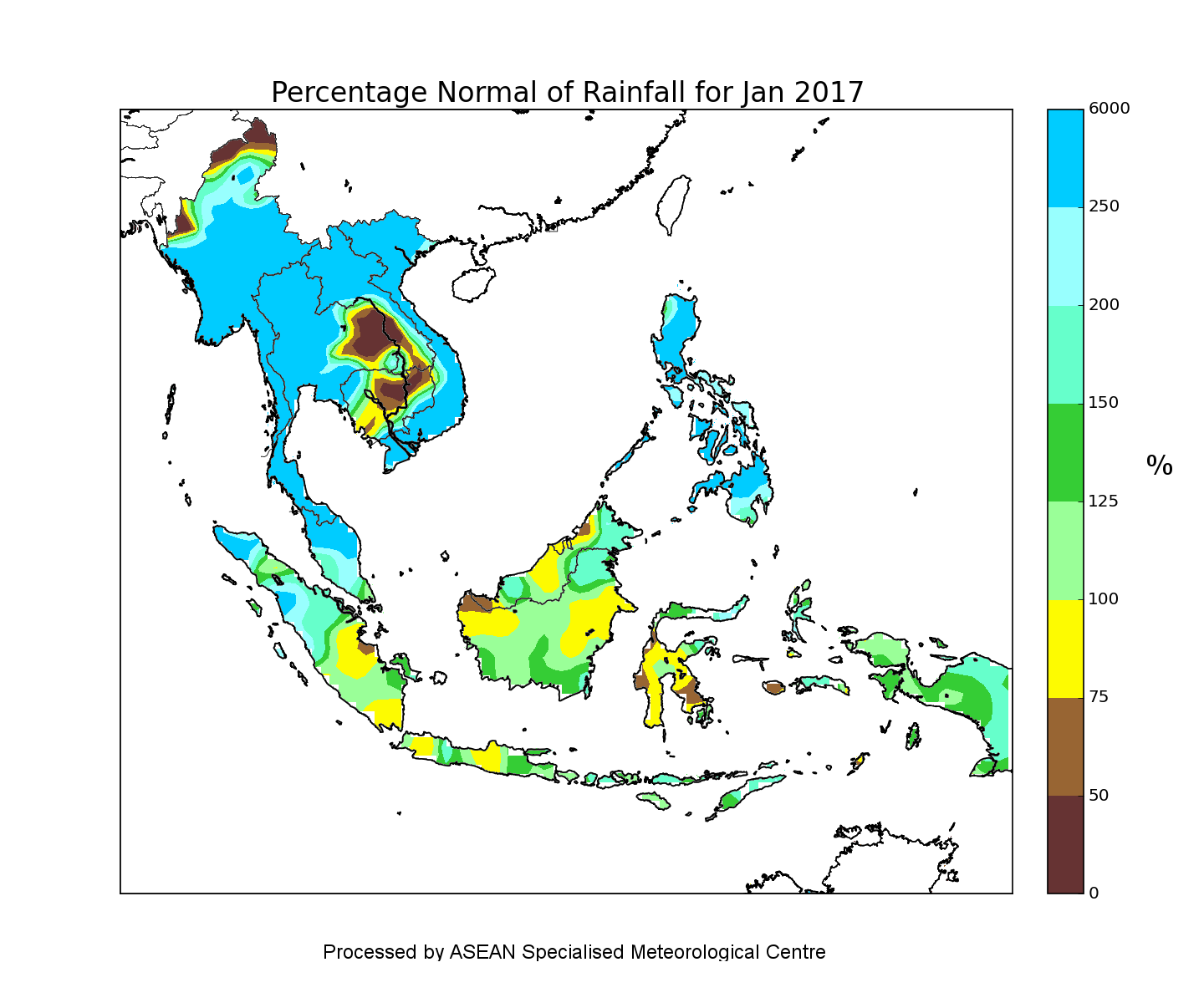
Figure 2: Percentage of Normal Rainfall for January 2017. The rainfall data may be less representative for areas with low density of rainfall network.

1.2    In January 2017, rainfall was above-normal over most parts of the northern ASEAN region except in Cambodia and the eastern parts of Thailand where rainfall was below-normal. In the southern ASEAN region, rainfall was near-normal to above-normal. The percentage normal of rainfall for January 2017 is shown in Figure 2.

1.3    The rainfall in January 2017 was distributed mainly across the equatorial region. Heavy rains affected parts of southern Thailand, Malaysia, southern Philippines and the surrounding region of Java Sea. In southern Philippines, a slow moving low-pressure system over the Mindanao and Visayas areas brought heavy rainfall to these areas. In addition, several monsoon surges, characteristic of the Northeast Monsoon season affected the region. Monsoon surges refer to the strengthening of winds over the South China Sea due to the intensification of high pressure system over northern China. In the first week of January, a monsoon surge brought heavy rains and caused widespread flooding in southern Thailand that affected over 12 provinces. Between 20 and 24 January, a second monsoon surge brought heavy rain showers that affected the near-equatorial region including the east coast of Peninsular Malaysia, Singapore and parts of central Sumatra.

1.4    In January 2017, northeasterly winds prevailed in the northern ASEAN region while northwesterly and westerly winds blew predominantly in the southern ASEAN region. The average and anomalous winds at 5000 feet are shown in Figure 3. Between the Equator and 10oS, there were large-scale westerly anomaly winds over an area extending from the Indian Ocean to the Java Sea. In addition, the presence of two distinct cyclonic circulations due to the formation of low pressure systems in the Andaman Sea and in southern Philippines brought well-above normal rainfall to the region.

figure3a

figure3b

Figure 3: 5000 ft average winds streamlines (left) and anomaly (right) for January 2017.

1.5    For the month, the equatorial Pacific Ocean’s sea surface temperature (SST) over the Niño 3.4 region was within neutral ENSO threshold values, and the atmospheric indicators such as the trade winds and cloudiness over the equatorial Pacific, indicated either weakening La-Niña or neutral conditions.

1.6    In the first half January 2017, the Madden Julian Oscillation (MJO) was weak or indiscernible and did not contribute significantly to the weather in the region. The MJO however, emerged from Phase 1 and progressed through Phase 2 to Phase 3 in the latter half of January. The passage of MJO through Phase 2 and 3 was likely to have enhanced the impact of monsoon surge which brought heavy rainfall over southern Thailand and east coast of Peninsular Malaysia between 20 and 24 January.

figure4

Figure 4: The MJO phase diagram for January 2017. The MJO phase diagram illustrates the movement of the MJO through different phases, which correspond to different locations along the equator. The distance of the index from the centre of the diagram is correlated with the strength of MJO. When the index falls within the circle, the MJO is considered weak or no signal exhibited. (Source: Bureau of Meteorology)

2.   Review of Land/Forest Fires and Smoke Haze Situation

2.1    In the Mekong sub region, hotspot activities were relatively low in the first half of January 2017. A few contributing factors could be due to the presence of cloud cover, obscuring detection by satellites, and occurrence of showers activities over parts of the northern ASEAN region which could have helped to subdue hotspot activities in parts of the northern ASEAN region. In the second half of January, dry weather conditions in the region brought a significant increase in the number of hotspots, in particular over Thailand and Cambodia. Clusters of scattered hotspots persisted in parts of central Thailand and the northern half of Cambodia. In addition, localised smoke plumes were seen to emanate from some of the hotspots detected.

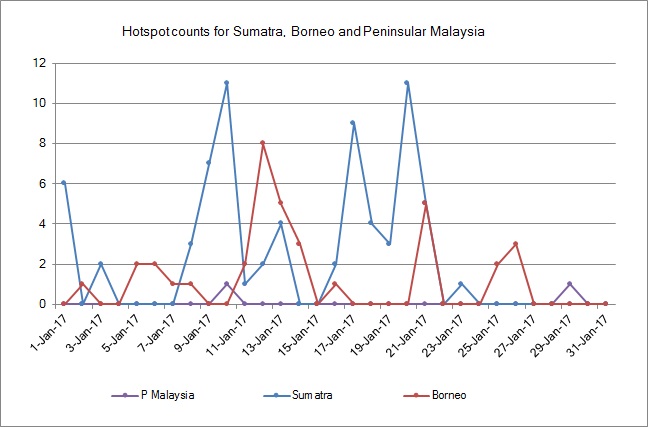
2.2    In the southern ASEAN region, most of the hotspots were detected in central Sumatra where brief periods of dry weather conditions were experienced in the first half of January 2017. Overall, the hotspot activities in the regioin remained largely subdued due to the prevailing shower activities.2.3    Satellite images depicting some of the hotspot activities over parts of the ASEAN region during January 2017 are shown in Figure 5 – Figure 9.

figure5

Fig. 5: NOAA-19 satellite image on 9 January 2017 shows hotspot activities over the Mekong sub-region were relatively inactive in the first half of January due to shower activities.

figure6

Fig. 6: NOAA-19 satellite image on 10 January 2017 shows isolated hotspots emerged over parts of central Sumatra during brief period of dry weather.


figure7

Figure 7: NOAA-19 satellite image on 20 January 2017 shows isolated hotspots began to emerge in Myanmar.

figure8

Figure 8: NOAA-19 satellite image on 28 January 2017 shows a cluster of scattered hotspots detected over northern Cambodia. Localised smoke plumes were observed to emanate from some of the hotspots.

figure9

Figure 9: NOAA-19 satellite image on 30 January 2017 shows hotspot activities subdued over Kalimantan due to shower activities.

2.4    The hotspot distribution charts and daily hotspot charts for January 2017 are shown in Figure 10, Figure 11 and Figure 12 respectively.

2.5    In January 2017, there were several clusters of scattered hotspots detected in the northern ASEAN region (as shown in Figure 10). Most notably, a cluster of high density hotspots was detected in the northern half of Cambodia including the provinces of Preah Vihear, Kampong Thom, Kratie and Mondulkiri. Scattered hotspots were also detected in Myanmar, central Thailand and Lao PDR. In the southern ASEAN region, the overall number of hotspots detected remained low. Isolated hotspots were detected mainly in Sumatra, West Kalimantan and Sarawak.

figure10

Figure 10: Figure 10: NOAA-19 hotspots distribution in January 2017.

figure11

Figure 11: Hotspot Counts in Cambodia, Lao PDR, Thailand, Vietnam and Myanmar in January 2017.

figure12

Figure 12: Hotspot Counts in Sumatra, Borneo and Peninsular Malaysia in January 2017.


3.   Status of El Niño/La Niña and Indian Ocean Dipole

3.1    Climate models from major climate centres project neutral ENSO conditions in the coming season until May 2017, and the weak cool anomalies over the Niño 3.4 region to gradually weaken by April 2017.

3.2    Typically, La Niña brings wetter-than-normal rainfall conditions to most parts of Southeast Asia, and has a less pronounced impact on the weather over the near-equatorial region during the Northeast Monsoon season. Locally-specific impact differs from place to place and for different seasons.

3.3    In January 2017, the Indian Ocean Dipole (IOD) continued to remain at neutral levels, as shown in Figure 13. International climate models forecast the IOD to be neutral and would unlikely have a significant influence on the weather over the region for the next few months. The formation of IOD typically starts around May or June, and peaks between August and October before decaying rapidly between December and April.

figure13

Figure 13: Indian Ocean Dipole (IOD) index time series. The IOD index is at the neutral level for January 2017. (Source: Bureau of Meteorology).

January 12, 2017

Review of Regional Weather and Smoke Haze for Dec 2016

Review of Regional Weather and Smoke Haze for Dec 2016

Print Version

1.   Review of Regional Weather Conditions in December 2016

1.1    Northeast Monsoon conditions prevailed in December 2016. These conditions brought dry weather conditions interspersed with brief periods of showers to most parts of the northern ASEAN region. On the other hand, with the gradual southward migration of the monsoon rain band, the Northeast Monsoon brought wet weather conditions to the southern ASEAN region. The rainfall distribution for December 2016 is shown in Figure 1.

figure1

Figure 1: Daily average rainfall for the ASEAN region in December 2016. (Source: JAXA Global Satellite Mapping of Precipitation).

figure2

Figure 2: Percentage of Normal Rainfall for December 2016. The rainfall data may be less representative for areas with low density of rainfall network.

1.2    For December 2016, above-normal rainfall was recorded in southern Thailand, Vietnam and the Philippines while rainfall was below-normal in Myanmar, central Thailand, parts of Lao PDR and northern Vietnam. In the southern ASEAN region, rainfall was near-normal in most regions except in central Sumatra and western Java, where below-normal rainfall was recorded. The percentage normal of rainfall for December 2016 is shown in Figure 2.

1.3    The rainfall in December 2016 was distributed mainly in the equatorial region between 10N and 15S with several areas affected by heavy rainfall. A few northeast monsoon surges in December 2016 brought heavy rains to southern Thailand, central and southern parts of Vietnam and the east coast of Peninsular Malaysia. In addition, the presence of a low pressure system over the South China Sea in mid-December 2016 brought well above normal rainfall to the central and southern parts of Vietnam.

1.4    Over the Western Pacific Ocean, Typhoon Nock-Ten was first categorised as a tropical storm on 22 December 2016. It intensified further and tracked west-north-westward toward central Philippines before it made landfall on the eastern coast near Catanduanes Island on 25 December 2016. The typhoon then tracked westward and brought heavy rains and strong winds to the regions of Bikon and Calabarzon in central Philippines. ”Nock-Ten” moved over the South China Sea on 26 December and rapidly weakened into a tropical depression the next day.

1.5    In December 2016, the average and anomalous winds at 5000 feet (as in Figure 3), showed that north-easterly winds prevailing in the northern ASEAN region while westerlies prevailed in the southern ASEAN region. In the equatorial region of South China Sea, a cyclonic circulation was observed off the west coast of Sarawak and Sabah. This was due to the formation of Borneo vortices on some days in December, a feature which is typical during the Northeast Monsoon. The anomaly wind chart suggests that the anomalous circulation off the coast of southern Thailand is likely to be the primary cause of the well-above normal rainfall received in that region. The easterly anomaly brought below normal rainfall to most parts of the northern ASEAN region. Large-scale and persistent westerly anomaly winds observed across the equatorial region between 5 N and 10 S inhibited the incursion of the prevailing north-easterly flow across the equatorial region, contributing to the reduction of shower activities over Sumatra and parts of Java.

figure3a

figure3b

Figure 3: 5000 ft average winds streamlines (left) and anomaly (right) for December 2016.

1.6    In December 2016, the equatorial Pacific Ocean’s sea surface temperature (SST) over the Nino 3.4 region was near weak La Niña threshold values. However, the atmospheric variables, such as trade winds and cloudiness over the equatorial Pacific, showed conditions that were more consistent with neutral ENSO conditions.

figure4

Figure 4: The MJO phase diagram for December 2016. The MJO phase diagram illustrates the movement of the MJO through different phases, which correspond to different locations along the equator. The distance of the index from the centre of the diagram is correlated with the strength of MJO. When the index falls within the circle, the MJO is considered weak or no signal exhibited. (Source: Bureau of Meteorology)

1.7    In December 2016, the Madden Julian Oscillation (MJO) was weak or indiscernible and is unlikely to have significantly influenced the weather over the region.

2.   Review of Land/Forest Fires and Smoke Haze Situation

2.1    In December 2016, dry weather conditions interspersed with brief periods of showers prevailed in the Mekong sub-region. This led to a gradual increase of hotspots detected in most parts of the northern ASEAN region. However, the hotspots were mostly short-lived and the smoke haze observed was localised.

2.2    In the southern ASEAN region, hotspot activities were subdued by shower activities, except in central Sumatra where drier than usual weather conditions emerged. Nonetheless, the hotspots did not persist or give rise to the emission of significant smoke haze.2.3    Satellite images depicting some of the hotspot activities over parts of the ASEAN region during December 2016 are shown in Figure 5 – Figure 9.

figure5

Fig. 5: NOAA-19 satellite image on 1 December 2016 shows hotspots subdued as wet weather conditions prevailed over Kalimantan.

figure6

Fig. 6: NOAA-19 satellite image on 9 December 2016 shows isolated hotspots began to emerge in the northern ASEAN region, particularly over eastern Thailand and northern Vietnam.


figure7

Figure 7: NOAA-19 satellite image on 14 December 2016 shows isolated hotspots detected in central Sumatra.

figure8

Figure 8: NOAA-19 satellite image on 18 December 2016 shows isolated hotspots detected in eastern Thailand.

figure9

Figure 9: NOAA-19 satellite image on 23 December 2016 shows isolated hotspots detected in the surrounding region of Yangon, Myanmar.


2.4    The hotspot distribution charts and daily hotspot charts for December 2016 are shown in Figure 10, Figure 11 and Figure 12 respectively.

2.5    Most of the hotspots detected in December 2016 were mainly in the northern ASEAN region, with several clusters found in the coastal region of Myanmar, central Thailand and northern Vietnam (as shown in Figure 10). In the southern ASEAN region, the number of hotspots detected remained low except in central Sumatra where few clusters of hotspots were detected.

figure10

Figure 10: Figure 10: NOAA-19 hotspots distribution in December 2016.

figure11

Figure 11: Hotspot Counts in Cambodia, Lao PDR, Thailand, Vietnam and Myanmar in December 2016.


figure12

Figure 12: Hotspot Counts in Sumatra, Borneo and Peninsular Malaysia in December 2016.


3.   Status of El Niño/La Niña and Indian Ocean Dipole

3.1    Climate models from major climate centres are expecting the borderline La Niña conditions to weaken to neutral conditions in the upcoming season. The neutral conditions are forecast to then persist till mid-2017.

3.2    The region is currently experiencing Northeast Monsoon conditions. The impact of La Niña on the weather over the near-equatorial region is usually less pronounced during the Northeast Monsoon as compared to the Southwest Monsoon (Jun – Sep).

3.3    The Indian Ocean Dipole (IOD) continued to remain at neutral levels, as shown in Figure 13. International climate models indicate that the IOD is expected to remain in neutral condition and is unlikely to have a significant influence on the weather over the region for the next few months. The formation of IOD typically starts around May or June, and peaks between August and October before decaying rapidly between December and April.

figure13

Figure 13: Indian Ocean Dipole (IOD) index time series. The IOD index is at the neutral level for December 2016. (Source: Bureau of Meteorology).

December 9, 2016

Review of Regional Weather and Smoke Haze for Nov 2016

Review of Regional Weather and Smoke Haze for Nov 2016

Print Version

1.   Review of Regional Weather Conditions in November 2016

1.1    Inter monsoon conditions prevailed in the first half of November 2016. During this period, there was a gradual migration of the monsoon rain band from the northern ASEAN region to the near-equatorial region. In the Mekong sub-region, rainfall decreased gradually as the month progressed, and in the second half of the month, dry weather conditions were observed to have set in over the region. In contrast, wet weather conditions prevailed in the southern ASEAN region, particularly over Indonesia.

1.2    Over the Western Pacific Ocean, a tropical depression that developed to the southeast of central Philippines on 23 November 2016 intensified into Tropical Storm Tokage and made landfall over central Philippines on 25 November 2016. “Tokage’s” passage through the Philippines was brief as it northeast and moved over the South China Sea before dissipating over water on 27 November 2016. “Tokage” brought heavy rainfall and strong winds of up to 102km/h to areas along its path.

1.3    The Northeast Monsoon season onset in the ASEAN region in late November 2016. Between 28 and 30 November, the region experienced a monsoon surge episode where cold and strong northeasterly winds from a high pressure system over northern China surged into the South China Sea bringing widespread showers to the surrounding region, including Sarawak and the eastern coastal areas of Peninsular Malaysia.

1.4    For November 2016, above-normal rainfall was received in parts of the Mekong sub-region including Myanmar, north-eastern Thailand, Lao PDR and Vietnam. For the Philippines, near-normal to above-normal rainfall prevailed. Below-normal to near-normal rainfall prevailed over most parts of the southern ASEAN region including southern Thailand, Malaysia, Singapore, Brunei and Indonesia The regional rainfall distribution for November 2016 is shown in Fig. 1A.


Fig. 1A: Percentage of Normal Rainfall for November 2016. The rainfall data may be less representative for areas with low density of rainfall network.


2.   Review of Land/Forest Fires and Smoke Haze Situation

2.1    In November 2016, hotspot activities in both the northern and southern ASEAN region remained largely subdued.

2.2    The Inter monsoon conditions in November 2016 brought an increase of rainfall over the southern ASEAN region, and the showers contributed to keep the hotspot activities over Sumatra and Kalimantan low. In the northern ASEAN region, hotspot activities were generally subdued on most days of the month and as the weather started to become drier, increase in hotspot activities were observed over parts of the Mekong sub-region towards the end of November 2016 with the onset of the Northeast Monsoon. Satellite images depicting some of the hotspot activities over parts of the ASEAN region during November 2016 are shown in Fig. 2AFig. 2E

Fig. 2A: NOAA-19 satellite image on 20 November 2016 shows isolated hotspot activities in the eastern part of Myanmar.

Fig. 2B: NOAA-19 satellite image on 21 November 2016 shows isolated hotspots over northern Vietnam.


Figure 2C: NOAA-19 satellite image on 24 November 2016 shows wet conditions over Kalimantan.

Fig. 2D: NOAA-19 satellite image on 29 November 2016 shows cloudy conditions over Sumatra and widespread showers over northern Peninsular Malaysia due to the presence of a northeast monsoon surge.

Fig. 2E: NOAA-19 satellite image on 29 November 2016 shows isolated hotspots detected over central Thailand and showers over southern part of Thailand due to a northeast monsoon surge.


2.3    The hotspot charts for November 2016 for

  1. Cambodia, Myanmar, Thailand, Lao PDR and Vietnam;
  2. Sumatra, Borneo and Peninsular Malaysia;

are shown in Figs. 2F to 2G respectively


Fig. 2F: Hotspot Counts in Cambodia, Lao PDR, Thailand, Vietnam, Myanmar for November 2016.


Fig 2G: Hotspot Counts in Sumatra, Borneo and Peninsular Malaysia for November 2016.


3.   Status of El Niño/La Niña

3.1    In November 2016, the equatorial Pacific Ocean’s sea-surface temperature (SST) continued to gradually cool over the Niño3.4 region and was at borderline La Niña threshold values. Atmospheric variables, such as trade winds and cloudiness, over the equatorial Pacific have been consistent with borderline La Niña conditions.3.2    Expert assessments of international climate models do not favour La Niña conditions significantly over neutral conditions in the coming December-January-February season.

3.3    The region is currently experiencing Northeast Monsoon conditions. The impact of La Niña on the weather over the near-equatorial region is usually less pronounced during the Northeast Monsoon as compared to the Southwest Monsoon (Jun – Sep).

November 11, 2016

Review of Regional Weather and Smoke Haze for Oct 2016

Review of Regional Weather and Smoke Haze for Oct 2016

Print Version

1.   Review of Regional Weather Conditions in October 2016

1.1    Southwest Monsoon conditions prevailed on most days in October 2016 and the winds were blowing mostly from the west over most of the ASEAN region. In October 2016, there was a gradual increase of shower activities over the southern ASEAN region, and wetter than usual weather conditions were experienced in Java due to the warmer than usual sea surface temperatures over the eastern Indian Ocean. In contrast, the northern ASEAN region experienced less rainfall with dry weather conditions beginning to set in over parts of the region.

1.2    On 16 October, Typhoon Sarika made landfall and brought strong winds and heavy rains over central Luzon, the Philippines before tracking west-northwestward toward Hainan Island. This was followed by the passage of Super Typhoon Haima, which struck the northern tip of Luzon, the Philippines on 19 October 2016. Super Typhoon Haima moved to the northwest over the South China Sea and continued to steer toward southern China. The influence of both typhoons brought moderate to heavy rainfall parts of Indonesia, Peninsular Malaysia, Singapore, and Borneo Island as well.

1.3    Towards the end of October 2016, the region gradually transitioned from Southwest Monsoon conditions to Inter-Monsoon conditions. For October 2016, the Philippines and most parts of the Mekong sub-region received near-normal to above-normal rainfall. In the southern ASEAN region, near-normal rainfall prevailed over most parts of the near-equatorial region. Above-normal rainfall continued to prevail over Kalimantan, Java and the eastern parts of Indonesia Archipelago. The regional rainfall distribution for October 2016 is shown in Fig. 1A.


Fig. 1A: Percentage of Normal Rainfall for October 2016. The rainfall data may be less representative for areas with low density of rainfall network.


2.   Review of Land/Forest Fires and Smoke Haze Situation

2.1    In October 2016, hotspot activities in both the northern and southern ASEAN region were largely subdued due to the prevailing wet weather conditions.

2.2    In early and mid-October 2016, there were brief periods of dry weather conditions over Sumatra and Kalimantan respectively. There was an increase in the number of hotspots, particularly in the western parts of central Sumatra and central Kalimantan. While smoke plumes were observed to emanate from some of the hotspots, the hotspot activities were localised and short-lived. The return of shower activities at the end of the brief dry periods helped to suppress the hotspot activities in Sumatra and Kalimantan. Satellite images depicting some of the hotspot activities over parts of the ASEAN region during October 2016 are shown in Fig. 2AFig. 2E

Fig. 2A: NOAA-19 satellite image on 4 October shows isolated hotspot activities in western parts of central Sumatra.

Fig. 2B: NOAA-19 satellite image on 19 October 2016 shows an increase of hotspot activities in central Kalimantan following a brief period of dry weather conditions.


Figure 2C: NOAA-19 satellite image on 20 October 2016 shows returning shower activities over Kalimantan after a brief period of dry weather conditions.

Fig. 2D: NOAA-19 satellite image on 26 October 2016 shows isolated shower activities in parts of the Mekong sub-region.

Fig. 2E: NOAA-19 satellite image on 29 October 2016 shows widespread shower activities over Peninsular Malaysia and Sumatra.


2.3    The hotspot charts for October 2016 for

  1. Cambodia, Myanmar, Thailand, Lao PDR and Vietnam;
  2. Sumatra, Borneo and Peninsular Malaysia;

are shown in Figs. 2F to 2G respectively


Fig. 2F: Hotspot Counts in Cambodia, Lao PDR, Thailand, Vietnam, Myanmar for October 2016.


Fig 2G: Hotspot Counts in Sumatra, Borneo and Peninsular Malaysia for October 2016.


3.   Status of El Niño/La Niña

3.1    In October 2016, the equatorial Pacific Ocean’s sea-surface temperature (SST) anomaly over the Nino3.4 region was cooler than average, at borderline La Niña threshold values. Atmospheric variables, such as trade winds and cloudiness, over the equatorial Pacific were mostly at levels indicative of weak La Niña conditions.3.2    Expert assessments of international climate models have maintained a 60% chance of weak or borderline La Niña developing in the November – January season.

3.3    The region is currently experiencing Inter-Monsoon conditions (Oct – Nov), and a transition into the Northeast Monsoon conditions (Dec – Mar) is expected in the latter part of November 2016. The impact of La Niña on the weather over the near-equatorial region is usually less pronounced during the Northeast Monsoon as compared to the Southwest Monsoon (Jun – Sep).

October 12, 2016

Review of Regional Weather and Smoke Haze for Sep 2016

Review of Regional Weather and Smoke Haze for Sep 2016

Print Version

1.   Review of Regional Weather Conditions in September 2016

1.1    Southwest Monsoon conditions continued to prevail in September 2016, and the prevailing winds in the region blew mainly from the southwest or west. The monsoon rain belt was north of the Equator between latitudes 5 N and 15 N on most days in September 2016.

1.2    During the review period, showers affected most parts of the northern ASEAN region. On 12 September 2016, Tropical Depression “Rai”, which developed over the South China Sea, east-northeast of Ho Chi Minh City, made landfall in central Vietnam. “Rai” brought heavy rainfall to the Mekong sub-region, in particular over Vietnam and northern Thailand, causing the rivers to break its banks which led to severe flooding and loss of 12 lives. Over the southern ASEAN region, it was generally wet with occasional brief periods of dry weather conditions. This wetter than normal conditions is atypical of the traditional dry season of the southern ASEAN region in September 2016.

1.3    For September 2016, most parts of the northern ASEAN region except Cambodia and southern Vietnam recorded near-normal to above-normal rainfall. In the southern ASEAN region, near-normal rainfall was recorded in Malaysia, Brunei Darussalam and most parts of Sumatra. Above-normal rainfall prevailed over large areas of the Indonesian Archipelago, including southern Sumatra, Kalimantan and Java. The regional rainfall distribution for September 2016 is shown in Fig. 1A.


Fig. 1A: Percentage of Normal Rainfall for September 2016. The rainfall data may be less representative for areas with low density of rainfall network.


2.   Review of Land/Forest Fires and Smoke Haze Situation

2.1    In September 2016, shower activities in the northern ASEAN region continued to subdue the hotspot activities there. For the southern ASEAN region, hotspot activities in the near-equatorial region were mostly subdued due to the higher than usual shower activities in the region.

2.2    In mid-September 2016, the influence of Super Typhoon Meranti over the western Pacific Ocean brought drier weather conditions over parts of Kalimantan. This led to an escalation of hotspot activities in West Kalimantan where more than 100 hotspots were detected between 12 and 14 September 2016. Visible smoke plumes and haze were observed mainly in West Kalimantan over the two days. The dry weather conditions were short-lived and an improvement in the hotspot and haze situation was experienced in the subsequent days as shower activities returned to Kalimantan.

2.3    In the last week of September 2016, the brief periods of dry weather conditions in parts of Sumatra brought an increase in hotspot activities but there were no significant smoke plumes or haze observed in the vicinity of the hotspots. Hotspot activities over parts of the ASEAN region during September 2016 are shown in Fig. 2AFig. 2E

Fig. 2A: NOAA-19 satellite image on 9 September 2016 shows hotspot activities in central Sumatra subdued by occurrence of shower. Isolated hotspots were detected in South Sumatra.

Fig. 2B: NOAA-19 satellite image on 13 September 2016 shows the presence of Tropical Depression Rai over northern Vietnam and the eastern part of Thailand and Lao PDR. Widespread showers affected most parts of the Mekong sub-region.


Figure 2C: NOAA-19 satellite image on 14 September 2016 shows widespread hotspot activities in West Kalimantan. Few clusters of hotspots with localised smoke plumes and haze were observed.

Fig. 2D: NOAA-19 satellite image on 15 September 2016 shows an increase in shower activities over Kalimantan which helped to subdue hotspot activities that had been persisting for the past few days.

Fig. 2E: NOAA-19 satellite image on 26 September 2016 shows hotspots in Sumatra, mostly in North Sumatra.


2.3    The hotspot charts for September 2016 for

  1. Cambodia, Myanmar, Thailand, Lao PDR and Vietnam;
  2. Sumatra, Borneo and Peninsular Malaysia;

are shown in Figs. 2F to 2G respectively


Fig. 2F: Hotspot Counts in Cambodia, Lao PDR, Thailand, Vietnam, Myanmar for September 2016.


Fig 2G: Hotspot Counts in Sumatra, Borneo and Peninsular Malaysia for September 2016.<


3.   Status of El Niño/La Niña

3.1    In September 2016, the equatorial Pacific Ocean sea surface temperature (SST) anomaly was near the La Niña threshold. However, the atmospheric variables (cloud and wind patterns) have yet to support weak La Niña conditions. There remains limited interaction between the atmospheric and oceanic conditions.

3.2    Experts’ assessment of international climate models suggests that there is about 60% chance of La Niña conditions developing in the October – December season and it is likely to be only weak or borderline.

3.3    The ASEAN region is currently in the Southwest Monsoon season (June-September/early October), where the La-Niña is known to have considerable impact (wetness) on the western part of the Maritime Continent.

September 14, 2016

Review of Regional Weather and Smoke Haze for Aug 2016

Review of Regional Weather and Smoke Haze for Aug 2016

Print Version

1.   Review of Regional Weather Conditions in August 2016

1.1    Southwest Monsoon conditions continued to prevail in August 2016, with prevailing winds in the region blowing from the southeast or southwest. In early-August, Tropical Storm Nida made landfall over parts of Cagayan province, Philippines bringing scattered showers there before steering westward toward Guangdong province, China.

1.2    During the first half of August 2016, the monsoon rain belt persisted in the northern ASEAN region and brought widespread showers particularly over coastal areas of Myanmar and north-western parts of Philippines. Drier weather conditions were experienced across most parts of the southern ASEAN region.

1.3    In the second half of August, with the southward migration of the monsoon rain belt towards the equatorial region, there was an increase in rainfall observed over most parts of the southern ASEAN region.

1.4    For August 2016, near-normal to above-normal rainfall was received in the Mekong sub-region. In the Philippines, near-normal to above-normal rainfall prevailed in the northern and southern parts, while the central parts received below-normal rainfall. In the southern ASEAN region, near-normal rainfall was received in most parts of the near-equatorial region, except in central Sumatra and West Kalimantan where below-normal rainfall prevailed. Southern Sumatra and Java received above-normal rainfall. The regional rainfall distribution for August 2016 is shown in Figure Fig. 1A.


Fig. 1A: Percentage of Normal Rainfall for August 2016. The rainfall data may be less representative for areas with low density of rainfall network.


2.   Review of Land/Forest Fires and Smoke Haze Situation

2.1    In August 2016, shower activities persisted on most days over the northern ASEAN region. This helped to subdue hotspot activities there.

2.2    Drier weather conditions in first half of August led to an escalation of hotspot activities over central Sumatra and West Kalimantan. Hotspots detected in central Sumatra were mostly localised, and slight hazy conditions were observed to have spread to the Strait of Malacca on a few days. In Kalimantan, widespread hotspot activities in excess of 100 hotspots with smoke haze were observed on a few days, particularly over West Kalimantan in mid-August 2016.

2.3    In the second half of August, an increase in shower activities over Kalimantan helped to ease the fire situation there. Showers fell over most parts of Sumatra, except in central Sumatra, where dry weather conditions with isolated hotspot activities were observed. The haze situation in Riau, central Sumatra deteriorated rapidly between 25 and 26 August 2016 and persisted until 29 August 2016 under dry weather and strong winds conditions. Moderate to dense smoke haze from the fires in Riau were blown by the southwesterly to westerly winds over the Strait of Malacca to central Peninsular Malaysia and Singapore, where the air quality deteriorated to Unhealthy levels.

2.4    The haze situation improved by 29 August 2016 with the return of shower activities over central Sumatra for the next few days. Hotspot activities over parts of the ASEAN region during August 2016 are shown in Figures 2A – 2E.

Fig. 2A: NOAA-19 satellite image on 1 July 2016 shows isolated hotspots detected in northern and central Sumatra.

Fig. 2B: NOAA-19 satellite image on 4 July 2016 shows showers over parts of the northern ASEAN region.


Figure 2C: NOAA-19 satellite image on 11 July 2016 shows few hotspots in central part of Peninsular Malaysia.

Fig. 2D: NOAA-19 satellite image on 14 July 2016 shows isolated hotspots detected in West Kalimantan during a brief period of dry weather conditions.

Fig. 2E: NOAA-19 satellite image on 20 July 2016 shows hotspot activities subdued as showers returned to the near-equatorial region in the second half of July 2016.


2.3The hotspot charts for August 2016 for

  1. Cambodia, Myanmar, Thailand, Lao PDR and Vietnam;
  2. Sumatra, Borneo and Peninsular Malaysia;

are shown in Figs. 2F to 2G respectively


Fig. 2F: Hotspot Counts in Cambodia, Lao PDR, Thailand, Vietnam, Myanmar for July 2016.


Fig 2G: Hotspot Counts in Sumatra, Borneo and Peninsular Malaysia for July 2016.


3.   Status of El Niño/La Niña

3.1    In August 2016, a weak cool sea surface temperature (SST) anomaly near La Niña thresholds was observed in the equatorial Pacific Ocean. However, key atmospheric variables (cloud and wind patterns) over the equatorial Pacific have yet to respond to the cooling of the SSTs.3.2    Neutral conditions are expected prevail in the equatorial Pacific in September 2016. Experts’ assessment of international climate models suggests that there is a 60% chance of weak La Niña conditions developing in the October – December season.

3.3    The ASEAN region is currently in the Southwest Monsoon season (June-September/early October), where the La-Niña is known to have considerable impact (wetness) on the western part of the Maritime Continent.

August 18, 2016

Review of Regional Weather and Smoke Haze for Jul 2016

Review of Regional Weather and Smoke Haze for Jul 2016

Print Version

1.   Review of Regional Weather Conditions in July 2016

1.1    Southwest Monsoon conditions prevailed in July 2016, and the low level winds in the region blew predominantly from the southeast or southwest. The monsoon rain belt was over the northern ASEAN region in particular in the first half of July 2016 which brought increased shower activities to the northern ASEAN region. In the southern ASEAN region during this period, dry weather conditions were experienced. In the second half of July 2016, with the southward migration of the monsoon rain belt to the near-equator region, several parts of the southern ASEAN region including Indonesia, Malaysia and Singapore experienced wet weather conditions.

1.2    Typhoon Nerpatak, the first typhoon in 2016 over the Western Pacific region, was categorised as a tropical depression on 2 July 2016, east of the Philippines. It intensified into a super typhoon on 6 July 2016 as it tracked north-west towards Taiwan. While Typhoon Nerpatak did not make landfall in the ASEAN region, its rainbands brought widespread showers and strong winds to the northern parts of ASEAN region.

1.3    For July 2016, near-normal to above-normal rainfall was received in most parts of the northern ASEAN region. For the southern ASEAN region, the southern and eastern parts of the Indonesia Archipelago received well above-normal rainfall while areas including Malaysia, Sumatra and Kalimantan received near-normal to above-normal rainfall. The regional rainfall distribution for July 2016 is shown in Figure Fig. 1A.


Fig. 1A: Percentage of Normal Rainfall for July 2016. The rainfall data may be less representative for areas with low density of rainfall network.


2.   Review of Land/Forest Fires and Smoke Haze Situation

2.1    In July 2016, it rained on most days for both the northern and southern ASEAN regions. In early July 2016, a brief period of dry weather conditions in parts of the southern ASEAN region led to an increase in hotspot activities over Sumatra. Smoke plumes were observed to emanate from some of the hotspots detected. Nonetheless, the hotspots were mostly short-lived and were mainly due to localised burning activities.

2.2    An increase in shower activities in the latter half of July 2016 brought a reduction to the number of hotspots detected over Sumatra and Kalimantan. There was no occurrence of transboundary smoke haze in July 2016. Some of the hotspot activities in the ASEAN region during July 2016 are shown in Figures 2A – 2E.

Fig. 2A: NOAA-19 satellite image on 1 July 2016 shows isolated hotspots detected in northern and central Sumatra.

Fig. 2B: NOAA-19 satellite image on 4 July 2016 shows showers over parts of the northern ASEAN region.


Figure 2C: NOAA-19 satellite image on 11 July 2016 shows few hotspots in central part of Peninsular Malaysia.

Fig. 2D: NOAA-19 satellite image on 14 July 2016 shows isolated hotspots detected in West Kalimantan during a brief period of dry weather conditions.

Fig. 2E: NOAA-19 satellite image on 20 July 2016 shows hotspot activities subdued as showers returned to the near-equatorial region in the second half of July 2016.


2.3    The hotspot charts for July 2016 for

  1. Cambodia, Myanmar, Thailand, Lao PDR and Vietnam;
  2. Sumatra, Borneo and Peninsular Malaysia;

are shown in Figs. 2F to 2G respectively


Fig. 2F: Hotspot Counts in Cambodia, Lao PDR, Thailand, Vietnam, Myanmar for July 2016.


Fig 2G: Hotspot Counts in Sumatra, Borneo and Peninsular Malaysia for July 2016.


3.   Status of El Niño/La Niña

3.1    In July 2016, the sea surface temperature (SST) anomaly in the equatorial Pacific Ocean was in Neutral conditions, i.e. neither El Niño nor La Niña. Key atmospheric variables (cloud and wind patterns) over the equatorial Pacific had also indicated Neutral conditions.3.2    While Neutral conditions currently prevail in the equatorial Pacific, latest assessment of international climate models from major climate centres suggest a moderate 60% chance of La Niña conditions developing during the October-December season.

3.3    The ASEAN region is currently in the Southwest Monsoon season (June-September/early October), where the La-Niña is known to have considerable impact (wetness) on the western part of the Maritime Continent.

July 14, 2016

Review of Regional Weather and Smoke Haze for Jun 2016

Review of Regional Weather and Smoke Haze for Jun 2016

Print Version

1.   Review of Regional Weather Conditions in June 2016

1.1    The Southwest Monsoon season onset in June 2016 with prevailing winds over the region blowing mostly from the southeast or southwest. Showers affected most parts of the southern ASEAN region, particularly over Java and its surrounding areas.

1.2    While shower activities affected many parts of the ASEAN region in the first three weeks of June 2016, dry weather conditions were experienced, in particular over the southern ASEAN region in the last week of June 2016.

1.3    For June 2016, most parts of the northern ASEAN region except Cambodia and Lao PDR received near-normal to above-normal rainfall. In the southern ASEAN region, above-normal rainfall was received over Peninsular Malaysia, Kalimantan and Java. The regional rainfall distribution for June 2016 is shown in Figure Fig. 1A.


Fig. 1A: Percentage of Normal Rainfall for June 2016


2.   Review of Land/Forest Fires and Smoke Haze Situation

2.1    In June 2016, hotspot activities remained largely subdued in both northern and southern ASEAN regions due to persistent wet weather conditions. In the last week of June 2016, the dry weather conditions experienced in the region contributed to a slight increase in hotspot activities in Sumatra. There was no occurrence of transboundary smoke haze in June 2016. Satellite images in Figure 2A – 2E show shower activities over various parts of the ASEAN region in June 2016.

Fig. 2A: NOAA-19 satellite image on 14 June 2016 shows shower activities over central and southern parts of Peninsular Malaysia.

Fig. 2B: NOAA-19 satellite image on 15 June 2016 shows shower activities over parts of the northern ASEAN region.


Figure 2C: NOAA-19 satellite image on 18 June 2016 shows shower activities over Sarawak and parts of Kalimantan.

Fig. 2D: NOAA-19 satellite image on 22 June 2016 shows shower activities over the southern parts of Sumatra.

Fig. 2E: NOAA-19 satellite image on 30 June 2016 shows isolated hotspots in central Sumatra.


2.3    The hotspot charts for June 2016 for

  1. Cambodia, Myanmar, Thailand, Lao PDR and Vietnam;
  2. Sumatra, Borneo and Peninsular Malaysia;

are shown in Figs. 2F to 2G respectively


Fig. 2F: Hotspot Counts in Cambodia, Lao PDR, Thailand, Vietnam, Myanmar for June 2016.


Fig 2G: Hotspot Counts in Sumatra, Borneo and Peninsular Malaysia for June 2016.


3.   Status of El Niño/La Niña

3.1    In June 2016, Niño3.4 sea-surface temperature (SST) readings were near zero, indicating Neutral (neither El Niño nor La Niña) conditions. Other atmospheric variables such as cloudiness and rainfall patterns in the central and eastern equatorial Pacific also indicate Neutral conditions.

3.2    Most international climate models and expert assessments project the Neutral condition to persist, with increasing possibility of La Niña conditions in the second-half of 2016. However, the possibility of Neutral conditions to persist for the rest of year 2016 cannot be ruled out.

3.3    The ASEAN region is currently in the Southwest Monsoon season (June-September/early October), where the La-Niña is known to have considerable impact (wetness) on the western part of the Maritime Continent.