Review of Regional Weather Conditions for First Fortnight of July 2019
1. Review of Regional Weather Conditions for First Fortnight of July 2019
1.1 In the first fortnight of July 2019, moderate to strong southwesterly or westerly winds prevailed over the northern ASEAN region. In particular, anomalously strong southwesterly winds were observed to the east of Viet Nam during the first half of the fortnight under the influence of Tropical Storm Mun (Figure 2). In the southern ASEAN region, the prevailing winds blew mainly from the southeast or southwest, with wind anomalies observed west of Sumatra. Figure 1 shows the average and anomalous winds at 5000 feet.


Figure 1: 5000 ft average winds (left) and anomalies (right) for 1 – 15 July 2019. (Source: JMA)

Figure 2: Track for Tropical Storm Mun (2-4 Jul 2019).
1.2 Southwest Monsoon conditions prevailed in the first half of July 2019. Much of the northern ASEAN region received above-average rainfall except for northern Philippines and Thailand. In the southern ASEAN region, below-average rainfall was observed over many areas (Figures 3 and 4).

Figure 3: Daily average rainfall for the ASEAN region in the first fortnight of July 2019. (Source: JAXA Global Satellite Mapping of Precipitation)

Figure 4: Percent of average rainfall for 1 – 15 July 2019. The rainfall data may be less representative for areas with a less dense rainfall network. (Source: IRI NOAA/NCEP CPC Unified Precipitation Analyses)
1.3 Throughout the first fortnight of July 2019, the Madden-Julian Oscillation (MJO) was in the Western Hemisphere and Africa, and it did not significantly influence the weather over the ASEAN region (Figure 5).

Figure 5: The MJO phase diagram for Jul 2019 (blue). The diagram illustrates the movement of the MJO through different phases, which correspond to different locations along the equator. The distance of the index from the centre of the diagram is correlated with the strength of MJO. When the index falls within the circle, the MJO is considered weak or indiscernible. (Source: Bureau of Meteorology)
1.4 The state of the El Niño-Southern Oscillation (ENSO) is currently neutral (neither El Niño nor La Niña). While the sea-surface temperature (SST) anomalies were slightly above average across the tropical Pacific Ocean Nino 3.4 region, other atmospheric indicators continued to show neutral conditions.
July 8, 2019
Review of Regional Weather Conditions for Second Fortnight of June 2019
Review of Regional Weather Conditions for Second Fortnight of June 2019
1. Review of Regional Weather Conditions for Second Fortnight of June 2019
1.1 In the second fortnight of June 2019, moderate to strong southwesterly or westerly winds prevailed over the northern ASEAN region. In the southern ASEAN region, winds continued to blow from the southeast or southwest. No significant wind anomalies were observed during this period.


Figure 1: 5000 ft average winds (left) and anomalies (right) for 16 – 30 June 2019. (Source: JMA)
1.2 In the second half of June 2019, the monsoon rain band brought widespread showers over parts of the northern ASEAN region, in particular over the coastal regions. In the southern ASEAN region, most of the rain/showers fell over the equatorial region including Malaysia, Sumatra and Kalimantan. Over Java and the southern parts of Sumatra and Kalimantan, dry weather prevailed and rainfall was below-average.

Figure 2: Daily average rainfall for the ASEAN region in the second fortnight of June 2019. (Source: JAXA Global Satellite Mapping of Precipitation)

Figure 3: Percent of average rainfall for 16 – 30 June 2019. The rainfall data may be less representative for areas with a less dense rainfall network. (Source: IRI NOAA/NCEP CPC Unified Precipitation Analyses)
1.3 In the early half of the fortnight, the Madden-Julian Oscillation (MJO) was in the Maritime Continent but weakened in the later part of the fortnight. There were no clear MJO signals during the period as shown in Figure 4.
1.4 The El-Nino Southern Oscillation (ENSO) is currently in the neutral state. Sea-surface temperature (SST) anomalies remained slightly warmer than average in the central eastern Pacific.

Figure 4: The MJO phase diagram for June 2019 (green). The diagram illustrates the movement of the MJO through different phases, which correspond to different locations along the equator. The distance of the index from the centre of the diagram is correlated with the strength of MJO. When the index falls within the circle, the MJO is generally considered weak or indiscernible. (Source: Bureau of Meteorology)
June 28, 2019
Review of Regional Weather Conditions for First Fortnight of June 2019
Review of Regional Weather Conditions for First Fortnight of June 2019
1. Review of Regional Weather Conditions for First Fortnight of June 2019
1.1 In the first fortnight of June 2019, strong southwesterly winds prevailed over the northern parts of Lao PDR and Viet Nam while anomalous easterly winds or southeasterly winds were observed elsewhere in the northern ASEAN region. In the southern ASEAN region, southeasterly winds prevailed (Figure 1).


Figure 1: 5000 ft average winds (left) and anomalies (right) for 1 – 15 June 2019. (Source: JMA)
1.2 There were isolated showers over many parts of the northern ASEAN region, while scattered showers fell over coastal Myanmar. Above-average rainfall was received in northern and southern Viet Nam, eastern half of Cambodia, and parts of northern Lao PDR. Below-average to near-average rainfall was received elsewhere in the northern ASEAN region. In the southern ASEAN region, above-average rainfall was received near the equator, in particular over Malaysia, Sulawesi, central Sumatra, and most parts of Kalimantan. Below-average rainfall was recorded mainly around Java and the Timor Sea regions.

Figure 2: Daily average rainfall for the ASEAN region in the first fortnight of June 2019. (Source: JAXA Global Satellite Mapping of Precipitation)

Figure 3: Percent of average rainfall for 1 – 15 June 2019. The rainfall data may be less representative for areas with a less dense rainfall network. (Source: IRI NOAA/NCEP CPC Unified Precipitation Analyses)
1.3 During the first week of June 2019, the Madden-Julian Oscillation (MJO) propagated through Phases 2 and 3. The MJO signal weakened briefly before strengthening again and propagating through Phase 4. The MJO signal in these phases typically bring wetter conditions over the equatorial parts of the ASEAN region, and its influence in early June 2019 may have been a contributing factor to the wetter-than-usual conditions experienced in the equatorial southern ASEAN region.
1.4 The sea-surface temperatures (SST) were warmer than average over the Nino3.4 region during the first fortnight of June 2019. However, trade winds were close to normal over the equatorial Pacific Ocean. Neither El Nino nor La Nina conditions prevailed during the period.

Figure 4: The MJO phase diagram for June 2019 (blue). The diagram illustrates the movement of the MJO through different phases, which correspond to different locations along the equator. The distance of the index from the centre of the diagram is correlated with the strength of MJO. When the index falls within the circle, the MJO is generally considered weak or indiscernible. (Source: Bureau of Meteorology)
June 12, 2019
Review of Regional Weather Conditions for Second Fortnight of May 2019
Review of Regional Weather Conditions for Second Fortnight of May 2019
1. Review of Regional Weather Conditions for Second Fortnight of May 2019
1.1 In the second fortnight of May 2019, prevailing winds were mostly from the southwest or west over the northern ASEAN region. In the southern ASEAN region, winds were generally weak and variable in direction over the equatorial region, but moderate to strong south-easterly winds prevailed over the Java Sea and Banda Sea areas.


Figure 1: 5000 ft average winds (left) and anomalies (right) for 16 – 31 May 2019. (Source: JMA)
1.2 In the second half of May 2019, there were shower activities on most days over many parts of the ASEAN region except over the Java Sea area where dry weather prevailed. This was brought about by the incursion of dry continental air mass from Australia, transported by the anomalously strong south-easterly winds over the Java Sea during the review period. Below-average rainfall was also observed in southern Sumatra, parts of Kalimantan, northern Myanmar and eastern Thailand.
1.3 The Madden-Julian Oscillation (MJO) propagated through Phases 8 – 1, and this could have contributed to the drier-than-average conditions over the Java Sea area. The MJO contributed to large-scale wind anomalies over the Indian Ocean and the Java Sea. Toward the end of May, the MJO reached the Indian Ocean (Phase 2).

Figure 2: Daily average rainfall for the ASEAN region in the Second Fortnight of May 2019. (Source: JAXA Global Satellite Mapping of Precipitation)

Figure 3: Percent of average rainfall for 16 – 31 May 2019. The rainfall data may be less representative for areas with a less dense rainfall network. Hatched areas indicate climatology dry mask (average daily rainfall below 1 mm). (Source: IRI NOAA/NCEP CPC Unified Precipitation Analyses)
1.4 Slightly warm sea-surface temperature (SST) anomalies over the Nino3.4 region were still observed. There was a slight weakening of the trade winds in the eastern Pacific Ocean towards the end of May 2019. Overall, there were no clear indications of El Nino conditions as the coupling of the SST and atmosphere over the tropical Pacific remained inconsistent.

Figure 4: The MJO phase diagram for April 2019-May 2019 (green for May). The diagram illustrates the movement of the MJO through different phases, which correspond to different locations along the equator. The distance of the index from the centre of the diagram is correlated with the strength of MJO. When the index falls within the circle, the MJO is considered weak or indiscernible. (Source: Bureau of Meteorology)
May 23, 2019
Review of Regional Weather Conditions for First Fortnight of May 2019
Review of Regional Weather Conditions for First Fortnight of May 2019
1. Review of Regional Weather Conditions for First Fortnight of May 2019
1.1 Under inter-monsoon conditions, the prevailing winds over the equatorial region were mostly light and variable in direction over the past fortnight. Over the northern ASEAN region, there were anomalous westerly winds (Figure 1).


1.2 There were scattered showers over the region in the first half of May (Figure 2), with the exception of Myanmar where generally dry weather prevailed. Myanmar and the northern parts of Lao PDR and Thailand received below-average rainfall, which could have been due to dry air from the Bay of Bengal that persisted over these areas early in the month. Many areas along the equatorial region (including southern parts of Peninsular Malaysia, Sumatra, and Borneo) received below-normal rainfall (Figure 3), and this could in part be attributed to the Madden-Julian Oscillation (MJO) activities from Phase 5 to Phase 8 during the fortnight.

1.3 In the first half of May, although there was a slight cooling of the sea surface, the sea surface temperatures of the equatorial Pacific Ocean remained warmer than average. There was no consistent coupling between the sea surface temperatures and the atmosphere, indicating that full-fledged El Niño conditions have not developed.
April 24, 2019
Review of Regional Weather Conditions for First Fortnight of April 2019
Review of Regional Weather Conditions for First Fortnight of April 2019
1. Review of Regional Weather Conditions for First Fortnight of April 2019
1.1 The ASEAN region is under the influence of inter-monsoon conditions. Southwesterly or westerly winds prevailed over the Mekong sub-region, with Myanmar experiencing stronger-than-usual westerly winds along the coast. Winds were generally weak in the southern ASEAN region, except for the area around Papua and south of Kalimantan where there were stronger-than-usual westerly or northwesterly winds due to Typhoon Wallace and a developing low pressure system in the Timor Sea.


Figure 1: 5000 ft average winds (left) and anomalies (right) for 1 – 15 April 2019. (Source: JMA)
1.2 Inter-monsoon conditions contributed to an increase in showers compared to March 2019 over the northern ASEAN region. However, dry weather continued to persist over many areas in Myanmar, northern Thailand and northern Lao PDR.
1.3 In the southern ASEAN region, showers fell over many parts of the region. Drier-than-average conditions were observed over northern Sumatra, east coast of Peninsular Malaysia, Sabah, Sarawak, and West Kalimantan.

Figure 2: Daily average rainfall for the ASEAN region in the First Fortnight of April 2019. (Source: JAXA Global Satellite Mapping of Precipitation)

Figure 3: Percent of average rainfall for 1 – 15 April 2019. The rainfall data may be less representative for areas with a less dense rainfall network. Hatched areas indicate climatology dry mask (average daily rainfall below 1 mm). (Source: IRI NOAA/NCEP CPC Unified Precipitation Analyses)
1.4 The Madden-Julian Oscillation (MJO) signal remained weak during the first fortnight of April 2019 and had no significant influence on the weather over the ASEAN region (Figure 4).

1.5 The sea surface temperatures over the tropical Pacific Ocean Nino 3.4 region remained warm and close to El Niño thresholds. However, other indicators of El Niño Southern Oscillation such as the strength of trade winds and sea level pressure difference between the eastern and western tropical Pacific Ocean were close to normal.
April 13, 2019
Review of Regional Weather Conditions for Second Fortnight of March 2019
Review of Regional Weather Conditions for Second Fortnight of March 2019
1. Review of Regional Weather Conditions for Second Fortnight of March 2019
1.1 The Northeast Monsoon season gradually weakened and transitioned to inter-monsoon conditions in the second fortnight of March 2019. The prevailing winds over the Mekong sub-region were generally weak and variable in direction, while that in the southern ASEAN region, were blowing from the southwest and northwest. Over Java, there were westerly and southwesterly anomalies due to low pressure systems that developed south of Java during the fortnight. Figure 1 shows the average and anomalous winds at 5000 feet.
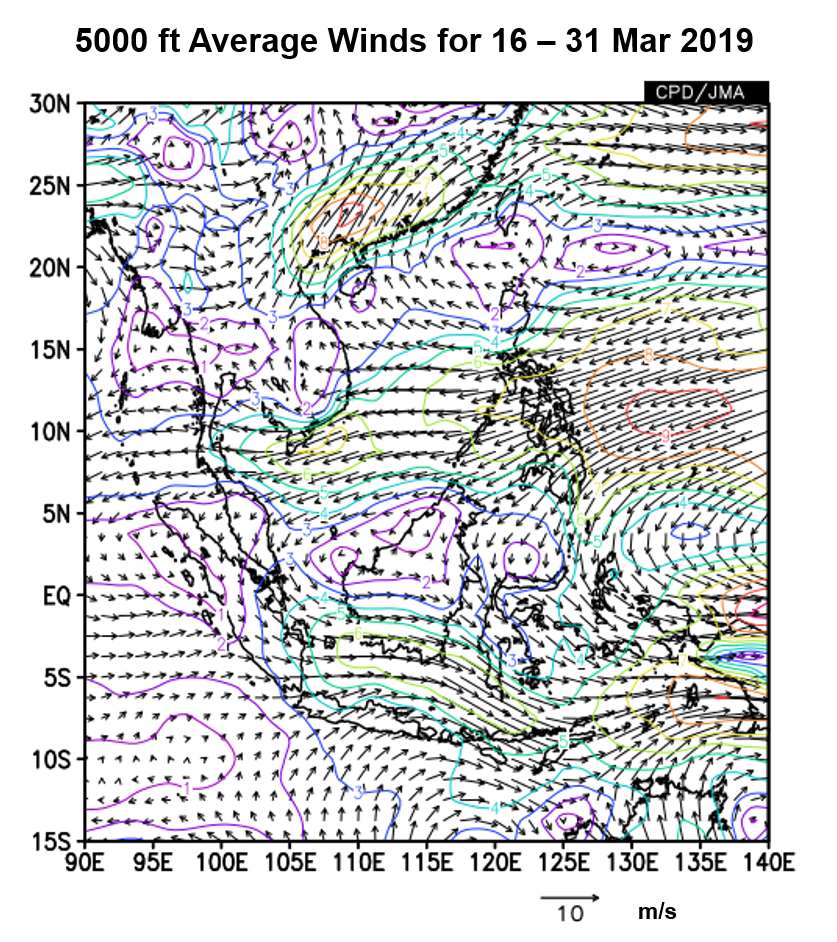
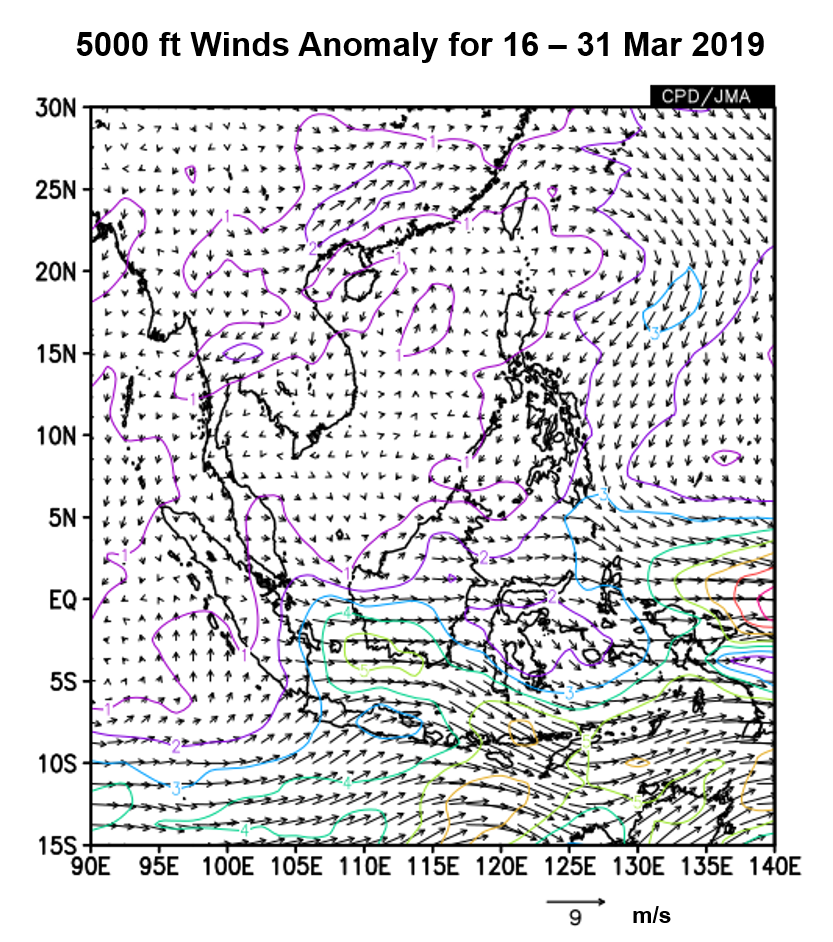
Figure 1: 5000 ft average winds (left) and anomalies (right) for 16 – 31 March 2019. (Source: JMA)
1.2 The transition to inter-monsoon conditions during the latter part of the fortnight brought an increase in rainfall over southern parts of the Mekong sub-region. However, dry conditions prevailed over Myanmar, and the northern parts of Lao PDR and Thailand (Figure 2). In the southern ASEAN region, areas along the equatorial region, including southern Thailand, Peninsular Malaysia, Sarawak, northern and central Sumatra and West Kalimantan received below-average rainfall under the influence of a persistent dry air mass extending from the Pacific Ocean over the Southeast Asia region (Figure 3).
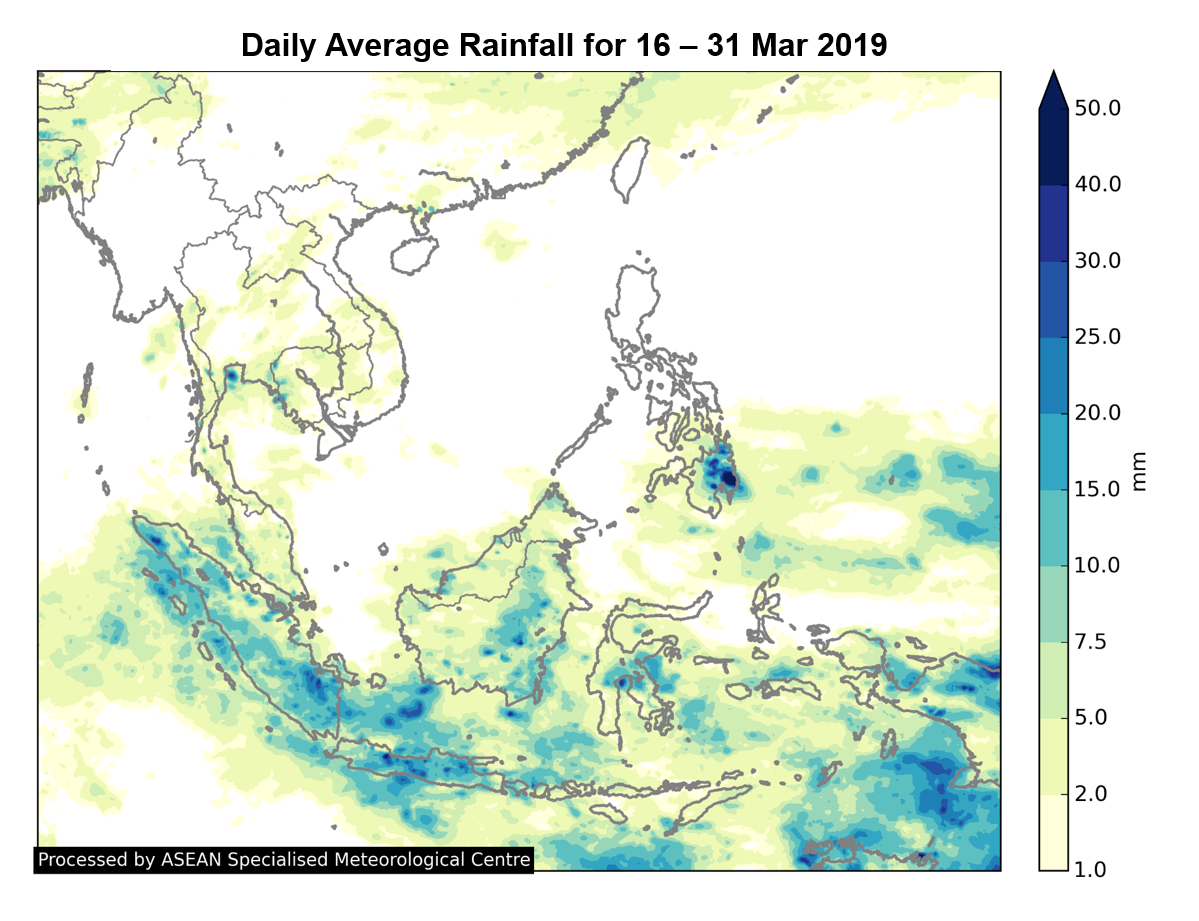
Figure 2: Daily average rainfall for the ASEAN region in the second fortnight of March 2019. (Source: JAXA Global Satellite Mapping of Precipitation)
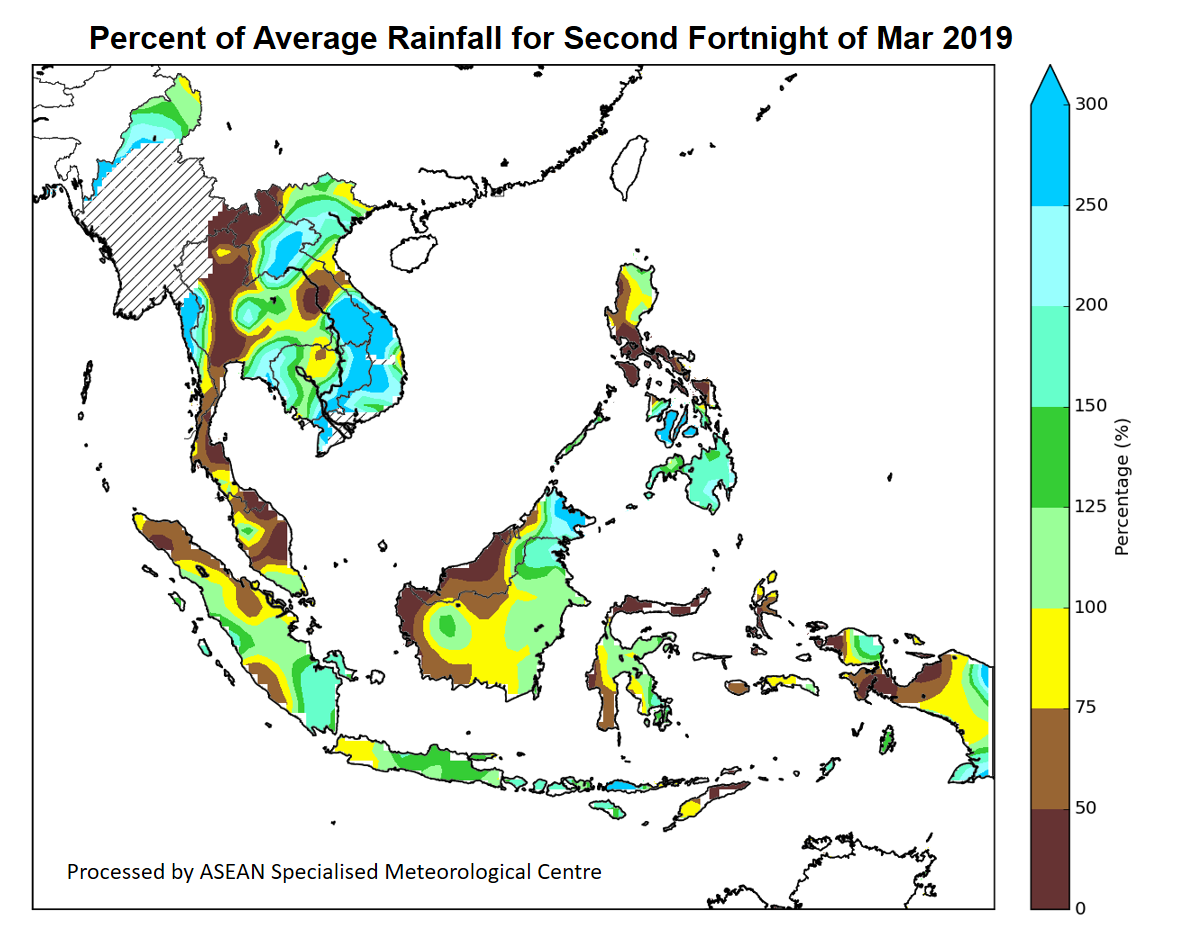
Figure 3: Percent of average rainfall for 16 – 31 March 2019. The rainfall data may be less representative for areas with a less dense rainfall network. Hatched areas indicate climatology dry mask (average daily rainfall below 1 mm). (Source: IRI NOAA/NCEP CPC Unified Precipitation Analyses)
1.3 The Madden-Julian Oscillation (MJO) signal remained weak during the second fortnight of March 2019 and had no significant influence on the weather over the ASEAN region (Figure 4).
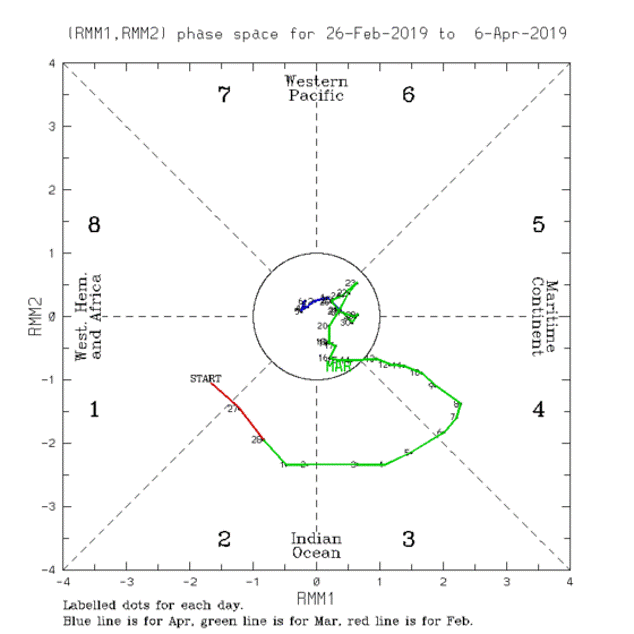
1.4 The sea surface temperatures over the tropical Pacific Ocean Nino 3.4 region were warm and close to the El Niño thresholds. However, there was little atmospheric response observed, such as the lack of consistent weaker-than-average trade winds and large-scale rainfall patterns over the tropical Pacific.
March 26, 2019
Review of Regional Weather Conditions for First Fortnight of March 2019
Review of Regional Weather Conditions for First Fortnight of March 2019
1. Review of Regional Weather Conditions for First Fortnight of March 2019
1.1 In the first fortnight of March 2019, northeasterly winds prevailed over the Philippines and the southern ASEAN region, while winds over the Mekong sub-region were light and blew mainly from the southwest. No significant wind anomalies were observed over the ASEAN region during this period. There was a gradual weakening of the northeasterly monsoonal winds during the first fortnight of the month.

Figure 1: 5000 ft average winds (left) and anomalies (right) for 1 – 15 March 2019. (Source: JMA)
1.2 The dry air mass that has been extending from the Pacific Ocean to the Southeast Asia region since late-January continued to bring persistent dry weather over the northern ASEAN region, as well as over parts of Peninsular Malaysia, northern and central Sumatra, and northern Borneo in the first half of March 2019. Rainfall was below-average for these areas.
1.3 In the first fortnight of March 2019, most of the rainfall fell over areas south of the equator (Figure 2). Rainfall was near-average to above-average for areas including southern Sumatra, Kalimantan, Java and the eastern archipelago of Indonesia (Figure 3).

Figure 2: Daily average rainfall for the ASEAN region in the first fortnight of March 2019. (Source: JAXA Global Satellite Mapping of Precipitation)

Figure 3: Percent of average rainfall for 1 – 15 March 2019. The rainfall data may be less representative for areas with a less dense rainfall network. Hatched areas indicate climatology dry mask (average daily rainfall below 1 mm). (Source: IRI NOAA/NCEP CPC Unified Precipitation Analyses)
1.4 The Madden-Julian Oscillation (MJO) propagated through Phase 2 – 3 and contributed to increased rainfall activities observed over areas south of the equator, including southern Sumatra, Java and the eastern archipelago of Indonesia. Towards the end of the fortnight, the MJO reached Phase 4, where it rapidly weakened.

1.5 Slightly warm sea surface temperature anomalies over the Pacific Ocean are nearing El Niño levels. Sub-surface waters have become warmer than average. Nonetheless, there remained a lack of atmosphere-ocean coupling as atmospheric conditions remained largely neutral and inconsistent with El Nino conditions.
March 8, 2019
Review of Regional Weather Conditions for Second Fortnight of February 2019
Review of Regional Weather Conditions for Second Fortnight of February 2019
1. Review of Regional Weather Conditions for Second Fortnight of February 2019
1.1 Northeast Monsoon conditions persisted over the ASEAN region in the second half of February 2019. Northeasterly or easterly winds prevailed over the Philippines, southern Thailand and most parts of the southern ASEAN region. Over the Mekong sub-region, prevailing winds were generally blowing from the southeast or southwest, with confluence of winds over parts of the Mekong sub-region.


Figure 1: 5000 ft average winds (left) and anomalies (right) for 16 – 28 February 2019. (Source: JMA)
1.2 A confluence of winds typically favours shower activity development, but weather over the Mekong sub-region remained dry mainly due to the presence of dry air mass that has extended from the Pacific Ocean over the Southeast Asia region. Elsewhere in the ASEAN region, rainfall distribution over the fortnight was also likely associated with the Madden – Julian Oscillation (MJO) which transitioned from phase 8 to phase 2 . Well below-average rainfall was recorded in the Philippines, Peninsular Malaysia, Sabah, western Kalimantan and parts of Java, while above-average rainfall was received in other parts of the southern ASEAN region.

Figure 2: Daily average rainfall for the ASEAN region in the second fortnight of February 2019. (Source: JAXA Global Satellite Mapping of Precipitation)

Figure 3: Percent of average rainfall for 16 – 28 February 2019. The rainfall data may be less representative for areas with a less dense rainfall network. Hatched areas indicate climatology dry mask (average daily rainfall below 1 mm). (Source: IRI NOAA/NCEP CPC Unified Precipitation Analyses)

February 23, 2019
Review of Regional Weather Conditions for First Fortnight of February 2019
Review of Regional Weather Conditions for First Fortnight of February 2019
1. Review of Regional Weather Conditions for First Fortnight of February 2019
1.1 Northeast Monsoon conditions prevailed over the ASEAN region during the first fortnight of February 2019.
1.2 The Mekong sub-region continued to experience dry conditions, which is typical over the region during this period. The dry conditions were exacerbated by the influence of an extensive dry air mass over the northern ASEAN region. Pockets of drier than usual conditions were observed mainly over parts of Viet Nam, and the eastern and southern parts of Thailand. The Philippines also observed below-average rainfall due to the influence of the dry air mass.
1.3 In the southern ASEAN region, scattered showers fell over most parts of the region. However, well below-average rainfall was recorded around the equatorial region over northern Sumatra, East Kalimantan, Singapore and most parts of Malaysia. This drier than normal conditions were partly due to the southward extension of the dry air mass from the northern ASEAN region. Elsewhere in the southern ASEAN region, above-average rainfall was observed.
1.4 The rainfall distribution and the percent of average rainfall for the first fortnight of February 2019 are shown in Figure 1 and 2.

Figure 1: Daily average rainfall for the ASEAN region in the first fortnight of February 2019. (Source: JAXA Global Satellite Mapping of Precipitation)

Figure 2: Percent of average rainfall for 1 – 15 February 2019. The rainfall data may be less representative for areas with a less dense rainfall network. Hatched areas indicate climatology dry mask (average daily rainfall below 1 mm). (Source: IRI NOAA/NCEP CPC Unified Precipitation Analyses)
1.5 During the fortnight, prevailing winds in the northern ASEAN region were generally blowing from the northeast or east, except for Myanmar where the winds were from the southwest or west. In the southern ASEAN region, westerly or northwesterly winds prevailed, except for the region west of southern Sumatra where southeasterly anomalies were observed.


Figure 3: 5000 ft average winds (left) and anomalies (right) for 1 – 15 February 2019. (Source: JMA)
1.6 The El Niño Southern Oscillation (ENSO) continued to remain neutral (neither El Niño nor La Niña). However, the sea surface temperatures (SSTs) over the tropical Pacific Ocean was observed to have warmed slightly during the fortnight, aided by the westerly wind anomalies in the presence of the MJO. Consequently, trade winds in the western Pacific Ocean were also observed to have weaken.
1.7 During the fortnight, the MJO propagated through Phase 7 – 8. The MJO in Phases 7 and 8 usually brings drier conditions over most parts of the southern ASEAN region and equatorial South China Sea. During this period, the MJO might have contributed to the drier conditions over the equatorial region.
