Review of Regional Weather for October 2020
1. Overview
1.1 During October 2020, much of the northern part of Southeast Asia experienced above-average rainfall (Figure 1). The largest positive anomalies (wetter conditions) were recorded over the Philippines, Viet Nam, parts of Lao PDR and southern Cambodia based on both satellite-derived rainfall estimates datasets (GSMaP-NRT and CMORPH-Blended). The large positive anomalies in these regions is linked to the high number of tropical storms and cyclones (including Tropical Storm Linfa, Tropical Storm Nangka, Tropical Cyclone Saudel, and Tropical Cyclone Molave). Elsewhere, the equatorial region experienced a mix between above- and below-average rainfall, while wetter-than-average conditions were recorded over much of the region south of the equator.
1.2 The observed large-scale rainfall anomaly pattern (i.e. above-average rainfall in regions linked to tropical storm and cyclone activity as well as south of the equator) is broadly consistent with the predictions from the subseasonal weather outlooks for October 2020 (5 – 18 Oct, 19 Oct – 1 Nov).


1.3 Colder-than-average temperatures were recorded over the eastern half of Mainland Southeast Asia in October 2020 (Figure 2). Parts of Viet Nam, Lao PDR, and Thailand were on average more than 1°C cooler than usual for this time of year. In contrast, warmer-than-average temperatures were recorded over northern Myanmar (more than 1°C warmer than average). Elsewhere, the temperature for October was closer to average.

2. Climate Drivers
2.1 A Madden-Julian Oscillation (MJO) signal developed in the Maritime Continent (Phase 5) during the first half of October (Figure 3), before propagating eastward through the western Pacific (phases 6 and 7) in the second half. Phases 5 and 6 tend to bring wetter conditions to the eastern half of Southeast Asia, while phases 6 and 7 bring drier conditions to parts of the western Maritime Continent.

2.2 Over the tropical Pacific Ocean, La Niña conditions were present. The sea surface temperatures in the central and eastern Pacific Ocean continued to cool, with atmospheric indicators (cloudiness and wind anomalies) also remaining consistent with La Niña conditions. La Niña events tend to bring wetter-than-average conditions to much of Southeast Asia during the September to November period.
October 15, 2020
Review of Regional Weather for September 2020
Review of Regional Weather for September 2020
1. Overview
1.1 During September 2020, most of the equatorial region and southern parts of the Mainland Southeast Asia experienced above-average rainfall (Figure 1). The largest positive anomalies (wetter conditions) were recorded in the coastal equatorial regions, southern Thailand, southern Cambodia and southern Viet Nam based on both satellite-derived rainfall estimates datasets (GSMaP-NRT and CMORPH-Blended). In contrast, most of the Philippines recorded below-average rainfall. The rest of regions either experienced near-average rainfall for this time of year, or a mix between above- and below-average.
1.2 The observed large-scale rainfall anomaly pattern (i.e. above-average rainfall in the equatorial regions and below-average rainfall in the Philippines) is broadly consistent with the predictions from the subseasonal weather outlooks for September 2020 (7 – 20 Sep, 21 Sep – 4 Oct). The only notable anomalies forecasted for Mainland Southeast Asia were the wetter conditions over its southern and eastern coastal regions (linked to the MJO signal in phases 4 and 5).


1.3 Most parts of equatorial Southeast Asia experienced near-average temperature during September 2020 (Figure 2), coinciding with areas that experienced wetter conditions during the same period. Warmer anomalies (≥ 0.5°C) are concentrated over Mainland Southeast Asia, northern parts of the Philippines and eastern Maritime Continent with the warmest anomalies in September (≥ 2.0°C) in northern Myanmar.

2. Climate Drivers
2.1 A weak and very slow-moving Madden-Julian Oscillation (MJO) signal was present in the Maritime Continent (Figure 3) during the month of September, momentarily strengthened in the middle of September for a few days and also towards the end of the month. At this time of year, phases 4 and 5 typically bring above-average rainfall for coastal regions in Southeast Asia between 5°N and 20°N.

September 11, 2020
Review of Regional Weather for August 2020
Review of Regional Weather for August 2020
1. Overview
1.1 During August 2020, most of Mainland Southeast Asia experienced above-average rainfall (Figure 1). The largest positive anomalies (wetter conditions) were recorded in Lao PDR and Rakhine State, Myanmar, based on both satellite-derived rainfall estimates datasets (GSMaP-NRT and CMORPH-Blended). In contrast, northern Philippines recorded below-average rainfall. For the southern half of Southeast Asia, below- to near-average rainfall was recorded in the west, and near- to above-average rainfall in the east. There is some discrepancy between the two satellite datasets for the below-average rainfall for Sumatra and Peninsular Malaysia, with more extensive drier conditions based on CMORPH-Blended (Figure 1, right) compared to GSMaP-NRT (Figure 1, left).
1.2 The observed large-scale rainfall anomaly pattern for southern Southeast Asia (i.e. below-average rainfall in the west and above-average rainfall in the east) is broadly consistent with the predictions from the subseasonal weather outlooks for August 2020 (27 July – 9 Aug, 10 – 23 Aug). The only notable anomalies forecasted for Mainland Southeast Asia were the wetter conditions over its southern and eastern coastal regions (linked to the MJO signal in phases 4 and 5).


1.3 Most of Southeast Asia experienced above-average temperature during August 2020, apart from central and northern Mainland Southeast Asia where the temperature was closer to the climatological average (Figure 2). Warmer anomalies (≥ 0.5°C) occured mainly in coastal regions, with the warmest anomalies in August (≥ 1.0°C) in southeastern Southeast Asia.

2. Climate Drivers
2.1 At the start of August, a Madden-Julian Oscillation (MJO) signal was present in the maritime continent (Figure 3). The signal then weakened and quickly moved across the Pacific reaching the Western Hemisphere (Phase 8) by the middle of the month. In the second half of August, the once again substantial MJO signal continued to propagate eastward with the enhanced phase reaching the eastern Indian Ocean (Phase 3) by the end of the month. At this time of year, phases 4 and 5 typically bring above-average rainfall for regions in Southeast Asia between 5° and 20°N, while phases 8 and 1 typically bring below-average rainfall for the same region. Phases 2 and 3 tend to bring wetter conditions to the western maritime continent (which was not evident in the rainfall anomalies for August 2020, Figure 1).

August 14, 2020
Review of Regional Weather for July 2020
Review of Regional Weather for July 2020
1. Overview
1.1 During July 2020, most of the equatorial region experienced above-average rainfall (Figure 1). The largest positive anomalies (wetter conditions) were recorded in the coastal equatorial regions based on both satellite-derived rainfall estimates datasets (GSMaP-NRT and CMORPH-Blended). For the Mainland Southeast Asia, below-average rainfall was observed over northern Viet Nam, northern Philippines, and coastal Myanmar. This pattern of below-normal rainfall broadly follows the coastal regions between 15°N to 20°N, although there is some discrepancy between the two satellites for the Rakhine State, Myanmar, where the GSMaP-NRT (Figure 1, left) observed below-average rainfall, while CMORPH-Blended (Figure 1, right) observed near-average rainfall.
1.2 The observed large-scale rainfall anomaly pattern (i.e. above-average rainfall conditions in the equatorial regions and below-average rainfall for some regions of Mainland Southeast Asia and northern parts of the Philippines) is broadly consistent with the predictions in the subseasonal weather outlooks for July 2020 (1-15 July, 16-31 July).


1.3 Most parts of equatorial Southeast Asia experienced near-average temperature during July 2020 (Figure 2), coinciding with areas that experienced wetter conditions during the same period. Warmer anomalies (≥ 0.5°C) are concentrated over Mainland Southeast Asia, northern parts of the Philippines and eastern Maritime Continent. This pattern is similar to the June temperature anomalies.

2. Climate Drivers
2.1 During the first half of July 2020, there was no coherent Madden-Julian Oscillation (MJO) signal. In Figure 3, the trace of the MJO moves between Phase 1 and Phase 2, with no clear eastward propagation. However, from the 19th of July, a clearer MJO signal formed and propagated eastward through the Indian Ocean (Phases 2 and 3), reaching the Maritime Continent at the end of the month. Typically in July, Phases 1 and 2 bring drier conditions in northern Southeast Asia while Phases 2 and 3 bring wetter conditions in the western Maritime Continent.

July 14, 2020
Review of Regional Weather for June 2020
Review of Regional Weather for June 2020
1. Overview
1.1 During June 2020, the region between 5°S and 15°N predominately experienced above-average rainfall (Figure 1). The largest positive anomalies (wetter conditions) were recorded over northern Sulawesi, southern Thailand, southern Viet Nam, and western Borneo based on both satellite-derived rainfall estimates datasets (GSMaP-NRT and CMORPH-Blended). For the Mainland Southeast Asia, above-average rainfall inland conditions were observed over northern Myanmar and northern Laos, whereas below-average rainfall conditions were observed along coastal regions of western Myanmar and northern Viet Nam. Below-average rainfall was also recorded over northern parts of the Philippines and some parts of the eastern Maritime Continent (Java and Nusa Tenggara, Indonesia).
1.2 The observed large-scale rainfall anomaly patterns (i.e. above-average rainfall conditions in the equatorial regions and below-average conditions in northern parts of the Philippines and coastal parts of northern Viet Nam) are broadly consistent with the predictions in the subseasonal weather outlooks for the first and second fortnights of June 2020, except for some parts of the eastern Maritime Continent region where drier conditions were observed.


1.3 Most parts of equatorial Southeast Asia experienced near-average temperature during June 2020 (Figure 2), coinciding with areas that experienced wetter conditions during the same period. Warmer anomalies (≥ 0.5°C) are concentrated over Mainland Southeast Asia, northern parts of the Philippines and eastern Maritime Continent.

2. Climate Drivers
2.1 The Madden-Julian Oscillation (MJO) signal propagated eastwards from Phase 1 (Western Hemisphere) to Phase 2 (Indian Ocean) during the first two weeks of June. Typically for the region in June, Phases 1 and 2 bring drier conditions in northern Southeast Asia while Phase 2 brings wetter conditions in the western Maritime Continent. Subsequently the MJO then stalled, before weakening and becoming indiscernible by early part of the third week of June, obscured by other equatorial atmospheric waves. Towards the last few days of June, a new MJO signal re-emerged in Phase 1 (Western Hemisphere).

June 15, 2020
Review of Regional Weather for May 2020
Review of Regional Weather for May 2020
1. Overview
1.1 The rainfall anomalies for May 2020 can be partitioned broadly into northern and southern Southeast Asia (Figure 1). Over northern Southeast Asia (10-20°N), most of the coastal regions and some areas further inland experienced below-average rainfall. As this period marks the start of the Southwest Monsoon season, this could mean a slight delay in the onset of the monsoon season for some parts of northern Southeast Asia. There are differences in the intensity and spatial extent between the two data sources, GSMaP-NRT and CMORPH-Blended. For CMORPH-Blended, the areas with below-average rainfall extended further inland over Mainland Southeast Asia, apart from coastal Myanmar (wetter based on CMORPH-Blended, but drier based on GSMaP-NRT).
1.2 For southern Southeast Asia, most of the Maritime Continent region experienced above-average rainfall amounts. The more intense rainfall was observed over the western Maritime Continent (parts of Java, Sumatra, and Borneo). Over the eastern side (Maluku Islands and West Papua), mostly drier conditions were observed. This large-scale rainfall anomaly pattern (below-rainfall conditions in the north and above-average conditions in the south) is broadly consistent with the predictions in the subseasonal weather outlooks for the first and second fortnights of May 2020, except for the eastern Maritime Continent region.


1.3 Most parts of Southeast Asia experienced above-average temperature during May 2020 (Figure 2). Much warmer anomalies (≥ 1.0°C) are concentrated over Mainland Southeast Asia and West Papua; thus broadly aligned to areas that experienced drier conditions during the same period.

2. Climate Drivers
2.1 The Madden-Julian Oscillation (MJO) retreated from Phase 4 into the unit circle (weak signal) during the first and second weeks of May 2020. The MJO then emerged over the Indian Ocean (Phase 2) in the later part of the second week, weakened momentarily during Phase 3 and Phase 4, and re-emerged to propagate strongly eastwards in Phase 6, Phase 7, and Phase 8 in the last week of May 2020. Typically, the Maritime Continent experiences drier conditions during Phase 6 to Phase 8 of the MJO. For May 2020, this is only true for the eastern Maritime Continent (see 1.2). The western Maritime Continent rainfall anomaly, on the other hand, could have been dominated by the wetter conditions that prevailed in the first three weeks.

May 13, 2020
Review of Regional Weather for April 2020
Review of Regional Weather for April 2020
1. Overview
1.1 The rainfall anomalies for April 2020 were a mix of above-, near-, and below- average (Figure 1). Above-average rainfall was experienced by much of the western and southern parts of the Maritime Continent (Peninsular Malaysia, Sumatra, Java, and western parts of Borneo) as well as parts of Mainland Southeast Asia (northern Lao PDR, northern Viet Nam, southern Cambodia, and southern Thailand). The largest positive anomalies (wetter conditions) were recorded over Sumatra based on both satellite-derived rainfall estimates datasets (GSMaP-NRT and CMORPH-Blended), as well as over Java (CMORPH-Blended only). Below-average rainfall was recorded over central and southern Philippines, as well as northern Borneo. The rest of the regions either experienced near-average rainfall for this time of year, or a mix between above- and below-average. The observed large-scale rainfall anomaly pattern over the Southeast Asia region during April (i.e. wetter over the southern parts of the Maritime Continent, and drier over central and southern Philippines, as well as northern Borneo) is broadly aligned with the model predictions depicted in the subseasonal weather outlooks for the first and second fortnights of April 2020, apart from the anomalies over Mainland Southeast Asia.


1.2 Most parts of Southeast Asia south of 10°N experienced above-average temperature during April 2020 (Figure 2). The region between 10°N and 20°N experiences a range of below-average to above-average temperatures, while the northernmost parts of Southeast Asia (northern Myanmar, northern Lao PDR, and northern Viet Nam) experienced below-average temperature.

2. Climate Drivers
2.1 The Madden-Julian Oscillation (MJO) was active during April 2020. The MJO signal propagated eastwards from Phase 4 (Maritime Continent) to Phase 1 (Western Hemisphere) during the first two weeks of April. The MJO then stalled during the third week, before continuing to propagate eastward through Phases 2 and 3 (Indian Ocean) before reaching Phase 4 (Maritime Continent) at the end of the month. Typically for the region in April, Phases 7, 8, and 1 bring drier conditions, while Phases 3 to 5 bring wetter conditions, particularly in southern Southeast Asia.

April 15, 2020
Review of Regional Weather for March 2020
Review of Regional Weather for March 2020
1. Overview
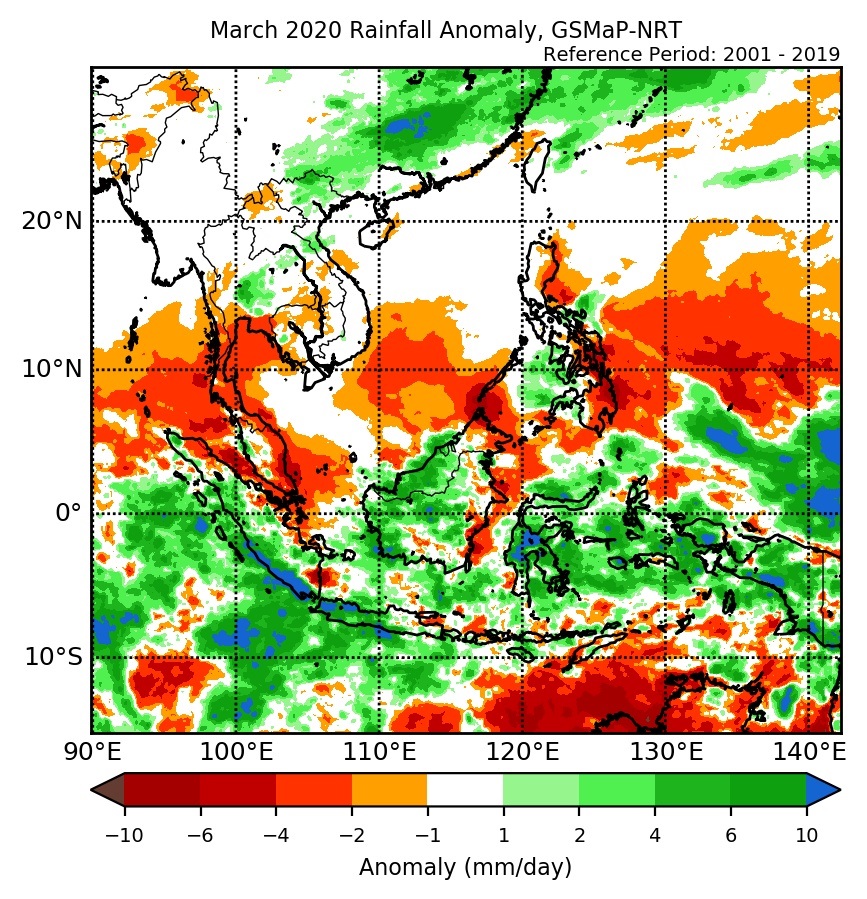
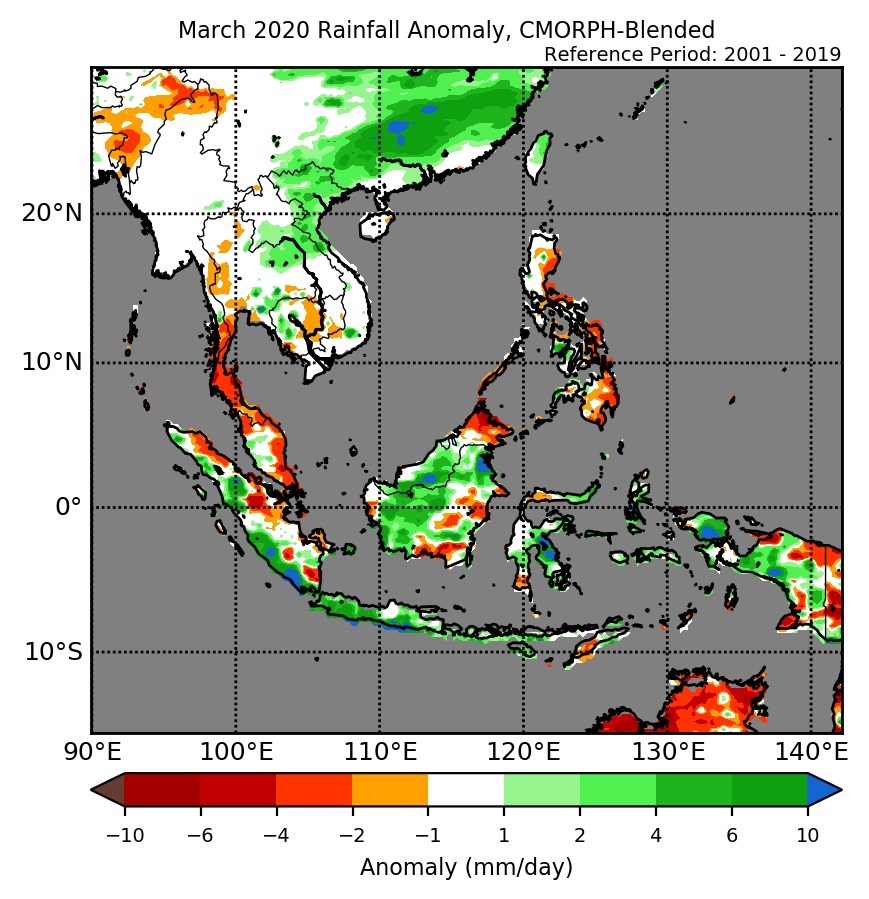
1.1 Much of the region south of the equator experienced above-normal rainfall during March 2020 (Figure 1). In particular, parts of southern Sumatra, West Papua, and central Sulawesi experienced more intense wetter conditions based on both satellite-derived rainfall estimates datasets (GSMaP-NRT and CMORPH-Blended). For north of the equator, below-average rainfall is experienced in most places (between 0°-15°N) over the sea, over the eastern coasts of land masses (Peninsular Malaysia, Borneo, and the Philippines) and southern Thailand. The observed large-scale rainfall anomaly patterns over the Southeast Asia region during March (i.e. wetter to the south, and drier to the north of the equator) are broadly aligned with the model predictions depicted in the subseasonal weather outlooks for the first and second fortnights of March 2020.
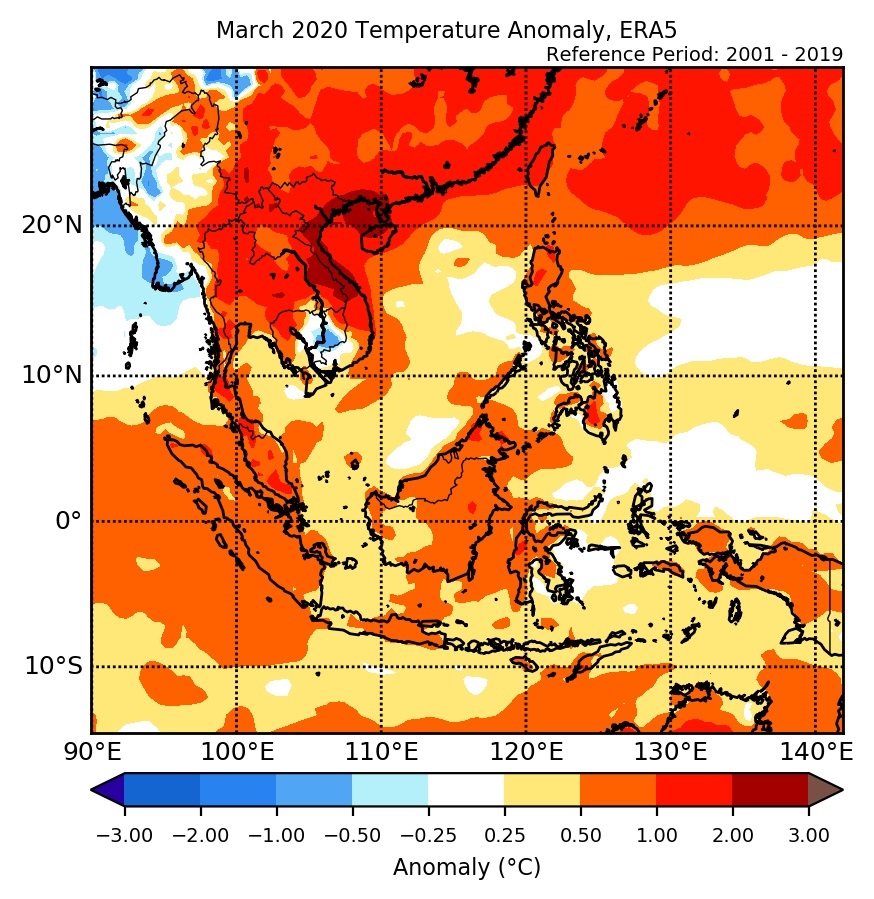
1.2 Most parts of Southeast Asia experienced above-average temperature during March 2020 (Figure 2). The largest warm anomalies occurred over parts of northern and central Viet Nam. Apart from the far eastern, southern, and northern corners, the rest of Myanmar experienced near-normal to below-normal temperature conditions during March 2020.
2. Climate Drivers
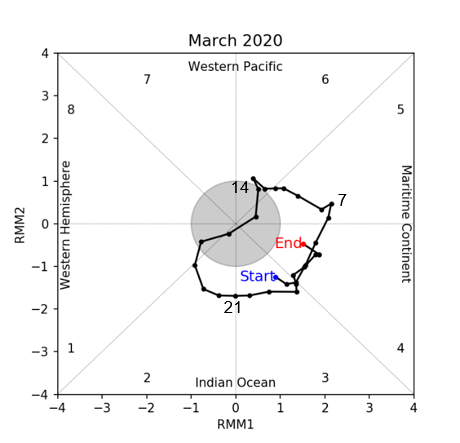
2.1 The Madden-Julian Oscillation (MJO) was active for much of March 2020. The MJO signal propagated eastwards from Phase 3 (Indian Ocean) to Phase 5 (Maritime Continent) during the first two weeks of March. The MJO then re-emerged in the third week in Phase 2 (Indian Ocean) and continued propagating until the end of March in Phase 4 (Maritime Continent). Generally, the phases the MJO went through (Phases 2-5) in March typically bring wetter conditions to many parts of the Maritime Continent, especially the south.
March 18, 2020
Review of Regional Weather for February 2020
Review of Regional Weather for February 2020
1. Overview
1.1 During February 2020, the region south of the equator predominately experienced above-average rainfall (Figure 1), with the largest positive anomalies (wetter conditions) over Java Island, Indonesia and southern Borneo. For north of the equator, above-average rainfall was observed over some coastal regions of Peninsular Malaysia while northern Borneo and most of the Philippines experienced below-average rainfall. The rainfall anomalies over mainland Southeast Asia were negligible, which is expected given that February is the drier time of the year for that region.


1.2 Overall, most of Southeast Asia experienced above-average temperature during February 2020 (Figure 2). The largest anomalies occurred over parts of Sulawesi, Papua and northern Viet Nam. As for the northern Southeast Asia, some parts of Cambodia, Thailand and Myanmar experienced below-average temperatures.

2. Climate Drivers
2.1 A Madden–Julian Oscillation (MJO) signal developed and strengthened over the Maritime Continent (Phases 4 and 5) during the first two weeks of February 2020 (Figure 3). The signal propagated eastwards with the main precipitation envelope reaching the western tip of Western Pacific (Phase 6). By the end of the second week, however, this MJO signal stalled, before weakening and becoming indiscernible in the third week of February. Broadly, Phases 4 and 5 normally bring wetter conditions for much of Southeast Asia in February, while Phase 6 brings a mixture of wetter and drier conditions.

2.2 The strong positive Indian Ocean Dipole (IOD) event from 2019, which had been weakening since November 2019, continued to weaken and returned to the neutral state in January 2020. The IOD typically remains in the neutral phase during the season from January to April.
February 25, 2020
Review of Regional Weather for January 2020
Review of Regional Weather for January 2020
1. Overview
1.1 During January 2020, the region between 0° and 10°N predominately experienced below-average rainfall (Figure 1). For south of the equator, there was a mixture of below- and above-average rainfall, with the largest positive anomalies (wetter conditions) over southern Borneo. The rainfall anomalies over mainland Southeast Asia were small, which is expected given that January is the drier time of the year for that region.


1.2 Overall, most of Southeast Asia experienced above-average temperature during January 2020 (Figure 2). The largest anomalies occurred over northern Thailand, Laos and Viet Nam. Only western and northern Myanmar, and some parts of Cambodia, experienced near-average temperatures.

2. Climate Drivers
2.1 A Madden–Julian Oscillation (MJO) signal developed over the Maritime Continent (Phase 4) during the first week of January 2020 (Figure 3). The signal strengthened rapidly, and then propagated eastwards with the main precipitation envelope reaching the Western Pacific (Phase 7). By the end of January, however, this MJO signal had weakened and became indiscernible. Phase 4 normally brings wetter conditions for much of Southeast Asia, while Phase 7 is associated with drier conditions. Phases 5 and 6 bring a mixture of wetter and drier conditions.

2.2 The strong positive Indian Ocean Dipole (IOD) event from 2019, which had been weakening since November 2019, continued to weaken and returned to the neutral state in January 2020. The IOD typically remains in the neutral phase during the season from January to April.