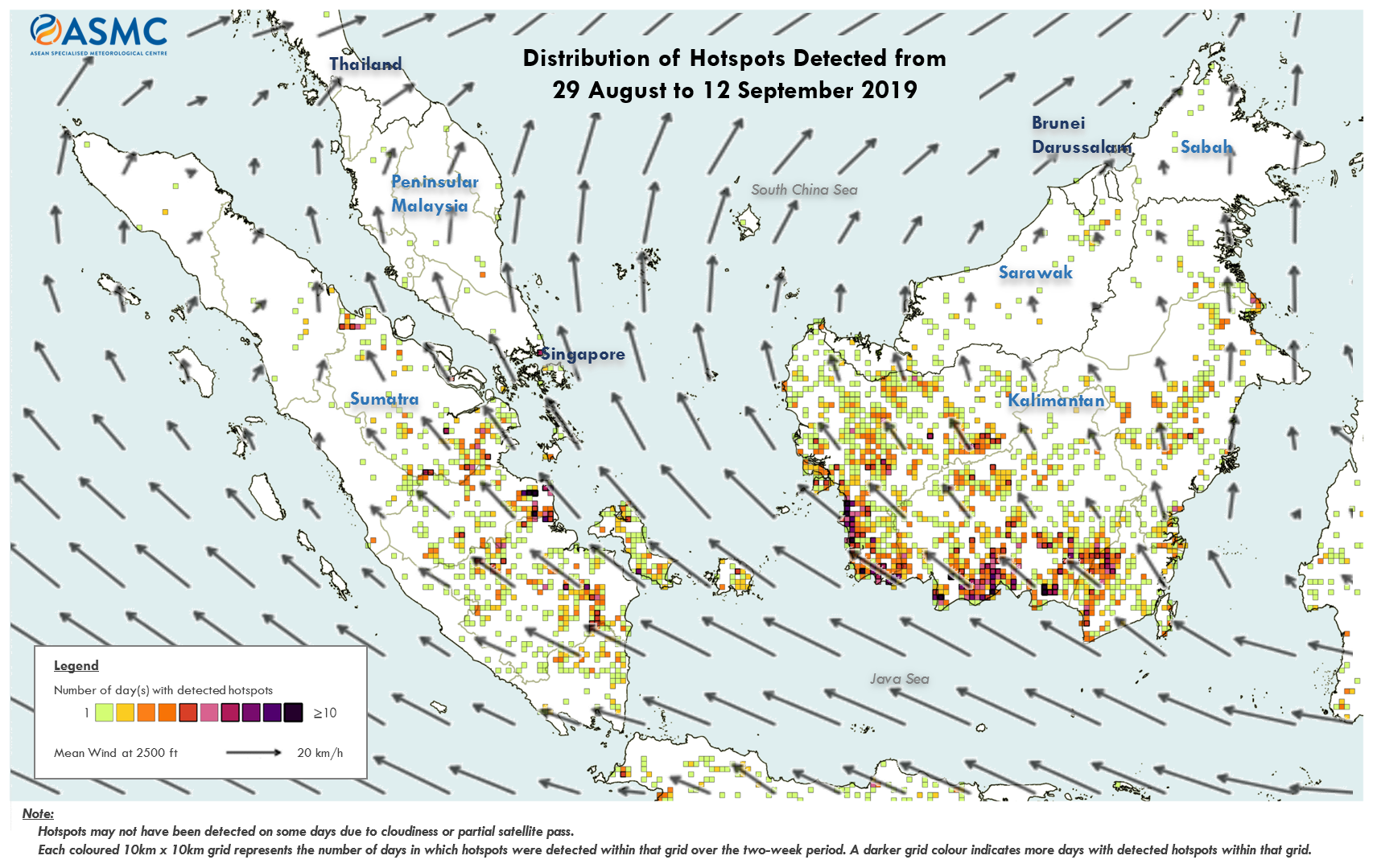

Satellite surveillance detected persistent hotspots with moderate to dense smoke haze in Sumatra and Kalimantan (29 Aug to 12 Sep 2019)
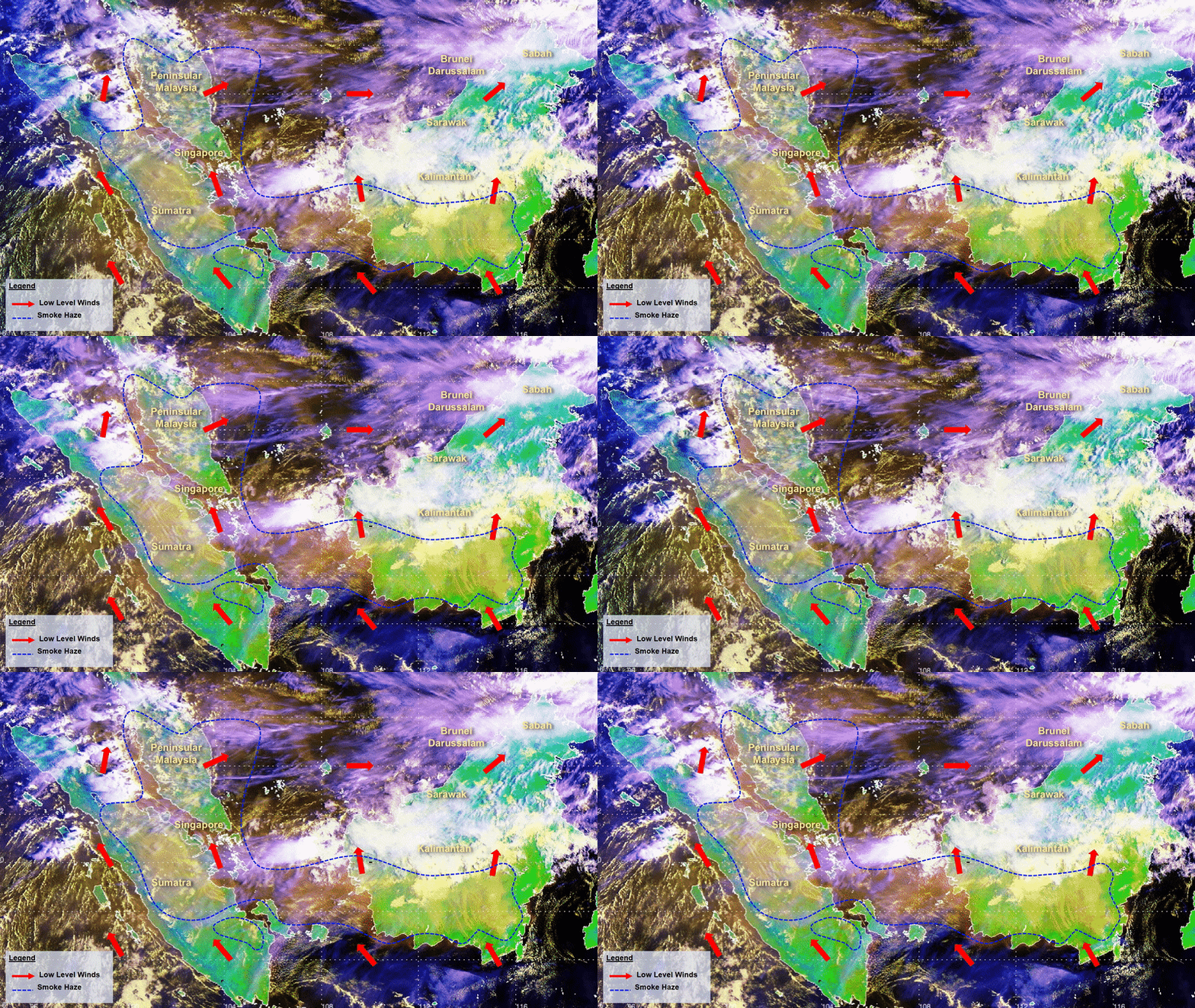
Situation Update (12 Sep 2019 0310 UTC) – Widespread smoke haze in the southern ASEAN region
 |
September 12, 2019
July 12, 2019
Issued 12 July 2019
The northern ASEAN region is currently in its traditional rainy season which will prevail for the next few months. With wet conditions predicted for the northern ASEAN region in the second fortnight of July 2019, hotspot activities there are expected to be generally subdued. In the southern ASEAN region, drier-than-usual conditions are expected during the outlook period. This could contribute to an increase in hotspot activities in the fire-prone provinces of Sumatra and Kalimantan, and increase the risk of occurrence of transboundary haze in the region.
March 7, 2019
February 28, 2019
Issued 28 February 2019
With warm and dry weather prevailing over many parts of the Mekong sub-region, current hotspot activities and smoke haze situation are expected to persist. In the southern ASEAN region, hotspot activities are likely to remain subdued except for some isolated hotspots with localised smoke plumes that may emerge during brief periods of dry weather.
Issued 28 Feb 2019
valid for weeks 1 and 2: 1 Mar – 15 Mar


In the coming fortnight, the Philippines, Malaysia, southern Viet Nam, southern Thailand and northern Sumatra are expected to receive below average rainfall. Wetter-than-usual conditions are forecast over the southwestern parts of the southern ASEAN region (marked in green in Figure 1) in the first week of March, and may extend eastward in the second week. The higher-than-average rainfall can be attributed to the passage of the Madden-Julian Oscillation (MJO) during this period.
Warmer-than-usual conditions are expected to persist over Cambodia, Lao PDR, southern Thailand, Viet Nam, Peninsular Malaysia and northern Sumatra in the first fortnight of March.
The outlook is assessed for the region in general. For specific updates on the national scale, the relevant ASEAN National Meteorological and Hydrological Services should be consulted.
January 30, 2019
1.1 In the Mekong sub-region, prolonged dry weather led to an escalation of hotspot activities in Cambodia. A build-up of smoke haze was observed around persistent hotspot clusters in Cambodia and smoke haze was blown westward toward Thailand. In Thailand, isolated hotspots with localised smoke plumes were also observed. In the southern ASEAN region, hotspot activities were subdued under the prevailing wet conditions.

Figures 1: AQUA satellite image on 7 Jan 2019 shows moderate to dense smoke haze observed in Cambodia.

Figures 2: Himawari-8 satellite image on 13 Jan 2019 shows moderate smoke haze observed in Cambodia. Localized smoke plumes were also observed in the vicinity of isolated hotspots in northeastern Thailand.
1.1 Northeast Monsoon conditions prevailed over the ASEAN region. In the Mekong sub-region, dry weather persisted over most parts of the region, except for some isolated showers that fell over coastal Viet Nam on a few days due to the strengthening of northeasterly and easterly winds over the South China Sea. Rainy conditions were also experienced in southern Thailand and northern Peninsular Malaysia due to the passage of Typhoon Pabuk during the first week of the month. This resulted in above-average rainfall over southern Thailand and northern Peninsular Malaysia.
1.2 There were scattered shower activities over the southern ASEAN region, and most parts of the region received average to above-average rainfall. However, there were some areas where below-average rainfall was received, namely parts of Malaysia, northern Sumatra, and Java.
1.3 The rainfall distribution and the percent of average rainfall for the first fortnight of January 2019 are shown in Figure 1 and 2.

Figure 1: Daily average rainfall for the ASEAN region in the first fortnight of January 2019. (Source: JAXA Global Satellite Mapping of Precipitation)

Figure 2: Percent of average rainfall for 1 – 15 January 2019. The rainfall data may be less representative for areas with a less dense rainfall network. Hatched areas indicate climatology dry mask (average daily rainfall below 1 mm). (Source: IRI NOAA/NCEP CPC Unified Precipitation Analyses)
1.4 In the northern ASEAN region, moderate to strong easterly winds prevailed over the South China Sea area. There were also anomalously southwesterly winds under the influence of the Typhoon Pabuk. In the southern ASEAN region, anomalous westerly winds were recorded.


Figure 3: 5000 ft average winds (left) and anomalies (right) for 1 – 15 January 2019. (Source: JMA)

Figure 4: Track of Typhoon Pabuk between 1 and 6 January 2019.
1.5 The sea surface temperature (SST) over the tropical Pacific Ocean is warmer than average, but temperatures remained in weak El Nino conditions and have weakened further. Prevailing atmospheric response, viz the cloudiness and trade winds over the tropical Pacific Ocean have remained neutral.
1.6 During the fortnight, moderate to strong Madden Julian Oscillation (MJO) signals propagated through Phase 6 – 8. The signal weakened towards the end of the second week of the fortnight. Although MJO signals in Phase 6 – 8 typically brought dry weather to the region, the MJO did not significantly influenced the weather in Southeast Asia during this period.

October 16, 2018
Issued 15 October 2018
Hotspot activities in the northern ASEAN region are expected to remain subdued. In the southern ASEAN region, sporadic hotpot activities are expected during brief periods of dry weather.
June 7, 2017
Start of dry season for the southern ASEAN region
The Southwest Monsoon onset in the region in late May 2017. Over the past few days, the region including Sumatra and Kalimantan has been experiencing dry weather conditions. The number of hotspots in Sumatra and Kalimantan has remained low but is expected to increase as the dry season progresses. Based on surveillance by the NOAA-19 satellite, 12 and 14 hotspots were detected in Sumatra on 6 and 7 June 2017 respectively.
The prevailing Southwest Monsoon is expected to strengthen and persist over the next few months. During this period, extended periods of drier weather can be expected, which could lead to elevated hotspot activities in the fire-prone areas.
June 23, 2015
The dry season for the southern ASEAN region has started
The Southwest Monsoon has onset in the region in early June 2015. In recent days, the region including Sumatra and Kalimantan have been experiencing dry weather conditions, signalling the start of the traditional dry season in the southern ASEAN region.
The prevailing Southwest Monsoon is expected to persist over the next few months. The prevailing El Nino could also exacerbate the dry season. During this period, extended periods of drier weather can be expected, which could lead to elevated hotspot activities in the fire-prone areas.